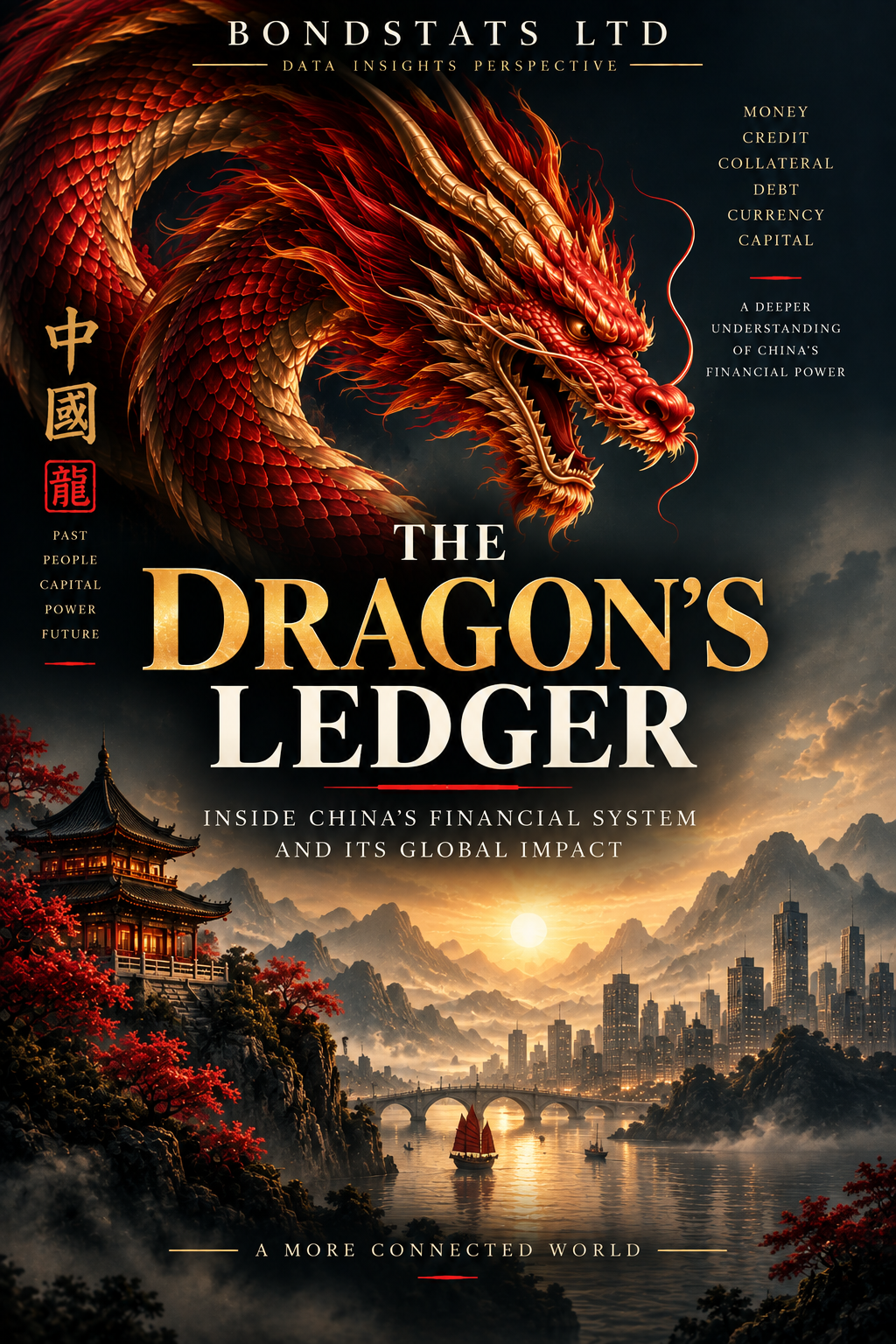
Why This Book Matters
China’s financial system cannot be understood by looking at a single market, institution or debt figure. Money moves through banks, policy institutions, local governments, state-linked borrowers, bond markets and tightly managed channels connecting the domestic system to the rest of the world. Pressure in one part of that structure can therefore reappear somewhere that initially seems unrelated.
The Dragon’s Ledger approaches China as an interconnected balance sheet. It follows the links between money, credit, collateral, debt, currency and capital to show how financing is created, where obligations accumulate and how financial pressure can migrate through the system.
BondStats Publication
Published by BondStats Ltd., The Dragon’s Ledger explores the architecture of Chinese money, debt and capital. The book moves from the creation and distribution of credit to the debt networks surrounding governments and borrowers, the development of China’s bond market, the role of the renminbi and the financial border separating a vast domestic system from global capital.
The focus is not on reducing China to a single debt ratio or headline indicator. Instead, the book develops a framework for asking where financing originates, what balance sheet absorbs the corresponding claim, how collateral and policy shape the transmission mechanism, and where pressure is likely to become visible when one part of the architecture changes.
📘 Available in Kindle and Paperback formats.What You’ll Learn
- How the architecture of Chinese money differs from a simple market-based view of finance
- How bank credit and policy transmission shape the wider credit economy
- How debt links households, companies, local governments, financial institutions and the state
- Why collateral and balance-sheet structure matter when tracing financial pressure
- How China’s government and corporate bond markets fit into the broader financing system
- Why the renminbi is both a domestic monetary instrument and a boundary between financial systems
- How capital controls and cross-border channels shape the financial border around China
- Why capital flows can reveal changes that are not obvious from domestic market prices alone
- How to distinguish the location of a financial problem from the place where its consequences emerge
- How the MONEY → CREDIT → COLLATERAL → DEBT → CURRENCY → CAPITAL framework connects the system
Call-to-Action
Read China as an interconnected balance sheet — and follow the chain from money and credit to collateral, debt, currency and the movement of capital across the financial border.
Buy on Amazon