Why This Book Matters
Singapore is often described through its visible success: a global financial centre, a major trading hub, a strong currency and one of the world’s most closely watched sovereign balance sheets. The more revealing story sits underneath those outcomes — in the way savings, reserves, public finance, monetary policy and international capital are connected.
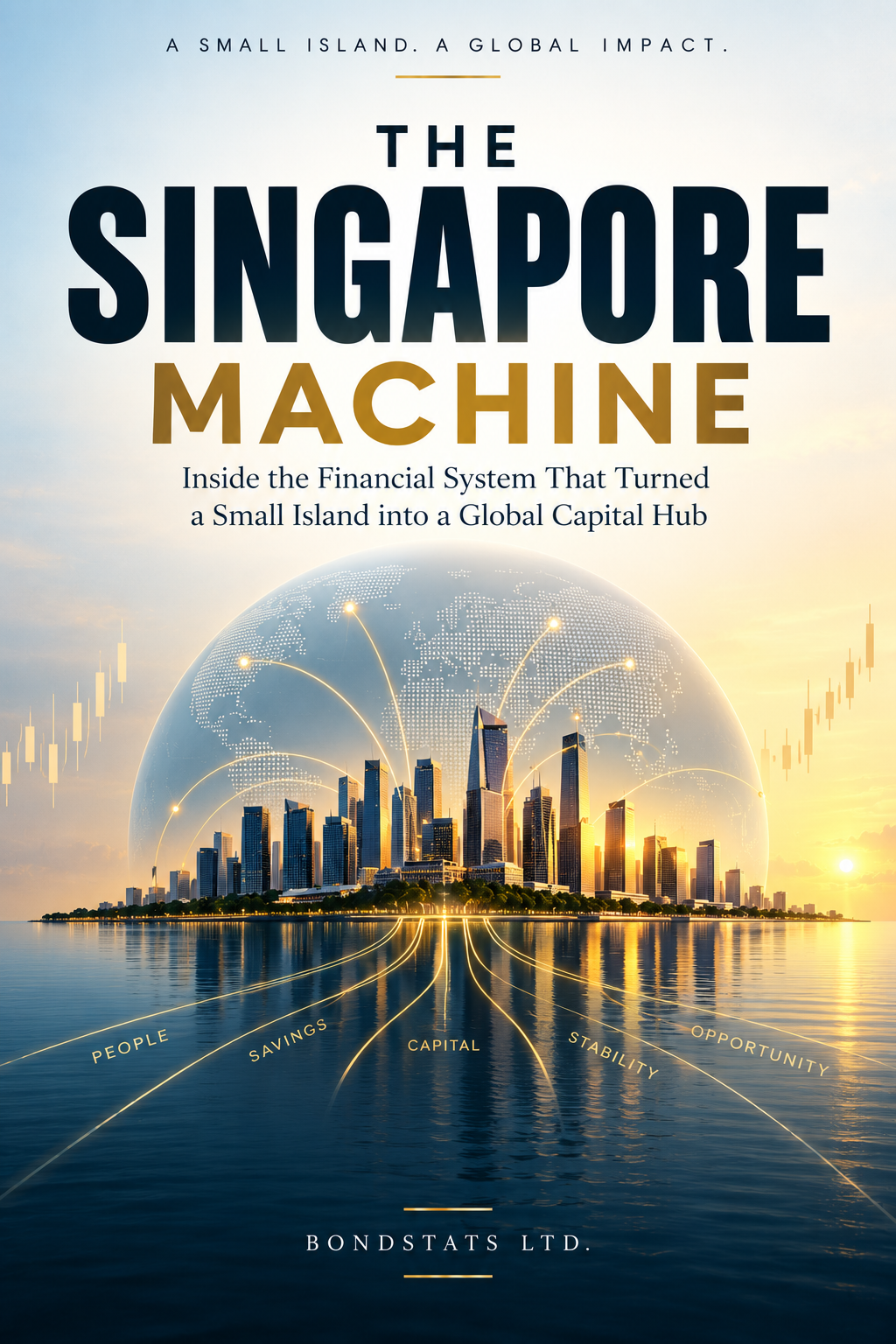
The Singapore Machine follows that architecture as one financial system rather than a collection of separate institutions. It explains how a small, resource-constrained city-state built mechanisms capable of mobilising domestic savings, maintaining monetary credibility, financing the state and connecting Singapore to global capital on an extraordinary scale.
BondStats Publication
Published by BondStats Ltd., The Singapore Machine examines the financial architecture behind Singapore’s transformation into a global capital hub. It moves through the relationships linking the Monetary Authority of Singapore, the exchange-rate-centred monetary framework, national reserves, CPF savings, government securities and the channels through which international capital enters and leaves the system.
Rather than treating each institution in isolation, the book asks how the parts work together. The result is a balance-sheet view of Singapore: where money originates, how it is redirected, which institutions stand between savers and markets, and why the structure of the system matters as much as any individual policy decision.
📘 Available in Kindle and Paperback formats.What You’ll Learn
- How Singapore developed a financial system far larger and more connected than its physical size would suggest
- Why Singapore’s monetary framework is centred on the exchange rate rather than a conventional policy-rate target
- How the Monetary Authority of Singapore sits at the centre of monetary, regulatory and financial-market architecture
- How CPF savings connect households, public finance and the broader national balance sheet
- Why Singapore issues government securities despite its unusual fiscal and reserve position
- How national reserves fit into Singapore’s long-term financial architecture
- How domestic savings and state balance sheets interact with global markets
- Why capital flows are central to understanding Singapore as an international financial hub
- How currency, liquidity and external capital can transmit pressure through the system
- How to read Singapore as an interconnected financial machine rather than a collection of separate institutions
Call-to-Action
Look beneath Singapore’s visible financial success and trace the machinery that connects savings, reserves, currency, public finance and global capital into one of the world’s most distinctive financial systems.
Buy on Amazon