
2025–2026 — The Refinancing Era
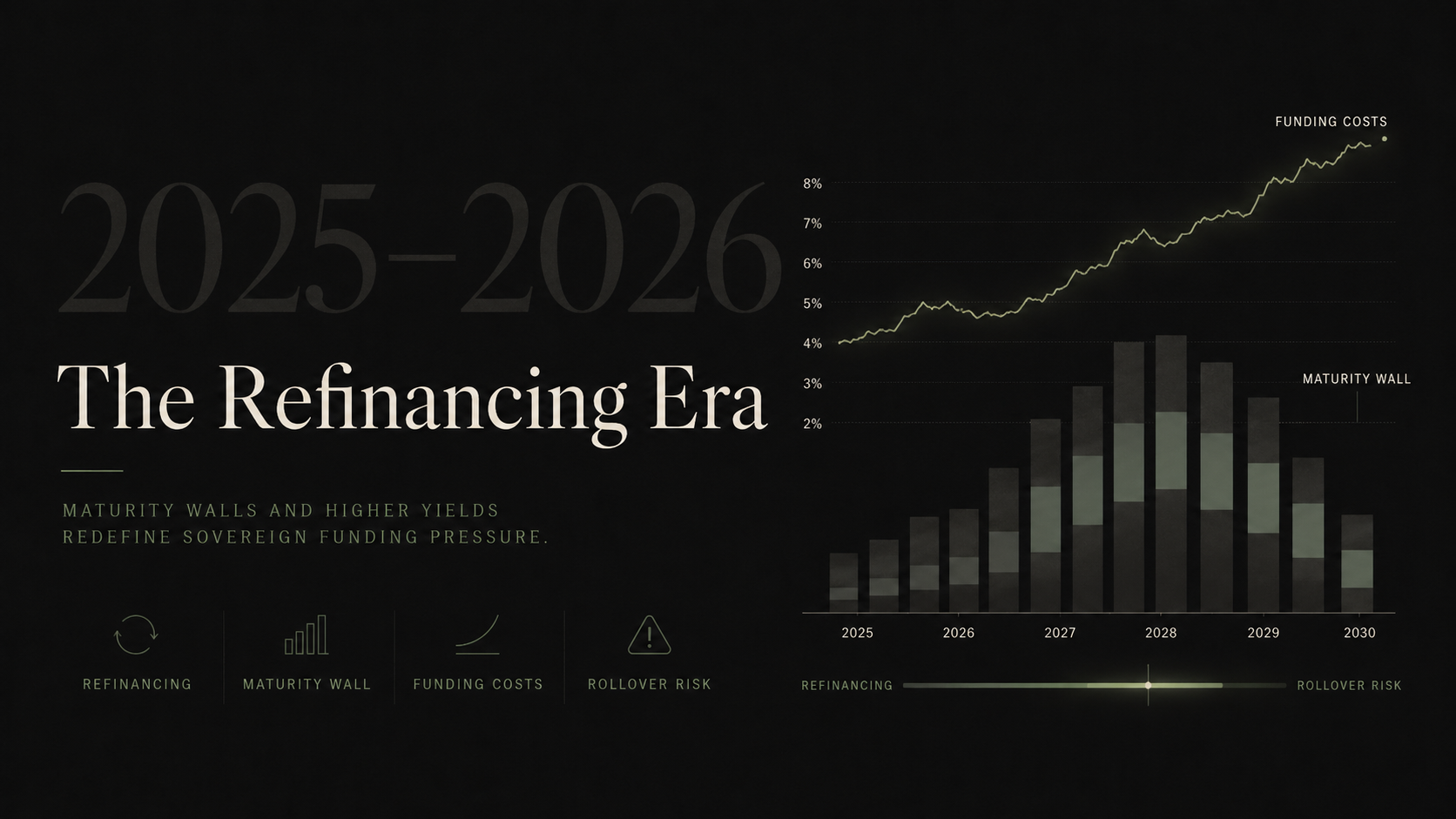
How the consequences of the higher-rate regime began moving from market prices into government balance sheets by turning maturity schedules, refinancing costs and debt-service pressure into central fixed-income variables
The Refinancing Era
By 2025 and 2026, the bond market had moved beyond the initial shock of the post-pandemic tightening cycle. The major central banks had already lifted rates dramatically from their pre-2022 levels, inflation had moderated from its peak and investors were increasingly debating when and how quickly monetary policy might normalize. Yet the consequences of the higher-rate regime were only beginning to pass through government balance sheets. That distinction matters because sovereign debt does not reprice all at once. A government may have issued large volumes of bonds when yields were extremely low, but those securities retain their existing coupons until they mature. The fiscal impact of higher market rates therefore appears gradually as old debt is refinanced into new securities carrying higher funding costs.
For the United States, this became particularly important because the debt stock had grown substantially while interest rates had reset higher. Treasury Fiscal Data showed total public debt approaching $40 trillion in 2026, while average rates on marketable Treasury bills, notes and bonds were materially above the ultra-low funding levels associated with the previous decade.
The central fixed-income question was changing. Investors were no longer asking only how large the debt was. Increasingly, they were asking when it matured, at what coupon it had been issued, and at what yield it would have to be refinanced.
Before the Refinancing Pressure
The foundations of the refinancing era were built during the long period of ultra-low interest rates that followed the Global Financial Crisis and intensified during the pandemic. Governments were able to issue enormous quantities of debt at historically low yields, while central-bank asset purchases and strong demand for safe assets helped keep borrowing costs contained. The pandemic accelerated this process. Fiscal support expanded dramatically, and the U.S. Treasury announced extraordinary borrowing needs during 2020, including an expected $2.999 trillion of privately held net marketable borrowing for the April–June quarter alone. Much of this debt was initially issued into an environment in which short-term rates were near zero and longer-term Treasury yields remained extremely low by historical standards.
The inflation shock of 2021–2022 changed that environment. Policy rates rose rapidly, Treasury yields reset higher and new borrowing became materially more expensive. But the cost did not immediately apply to the entire outstanding debt stock. Existing securities continued paying their original coupons.
This created a lag between the market repricing and the fiscal consequences. The higher-rate shock occurred first in bond prices. The refinancing era emerged later, as maturity dates gradually forced governments to borrow again under the new rate regime.
The Break
The defining transition was the growing scale of debt that had to be rolled over at interest rates considerably higher than those prevailing when much of the original borrowing had taken place. Treasury debt management therefore became increasingly important to markets. Bills, notes and bonds mature on different schedules, and the maturity composition of the debt determines how quickly higher rates pass through to the government’s average cost of funding.
Short-term securities transmit changes particularly quickly because they must be refinanced frequently. Longer-dated securities delay the effect because their coupons remain fixed until maturity. The fiscal sensitivity of a sovereign to higher rates therefore depends not simply on the total amount of debt but on its maturity profile.
By 2026, Treasury’s own data showed average rates of roughly 3.7% on marketable bills, 3.3% on notes and 3.4% on bonds as of June, illustrating how far the effective funding environment had moved from the near-zero-rate world of the pandemic period.
The market was beginning to focus less on the shock of rising rates and more on the cumulative effect of refinancing at those rates.
The Bond-Market Signal
The defining signal of the refinancing era was not a single yield or spread. It was the gap between the cost embedded in maturing debt and the yield at which that debt could be replaced. If a Treasury security carrying a low coupon matures while comparable new borrowing costs significantly more, the government’s interest burden rises even if the total debt stock remains unchanged. When this occurs across very large maturity volumes, the cumulative effect can become substantial. This is why maturity schedules began to matter more. The amount of debt coming due over the next 30, 90 or 365 days provides information about how quickly the existing debt stock will be repriced into the prevailing market environment.
Treasury’s quarterly refunding process also became increasingly important because it communicates changes in issuance strategy and financing needs. The department uses these announcements to provide information about the volume and maturity composition of upcoming borrowing.
The fixed-income signal was therefore becoming more structural. Investors were not simply watching whether the 10-year yield moved 10 or 20 basis points. They were increasingly evaluating how market yields interacted with trillions of dollars of debt that would eventually have to be rolled over.
The Treasury Response
Unlike a central bank, the U.S. Treasury does not determine the policy rate. Its challenge is to finance government operations at the lowest expected cost over time while maintaining regular and predictable access to markets. That makes debt management particularly important during a refinancing cycle. Treasury must decide how much borrowing to conduct through short-term bills versus longer-dated notes and bonds, how frequently to adjust auction sizes and how to balance immediate financing costs against future refinancing risk.
The scale of issuance remained substantial. Treasury continued publishing large quarterly borrowing estimates and using the refunding process to communicate changes in financing needs and auction composition. For example, it projected hundreds of billions of dollars of privately held net marketable borrowing in individual quarters during 2025 and 2026.
These choices matter because maturity structure determines where future interest-rate risk sits. Heavy reliance on short-term bills may initially reduce borrowing costs when the curve is favorable, but it also exposes the government to faster repricing if rates remain elevated. Longer maturities lock in funding for longer but may require a higher yield at issuance.
The refinancing era therefore made Treasury debt management itself an increasingly relevant part of fixed-income analysis.
The Aftermath
The full consequences of the refinancing cycle cannot be observed in a single year because the process unfolds gradually. Each maturity replaces another portion of the old debt stock with securities priced under current market conditions. As this continues, the average interest rate on outstanding government debt can rise even if market yields stop increasing. This is one of the most important differences between a bond-market shock and a refinancing cycle. The market move may happen quickly, but the balance-sheet consequences can continue for years. Treasury Fiscal Data explicitly notes that recent increases in interest rates and inflation have been contributing to higher interest expense on the national debt. The implications therefore extend beyond the bond market itself. Higher interest expense can affect fiscal flexibility, future borrowing requirements and the composition of government spending.
At the same time, investors may demand additional compensation if they expect larger issuance volumes, persistent deficits or greater uncertainty surrounding future inflation and fiscal policy. That creates the possibility of a feedback mechanism in which higher borrowing requirements contribute to higher yields, which then gradually increase future interest expense.
This does not mean that such a cycle must become unstable. It means that refinancing dynamics become increasingly important when debt stocks are large and market rates have moved substantially above the coupons embedded in older securities.
What the Market Knew
By 2025–2026, investors had considerably more information about refinancing pressure than they had during earlier phases of the rate cycle. Treasury publishes detailed debt data, maturity information, auction schedules and quarterly borrowing estimates. The market can therefore observe much of the refinancing calendar in advance. What remains uncertain is the rate environment in which that debt will ultimately be rolled over. A large maturity schedule may be relatively manageable if market yields fall substantially before refinancing occurs. The same schedule can become much more expensive if rates remain elevated. Fiscal outcomes therefore depend on the interaction between known maturity dates and unknown future funding costs.
This makes the refinancing era fundamentally different from a conventional debt discussion. The headline debt number alone is insufficient. Two governments with identical debt stocks may face very different risks if one has locked in low borrowing costs for decades while the other must refinance a large share of its liabilities within a few years.
The bond market was therefore moving toward a more precise question: not simply how much does the government owe?, but how quickly does that debt reprice?
The Fixed-Income Lesson
The refinancing era demonstrates why sovereign debt should be understood as a maturity structure rather than a single headline number. Total debt matters, but so do the timing of maturities, the coupons attached to existing securities, the prevailing yield curve and the amount of new borrowing required alongside refinancing. This also explains why higher rates can continue affecting fiscal conditions long after the original tightening cycle ends. A government does not need yields to rise further for its average funding cost to increase. It may simply need previously issued low-coupon debt to mature.
For investors, the relevant variables therefore expand beyond inflation and central-bank policy. Treasury issuance, auction demand, maturity concentration and interest expense become increasingly important parts of the sovereign-risk framework.
In 2022, the bond market repriced the cost of money. In 2023, the long end began demanding more compensation for duration and supply. By 2025–2026, those higher yields were increasingly moving from market screens into the actual cost of financing government debt.
That is the essence of the refinancing era.
From the Archive
← Previous Archive File
2023 — The Long-End Revolt
In 2023, long-term yields rose as investors reassessed monetary persistence, Treasury supply and the compensation required for holding duration.