
How Banknotes Became Money
Understanding how paper receipts evolved into banknotes and transformed the way people used money.
Introduction
For most of history, money was made from precious metals such as gold and silver and while these metals were valuable, they were often difficult to transport, store, and protect. As trade expanded, merchants began looking for safer and more convenient ways to conduct transactions.
One solution emerged from an unlikely source: goldsmiths.
What started as simple receipts for stored gold eventually evolved into banknotes, laying the foundation for the modern financial system.
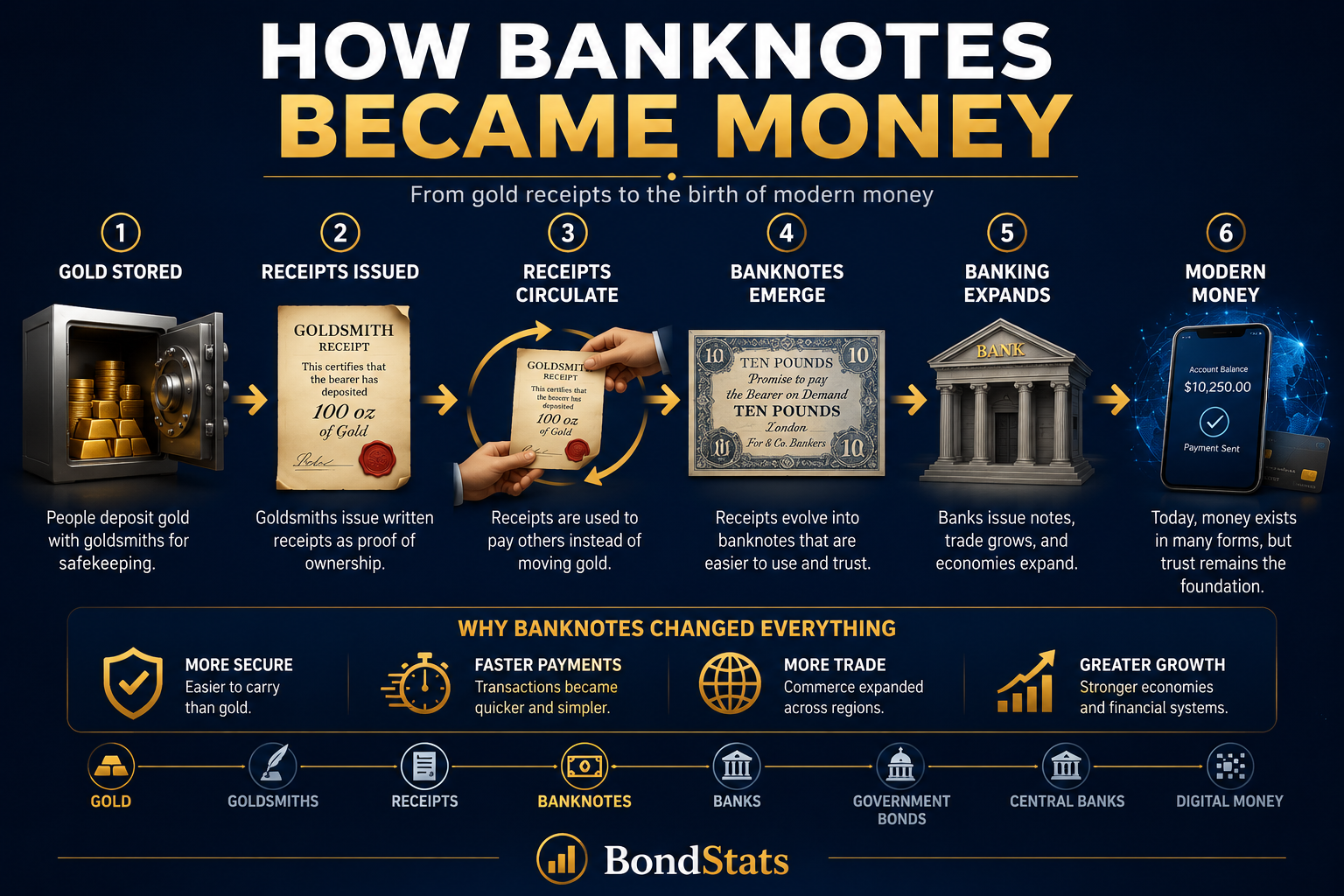
Gold Storage and Receipts
Goldsmiths operated some of the safest vaults available and people deposited gold and received written receipts confirming ownership.
Initially, these receipts served only one purpose:
To prove that a specific amount of gold was being held in storage.
The receipt itself had no independent value but its value came from the gold it represented.
When Receipts Started Circulating
Over time, something changed and instead of returning to the goldsmith and withdrawing gold for every transaction, people began exchanging the receipts directly. This was often easier than transporting heavy coins or bullion.
As trust in the receipts grew, they started functioning as a practical form of money.
The paper became more useful than the gold itself.
The Birth of Banknotes
As receipts became widely accepted, they evolved into early banknotes, rather than representing a specific gold deposit owned by one person, these notes became transferable claims that could circulate throughout the economy.
People accepted them because they trusted they could be exchanged for gold when needed.
Trust became the key ingredient.
Why Banknotes Were Useful
Banknotes offered several advantages:
Easier Trade
Large transactions became simpler.
Improved Security
Carrying paper was safer than carrying gold.
Faster Payments
Money could move more efficiently through the economy.
Greater Flexibility
Trade expanded as financial transactions became easier.
The Expansion of Banking
As confidence increased, banks began issuing their own notes and these notes circulated alongside gold and silver coins. Over time, banking systems became more organized and regulated.
What began as private receipts evolved into national banking systems and eventually central bank-issued currency.
From Banknotes to Modern Money
Today, most money exists digitally rather than as paper, yet the underlying concept remains surprisingly familiar.
Modern money still relies on:
Trust
Financial institutions
Confidence
Accepted claims
The physical form has changed, but the foundations remain similar to those established centuries ago.
From Banknotes to Modern Money
Today, most money exists digitally rather than as paper and yet the underlying concept remains surprisingly familiar.
Modern money still relies on:
Trust
Financial institutions
Confidence
Accepted claims
The physical form has changed, but the foundations remain similar to those established centuries ago.