
Bank of Korea (BOK)
How the Bank of Korea Shapes Interest Rates, Government Bond Yields and Financial Stability
Introduction
The Bank of Korea (BOK) is the central bank of South Korea and one of Asia’s most influential monetary authorities. Responsible for maintaining price stability and supporting financial system resilience, the BOK plays a key role in shaping interest rates, government bond yields, and one of the world’s most advanced export-driven economies.
As South Korea is a global leader in technology, manufacturing, and international trade, the Bank of Korea’s policy decisions are closely followed by investors across Asia and global financial markets.
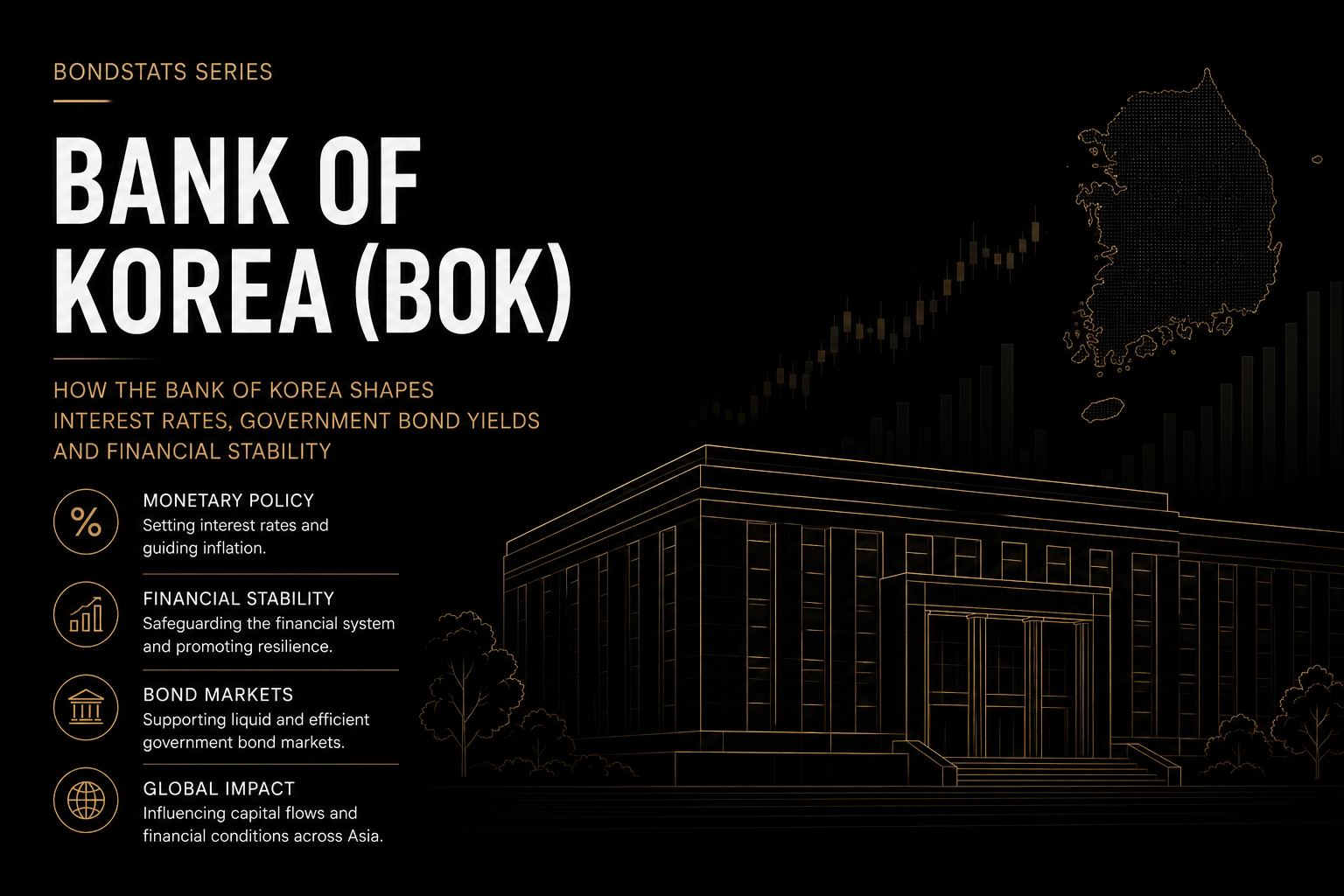
The History of the Bank of Korea
The Bank of Korea was established in 1950, shortly after the founding of the Republic of Korea but despite decades of rapid economic transformation, financial crises, and technological innovation, the BOK has remained at the center of South Korea’s monetary and financial system. Today, it is recognized as one of Asia’s most respected central banks.
Main Responsibilities
The Bank of Korea is responsible for:
Maintaining price stability.
Conducting monetary policy.
Issuing the South Korean Won (KRW).
Promoting financial system stability.
Managing foreign exchange reserves.
Supporting payment and settlement systems.
Monitoring financial risks.
These responsibilities help ensure confidence in South Korea’s highly developed financial system.
Monetary Policy
The Bank of Korea conducts monetary policy using several key instruments, including:
Base Rate.
Open Market Operations.
Liquidity facilities.
Reserve Requirements.
Forward guidance.
Foreign exchange market operations.
Changes in the Base Rate influence borrowing costs, inflation, mortgage rates, exchange rates, and South Korean government bond yields.
The BOK and Bond Markets
South Korea operates one of Asia’s largest and most liquid government bond markets.
The Bank of Korea influences bond markets through:
Interest rate decisions.
Liquidity management.
Market operations.
Financial stability measures.
Policy communication.
Because South Korea is deeply integrated into global supply chains, BOK policy decisions often have implications beyond the domestic economy.
South Korea’s Financial System
South Korea has developed one of the world’s most advanced financial systems.
The Bank of Korea supports this system by:
Maintaining monetary stability.
Promoting financial resilience.
Supporting secure payment infrastructure.
Monitoring systemic risks.
Strengthening market confidence.
Its role has become increasingly important as South Korea continues to expand its presence in global financial markets.
Why the BOK Matters
The Bank of Korea’s decisions influence:
South Korean government bond yields.
Inflation expectations.
The South Korean Won (KRW).
Banking liquidity.
Asian financial markets.
International capital flows.
As one of Asia’s largest developed economies, South Korea plays an increasingly important role in global fixed-income and capital markets.
Key Facts
Founded: 1950
Headquarters: Seoul, South Korea
Currency: South Korean Won (KRW)
Primary Objective: Price and financial stability
Key Tools: Base Rate, Open Market Operations, Reserve Requirements
Global Importance: One of Asia’s leading central banks supporting a major technology and export-driven economy
Conclusion
The Bank of Korea plays a vital role in maintaining monetary stability and supporting one of the world’s most innovative economies. Through its influence on interest rates, government bond markets, and financial stability, the BOK helps shape not only South Korea’s economic outlook but also broader financial conditions across Asia. As the country’s role in global trade and capital markets continues to grow, understanding the Bank of Korea has become increasingly important for investors following sovereign debt, monetary policy, and international fixed-income markets.