
World Bank
Financing Sustainable Development and Long-Term Economic Growth
Introduction
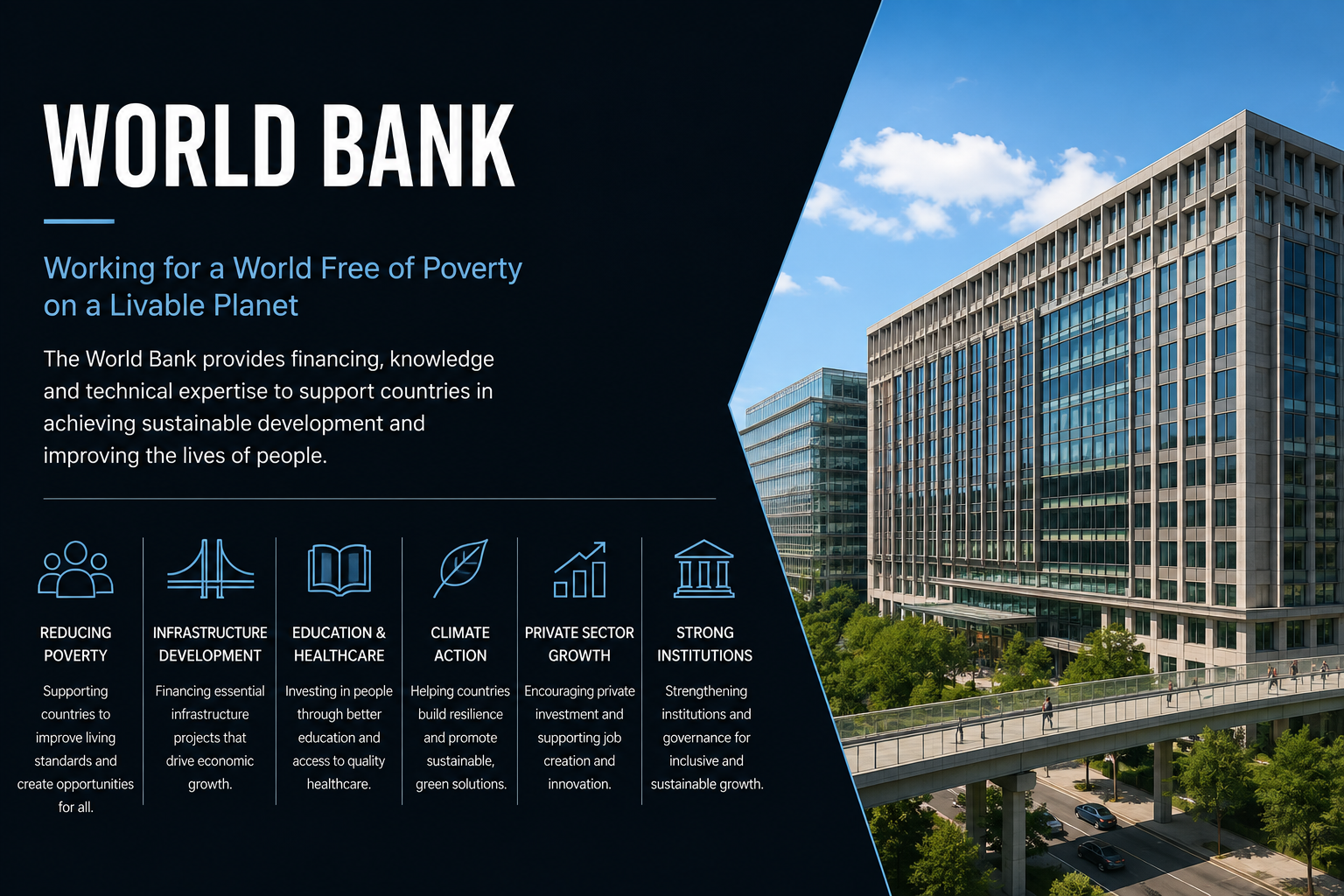
The World Bank is one of the world’s leading international development institutions, dedicated to reducing poverty and promoting sustainable economic growth. Founded in 1944 and headquartered in Washington, D.C., the World Bank provides financing, technical expertise, and development support to countries around the globe. Its investments span infrastructure, education, healthcare, climate resilience, agriculture, and institutional development.
History and Development
The World Bank was established at the Bretton Woods Conference in 1944, alongside the International Monetary Fund (IMF). Originally created to finance the reconstruction of countries after World War II, its mission gradually expanded toward supporting long-term economic development in low- and middle-income countries.
Today, the World Bank Group operates through several specialized institutions serving different development objectives worldwide.
Institutional Role
Unlike commercial banks, the World Bank finances projects designed to improve long-term economic development. Its primary responsibilities include:
Financing infrastructure projects
Supporting education and healthcare
Reducing poverty
Promoting sustainable development
Strengthening public institutions
Supporting climate resilience
Encouraging private-sector development
Its goal is to improve living standards while fostering inclusive and sustainable economic growth.
International Importance
With 189 member countries, the World Bank is one of the largest sources of development financing in the world. It works closely with governments, development agencies, and international organizations to finance projects that improve economic opportunity and social development.
Its research, economic data, and development expertise also influence policymakers, investors, and international institutions.
Governance and Membership
The World Bank is owned by its member countries, with voting power primarily determined by capital contributions. It is governed by a Board of Governors, an Executive Board, and a President who oversees the institution’s global operations.
The World Bank Group includes several organizations, including the International Bank for Reconstruction and Development (IBRD) and the International Development Association (IDA).
Why the World Bank Matters
The World Bank plays a central role in financing long-term development projects that strengthen economies, improve infrastructure, and support sustainable growth. Its investments help countries expand transportation networks, energy systems, healthcare, education, and digital infrastructure while encouraging economic resilience and institutional development.
Conclusion
The World Bank remains one of the most influential international financial institutions. Through development financing, technical expertise, and global partnerships, it has supported economic progress across numerous countries for decades. For policymakers, economists, and investors, understanding the World Bank is essential to understanding how long-term development financing contributes to global economic growth and financial stability.