
The Financial System Has a Clock
Why time zones, settlement windows and intraday liquidity quietly determine how money moves through the global financial system
Introduction
Modern finance creates the impression that time has almost disappeared. Foreign exchange trades around the clock, government bonds issued in one country are held by institutions on another continent, and information can move from Washington to London, Singapore or Tokyo almost instantaneously. A portfolio manager can react to an event thousands of kilometers away before the institutions physically closest to it have opened their offices. From this perspective, the global financial system appears to be one continuous market that never truly closes.
The infrastructure underneath that market tells a different story. Money does not move continuously simply because prices do. Banks operate through payment systems with defined schedules, securities have settlement deadlines, collateral must be delivered before it can generate funding, currencies have to reach the correct accounts at the correct time, and financial institutions continuously manage the difference between incoming and outgoing payments. As the financial day moves from Asia through Europe and into North America, different pools of capital and balance-sheet capacity become available while others gradually disappear.
This means that the global financial system has a clock. It is not simply the familiar clock of exchange opening hours or trading sessions. It is an institutional clock governing when liquidity can move, when collateral can be mobilized, when payments can settle and when the largest financial centers can interact with one another. Understanding this clock reveals something that conventional market analysis often overlooks: the value of financial resources depends partly on when and where they are available.
The Financial Day Moves Around the World
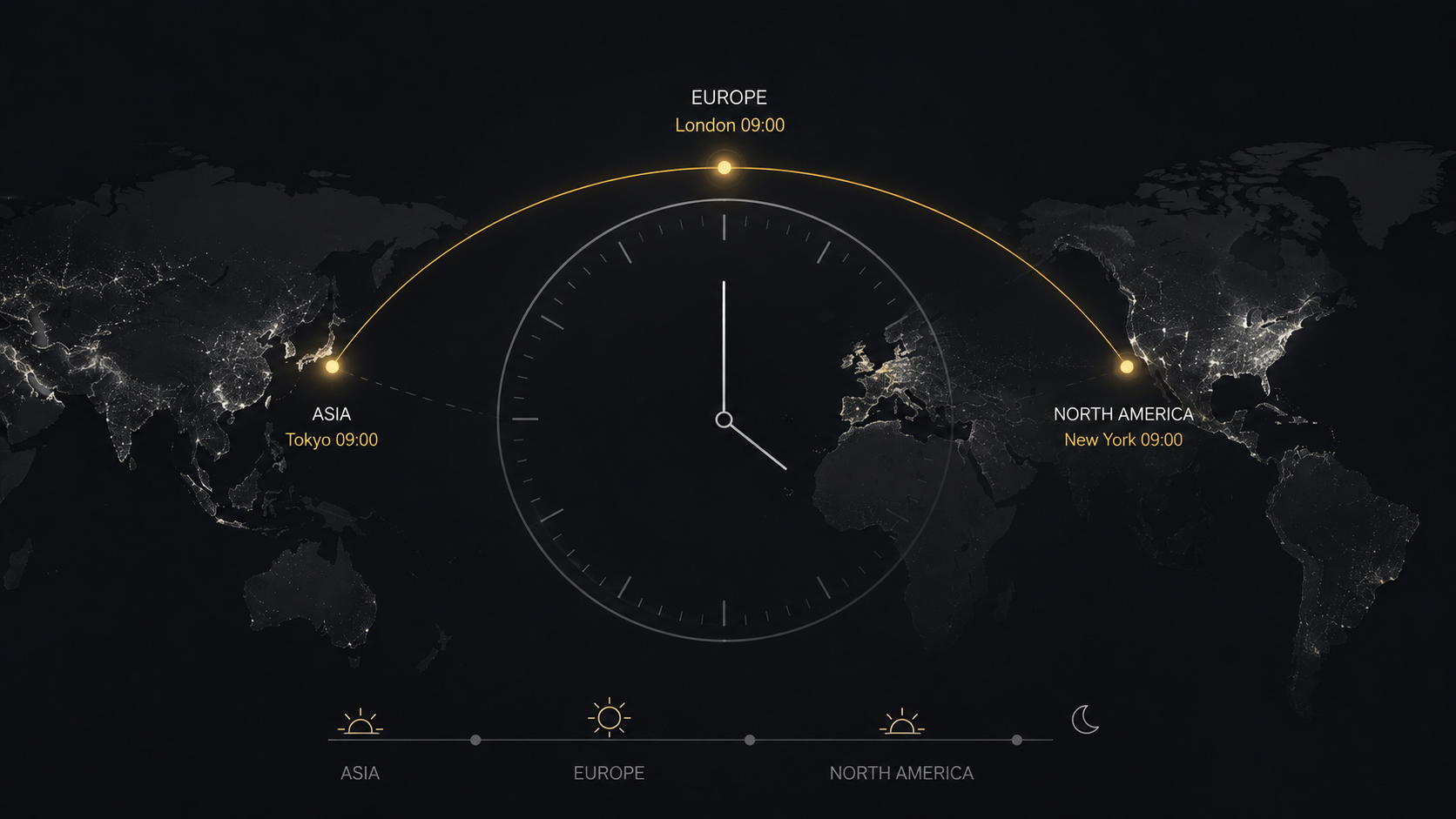
The global financial day is better understood as a sequence of handovers than as one uninterrupted session. Asia becomes active first, with Tokyo, Singapore, Hong Kong and other financial centers processing information that accumulated during the later stages of the American day. Europe then enters while parts of Asia remain active, and London eventually becomes an important bridge between the two regions. Several hours later New York joins the system while Europe is still operating, creating another period in which major pools of institutional capital are simultaneously available.
This sequence matters for reasons extending far beyond trading volume. When a financial center becomes active, an entire network of institutions becomes more operationally relevant: banks manage payments and funding, dealers provide market-making capacity, asset managers adjust portfolios, companies move cash, custodians process securities and financial-market infrastructures handle transactions. The composition of the global financial system therefore changes continuously during the day even though the securities being traded remain the same.
Consider a US Treasury held by a European institution. Its fundamental characteristics do not change because London closes for the evening, but the environment surrounding that security does. The institutions available to finance it, trade it, hedge its currency exposure or use it as collateral can change as different financial centers enter and leave their working day. A global asset therefore exists inside a financial infrastructure whose capacity is partly determined by time.
This is why the common description of “Asian, London and New York sessions” understates what is happening. These are not merely periods during which different groups of traders look at screens. They are periods during which different portions of the global financial machinery are simultaneously capable of processing risk, liquidity and settlement.
Why London Is More Than a Trading Session
London occupies an unusually important position within this daily sequence. Its location allows the European financial day to overlap first with Asian activity and later with North America, making London a natural transition point between major pools of global capital. Its significance is especially visible in foreign exchange, international banking and cross-border finance, but the underlying principle extends into bonds, derivatives, collateral and funding markets.
Foreign exchange demonstrates why time matters so much. An FX transaction may look instantaneous on a trading screen, yet the financial obligations behind that transaction ultimately involve currencies operating through different banking and central-bank systems. Institutions therefore need mechanisms that allow enormous cross-border payment obligations to be coordinated without unnecessarily exposing participants to the risk that one currency is delivered while the other is not. CLS, a major piece of global FX infrastructure, settles instructions across 18 currencies and reports average daily settlement values exceeding $8 trillion. Its settlement model relies on a period during which the relevant real-time gross settlement systems are simultaneously available.
This illustrates a fundamental constraint of global finance. Markets can price two currencies against each other almost continuously, but final settlement still depends on financial infrastructure located in different jurisdictions. Globalization has therefore not eliminated geography or time; it has connected multiple geographically separate systems and created mechanisms for synchronizing them.
The London–New York overlap is particularly important in this context. For several hours, a large concentration of global banking, investment management, market-making and corporate treasury activity is simultaneously operational. US Treasury markets interact with European portfolios, dollar funding interacts with non-US balance sheets, foreign-exchange transactions connect currencies and derivatives generate collateral requirements across jurisdictions. What makes this period important is therefore not simply that more securities change hands.
A particularly large amount of global balance-sheet capacity is awake at the same time.
Money at 10:00 Is Not Always the Same as Money at 16:00
One of the clearest ways to understand the financial clock is to look at a bank's liquidity during a single day. Imagine that an institution must make a $1 billion payment at 10:00 and expects to receive $1 billion at 16:00. Looking only at the complete day, the two transactions cancel each other. The bank pays $1 billion and receives $1 billion, producing no net funding requirement from those two flows but etween 10:00 and 16:00, however, the institution is missing $1 billion.
That six-hour difference is economically important because payment obligations cannot necessarily wait for future receipts. The bank needs sufficient reserves, incoming liquidity, secured funding or another source of intraday financing to bridge the interval. This is one reason central banks and regulators pay close attention to intraday liquidity rather than assessing institutions exclusively at the end of the business day. In the United States, the Federal Reserve's Payment System Risk framework explicitly addresses intraday credit and daylight overdrafts associated with payment activity.
Under ordinary conditions, these timing differences are handled almost invisibly. Banks know broadly when large payments are expected, maintain liquidity buffers and use money markets and collateralized financing to manage temporary mismatches. The system becomes more interesting when uncertainty rises. If an institution becomes less confident that an expected payment will arrive on schedule, releasing its own liquidity early in the day becomes less attractive. Preserving cash for longer is individually rational, but if many institutions adopt the same behavior simultaneously, liquidity can become less freely available across the system.
This reveals why financial stress can develop even without an immediate solvency problem. An institution may possess enough assets to cover its liabilities and still experience difficulty if those assets cannot produce usable liquidity quickly enough. The relevant question is no longer simply how much wealth sits on the balance sheet, but how rapidly that wealth can be transformed into settlement-ready money.
Government Bonds Are Part of the Financial Clock
Government bonds become particularly important at this point because high-quality sovereign securities can bridge the gap between owning an asset and possessing cash. A bank or financial institution does not necessarily need to sell a government bond when it requires temporary liquidity. Through secured funding markets such as repo, the security can be pledged against cash and later returned when the transaction unwinds. This is one of the reasons government bonds occupy such a central position in modern financial systems. Their importance cannot be measured solely through their yield or their role in financing public deficits. High-quality government securities can function as collateral, liquidity reserves and instruments through which balance sheets obtain short-term funding. Their usefulness therefore extends directly into the daily movement of money.
Time introduces an additional layer to this relationship. A security can only solve an immediate liquidity problem if it can actually be mobilized quickly enough. It may need to sit within the appropriate legal entity, be held through infrastructure capable of transferring it, satisfy the collateral requirements of the counterparty and arrive before the cash is required. An institution can therefore possess substantial high-quality assets in aggregate while still encountering a temporary liquidity constraint because those assets are not immediately available in the right part of its financial network.
The distinction is subtle but important. Owning liquidity is not always the same as being able to mobilize liquidity. In a globally interconnected institution, collateral can be distributed across currencies, subsidiaries, custodians and jurisdictions. Moving a security from where it currently sits to where it can support a particular obligation introduces operational and temporal constraints. During calm markets, these constraints are easy to overlook because institutions expect funding to remain available. During stress, the speed with which collateral can be transformed into usable cash becomes part of the asset's practical value.
This connects the government bond market directly with the financial clock. A Treasury security may have the same coupon, maturity and credit characteristics throughout the day, yet its usefulness to a particular institution can depend on whether it can be financed or transferred before an approaching obligation. Time therefore becomes another dimension of liquidity alongside market depth, transaction costs and credit quality.
Markets Also Schedule Information
The financial clock is not determined only by payment and settlement systems. Governments, statistical agencies and central banks deliberately concentrate information into particular moments. Inflation reports, employment figures, central-bank decisions, government debt auctions and other events are released according to predetermined schedules. The information may concern economic developments accumulated over weeks or months, yet the market is often required to process it within seconds. This creates an unusual feature of modern markets: participants know when uncertainty is likely to increase even though they do not yet know what the information will say. Dealers can adjust inventories, investors can postpone large decisions, derivatives markets can price additional event risk and liquidity conditions can change before the scheduled release occurs. Time therefore influences market behavior before any new fundamental information has actually entered the system.
For government bonds, this is particularly powerful because one macroeconomic release can affect expectations across several layers of the yield curve. An inflation surprise can change assumptions about the next central-bank meeting, the expected path of policy rates further into the future, real yields and the compensation investors demand for inflation uncertainty. These adjustments can then spread into currencies, corporate bonds, equities and derivatives.
The important point is not that certain hours offer better trading opportunities. It is that the financial system has created scheduled moments of collective repricing. Millions of decisions that would otherwise occur gradually can become concentrated into a narrow interval because the underlying information arrives at a known time.
Faster Settlement Makes Every Hour More Valuable
The movement toward shorter settlement cycles provides another example of how financial time has economic consequences. The United States moved most applicable securities transactions from T+2 to T+1 settlement in May 2024. Shortening the interval between a trade and its settlement can reduce counterparty exposure, but it also leaves institutions with less time to arrange the cash, securities and foreign exchange required to complete transactions. The effect is particularly interesting for international investors. A European or Asian institution buying a US security may need dollars to settle the transaction. When the settlement period contracts, the time available to execute and coordinate the associated foreign-exchange transaction contracts as well. CLS has examined how the transition to T+1 affects these FX workflows and the operational timetable facing global investors.
This demonstrates that reducing time does not simply make finance faster. It changes the distribution of risk. Less time between execution and settlement can reduce the period during which one form of counterparty exposure exists, while simultaneously increasing the importance of operational efficiency, funding access and intraday liquidity. A financial institution now has fewer hours in which to move the necessary resources into position.
The development also points toward a broader trend. Modern financial infrastructure is becoming faster while remaining dependent on institutions distributed across different time zones and currencies. As settlement cycles compress, the ability to mobilize collateral and cash quickly becomes increasingly valuable. The financial system may become more efficient, but efficiency also means that delays have less room to be absorbed.
When the Clock Becomes Visible
During normal conditions, the temporal architecture of finance is almost invisible precisely because it works. Payments settle, securities arrive, repo transactions generate cash, currencies are exchanged and financial institutions continuously bridge small differences between incoming and outgoing flows. Investors watching asset prices see the outcome but rarely see the machinery producing it. Periods of stress expose that machinery. Institutions become more cautious about lending liquidity, collateral preferences can shift toward the highest-quality securities, margin requirements can create unexpected cash demands and funding markets can become less willing to extend financing at precisely the moment balance sheets need it most. A timing mismatch that would ordinarily be trivial can suddenly matter because the institution is less certain that the next source of liquidity will remain available.
This is also why central banks care about much more than setting interest rates. They sit at the center of payment and settlement systems, define eligible collateral for various operations and can provide liquidity when private funding mechanisms become impaired. In severe stress, stabilizing the financial system can therefore mean ensuring not merely that enough money exists in aggregate, but that usable liquidity can reach institutions before their obligations become disruptive.
The financial clock becomes most visible when institutions begin racing against it. The crucial variable may no longer be the eventual value of an asset or the long-term solvency of an institution. It can become the number of hours available to transform collateral into cash, meet margin, complete settlement or receive an expected payment. What appears from the outside to be a crisis of money can partly be a crisis of money arriving too late.
Conclusion
The global financial system may appear continuous, but the infrastructure beneath it remains deeply organized around time. Asia, Europe and North America do not simply represent successive trading sessions; they represent changing configurations of banks, dealers, payment systems, investors and balance sheets. As these financial centers open, overlap and close, the amount and location of usable liquidity changes with them. This perspective also changes how government bonds should be understood. A sovereign security is not valuable only because of its yield, duration or perceived safety. It can function as collateral capable of transforming an asset into funding, but that function depends on whether the security can be mobilized in the correct place before the liquidity is required. The same principle applies to cash flows themselves: money expected later in the day cannot necessarily satisfy an obligation that must be settled now.
Faster settlement, increasingly interconnected markets and enormous cross-border capital flows make these relationships more rather than less important. Modern finance has reduced the time required to transmit information and complete transactions, but it has not eliminated the institutional clocks governing payments, collateral and settlement. In some respects, greater speed has made those clocks more consequential because there is less time available when something fails to arrive as expected.
Understanding the financial system therefore requires looking beyond prices and asking a different set of questions: when does liquidity become available, where is collateral located, which financial infrastructures are simultaneously operating, and how much time remains before an obligation must be fulfilled? These questions reveal a layer of finance that is largely invisible during ordinary markets but can become decisive during periods of stress.
Capital is global, but its availability is still governed by time. The financial system does not merely have a balance sheet. It has a clock.