
Asian Development Bank (ADB)
Connecting Global Capital with Asia-Pacific Development
Introduction
The Asian Development Bank (ADB) is a multilateral development bank focused on economic and social development across Asia and the Pacific. Established in 1966 and headquartered in Manila, Philippines, the institution provides loans, grants, technical assistance, and investment to governments and private-sector projects.
The ADB occupies an important position between public development policy and international capital markets, financing infrastructure, energy, transportation, climate projects, and regional economic integration.
History and Development
The Asian Development Bank was established in 1966 during a period of rapid economic transformation across Asia. Its original objective was to mobilize financial resources and expertise for countries facing significant infrastructure and development needs. As Asian economies expanded, the ADB’s activities evolved from traditional development lending toward a much broader range of economic, environmental, and financial projects.
Today, its membership extends beyond Asia and includes countries from Europe and North America alongside its regional members.
Institutional Role
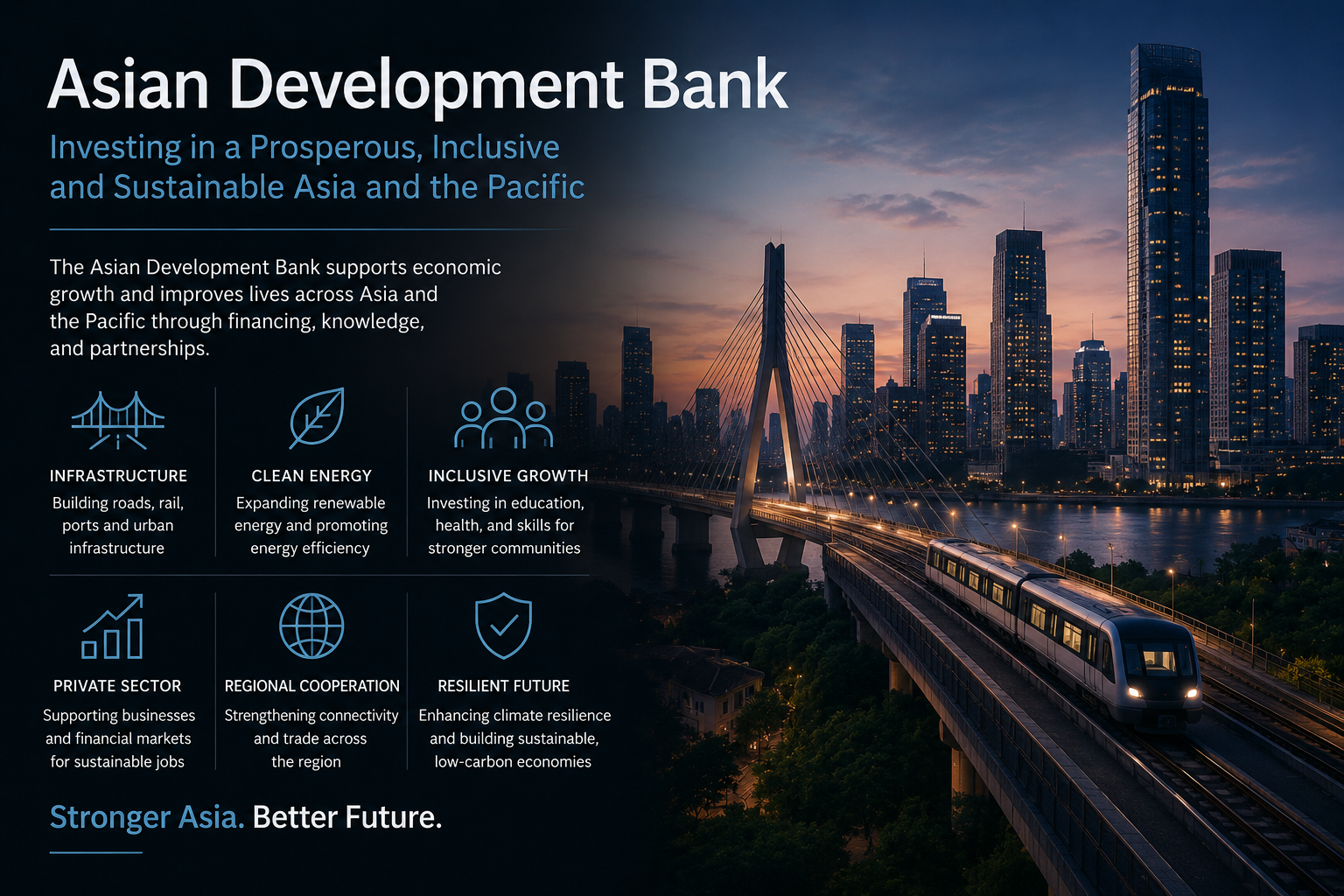
The ADB finances projects across numerous areas, including:
Transportation infrastructure
Renewable and conventional energy infrastructure
Water and sanitation
Healthcare
Education
Digital connectivity
Financial-sector development
Climate resilience
Urban development
Regional trade and integration
Financing can take the form of sovereign loans, private-sector financing, grants, guarantees, equity investments, and technical assistance.
Infrastructure Financing
Infrastructure represents one of the ADB’s most important areas of activity and many Asian economies require substantial investment in transportation networks, electricity grids, water infrastructure, urban systems, and digital connectivity. The ADB provides long-term financing that can help governments undertake projects that might otherwise be difficult to finance solely through domestic markets.
The institution frequently works alongside governments, commercial lenders, institutional investors, and other development banks.
Infrastructure Financing
Infrastructure represents one of the ADB’s most important areas of activity. Many Asian economies require substantial investment in transportation networks, electricity grids, water infrastructure, urban systems, and digital connectivity. The ADB provides long-term financing that can help governments undertake projects that might otherwise be difficult to finance solely through domestic markets.
The institution frequently works alongside governments, commercial lenders, institutional investors, and other development banks.
ADB and the Bond Market
The ADB is also a significant supranational bond issuer and rather than funding its lending activities exclusively through contributions from member governments, the institution raises substantial amounts of capital through international bond markets. Its funding operations include bonds issued in major international currencies as well as selected local currencies.
This creates an important connection between global institutional investors and development projects throughout Asia and the Pacific.
Local Currency Markets
The ADB has also supported the development of domestic bond markets across Asia and deeper local-currency capital markets can allow governments and companies to borrow domestically rather than relying excessively on foreign-currency debt.
This can reduce currency mismatches and strengthen the resilience of national financial systems — an issue that became particularly important following the Asian Financial Crisis of 1997–1998.
Governance and Membership
The Asian Development Bank is owned by its member governments.
Its governance structure includes:
Board of Governors
Board of Directors
President
Executive management
Voting power is linked primarily to members’ capital subscriptions, meaning larger shareholders exercise greater influence over institutional decisions.
International Importance
The ADB operates in a region containing some of the world’s largest and fastest-growing economies as well as numerous smaller developing states. Its activities therefore cover very different economic environments, ranging from major infrastructure projects in emerging economies to development assistance for smaller and more vulnerable countries.
The institution also plays an important role in regional economic cooperation and cross-border infrastructure.
Why the ADB Matters
The Asian Development Bank provides an important link between international capital markets and Asia’s long-term investment requirements and its combination of bond issuance, infrastructure financing, private-sector investment, and local capital-market development makes it particularly relevant to understanding the financial architecture of the Asia-Pacific region.
For fixed-income investors, the ADB is also an important participant in the broader supranational bond market.
Conclusion
The Asian Development Bank has been part of Asia’s financial and economic development for more than half a century. As the region’s infrastructure and financing requirements have expanded, the institution has developed into a major source of long-term development capital. Its significance extends beyond individual projects. By raising capital internationally and directing it toward infrastructure and economic development, the ADB illustrates how global bond markets can be connected directly with the long-term transformation of national economies.