
Lump Sum vs Dollar-Cost Averaging
Understanding two common strategies for investing money over time
What Is Lump Sum Investing?
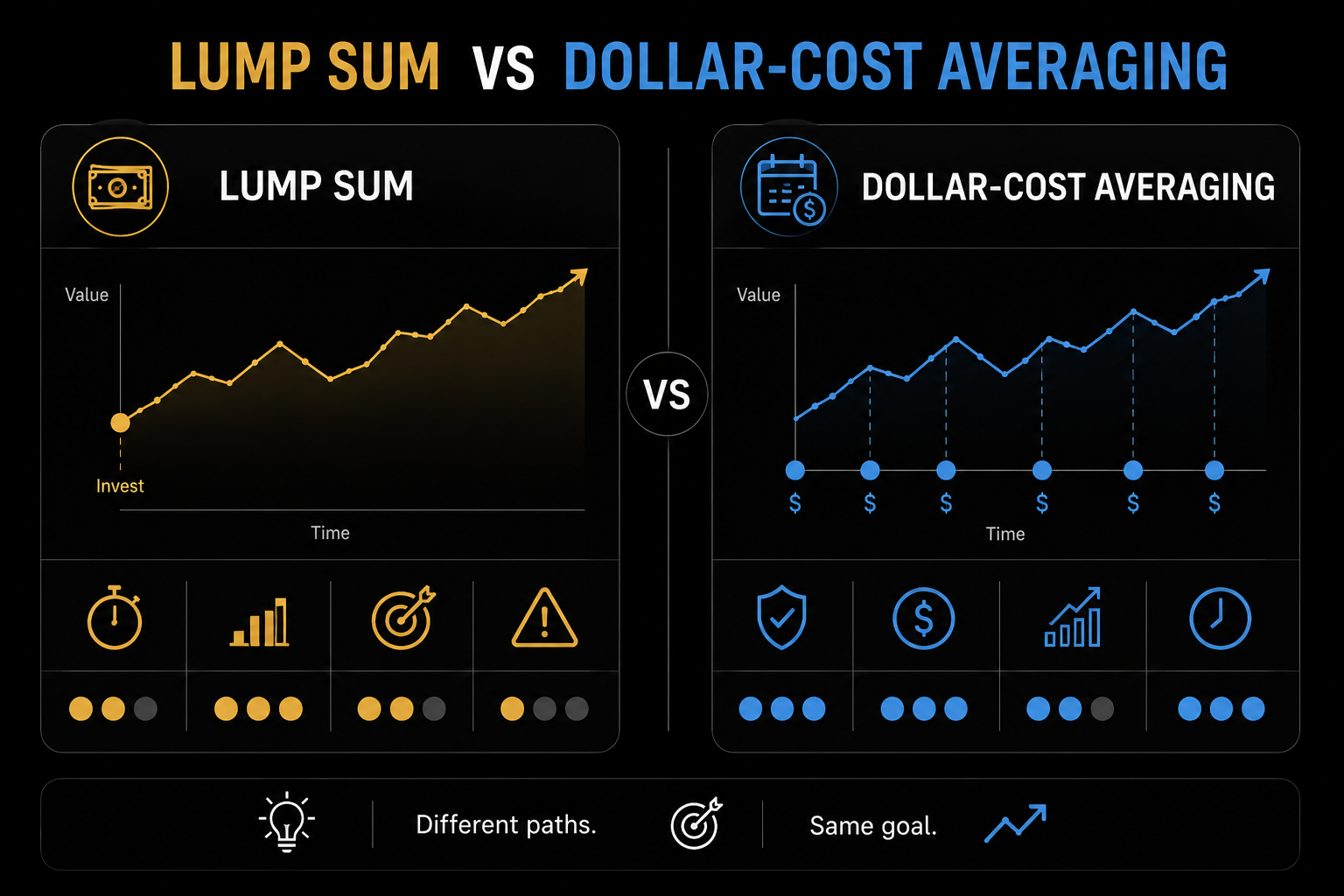
Lump sum investing means investing a large amount of money all at once andnstead of spreading investments over time, the entire capital is invested immediately, allowing it to participate in the market from day one.
This strategy is often used after receiving a bonus, inheritance or proceeds from selling an asset.
What Is Dollar-Cost Averaging?
Dollar-Cost Averaging (DCA) is an investment strategy where a fixed amount of money is invested at regular intervals, regardless of market conditions.
Because investments occur over time, investors buy more shares when prices are lower and fewer shares when prices are higher.
Key Differences
Lump Sum Investing
Characteristics include:
One-time investment
Immediate market exposure
Maximum time invested
Higher short-term market risk
Dollar-Cost Averaging
Characteristics include:
Regular investing
Gradual market exposure
Reduced timing risk
Disciplined investing approach
Advantages of Lump Sum Investing
More time in the market
Potentially higher long-term returns
Simplicity
Immediate portfolio allocation
Advantages of Dollar-Cost Averaging
Reduces emotional investing
Lowers timing risk
Encourages consistent investing
Suitable for regular income
Risks
Lump Sum Investing
If markets decline shortly after investing, portfolio values may fall significantly in the short term.
Dollar-Cost Averaging
If markets rise steadily, investing gradually may produce lower returns than investing immediately.
Which Strategy Is Better?
Neither strategy is universally better.
The best choice depends on:
Investment goals
Risk tolerance
Available capital
Time horizon
Personal comfort with market volatility
Some investors also combine both approaches by investing part of their capital immediately while spreading the remainder over time.
Common Misconceptions
Dollar-Cost Averaging does not eliminate market risk but lump sum investing does not guarantee higher returns.
Both strategies can be effective when combined with diversification and a long-term investment plan.
Key Takeaways
✓ Lump sum investing places all capital into the market immediately.
✓ Dollar-Cost Averaging invests gradually over time.
✓ Both strategies have advantages and trade-offs.
✓ Risk tolerance and investment goals should guide the decision.
✓ Long-term discipline is often more important than choosing one strategy over the other.