
Positioning for the Next Regime
Why counter-cyclical investing is less about predicting the turning point and more about preparing before the market recognizes a new environment
Introduction
Financial markets rarely move neatly from one economic regime into another. Inflation can decline while growth remains resilient, monetary policy can stay restrictive even as economic momentum weakens, and bond yields can begin moving months before the economic data confirm that conditions have changed. By the time a new regime becomes obvious, a significant part of the market adjustment may already have occurred.
This creates a fundamental challenge for counter-cyclical investors. Waiting for certainty reduces the probability of being wrong, but it can also mean entering after valuations have already adjusted. Moving too early creates the opposite problem: an investor may correctly identify the direction of the next regime but experience substantial losses before the transition actually takes place.
Positioning for the next regime is therefore not primarily an exercise in forecasting the exact date of a recession, rate cut or inflation turning point. It is about understanding what the market currently prices, identifying where that pricing has become vulnerable and gradually building exposure to outcomes that remain underappreciated.
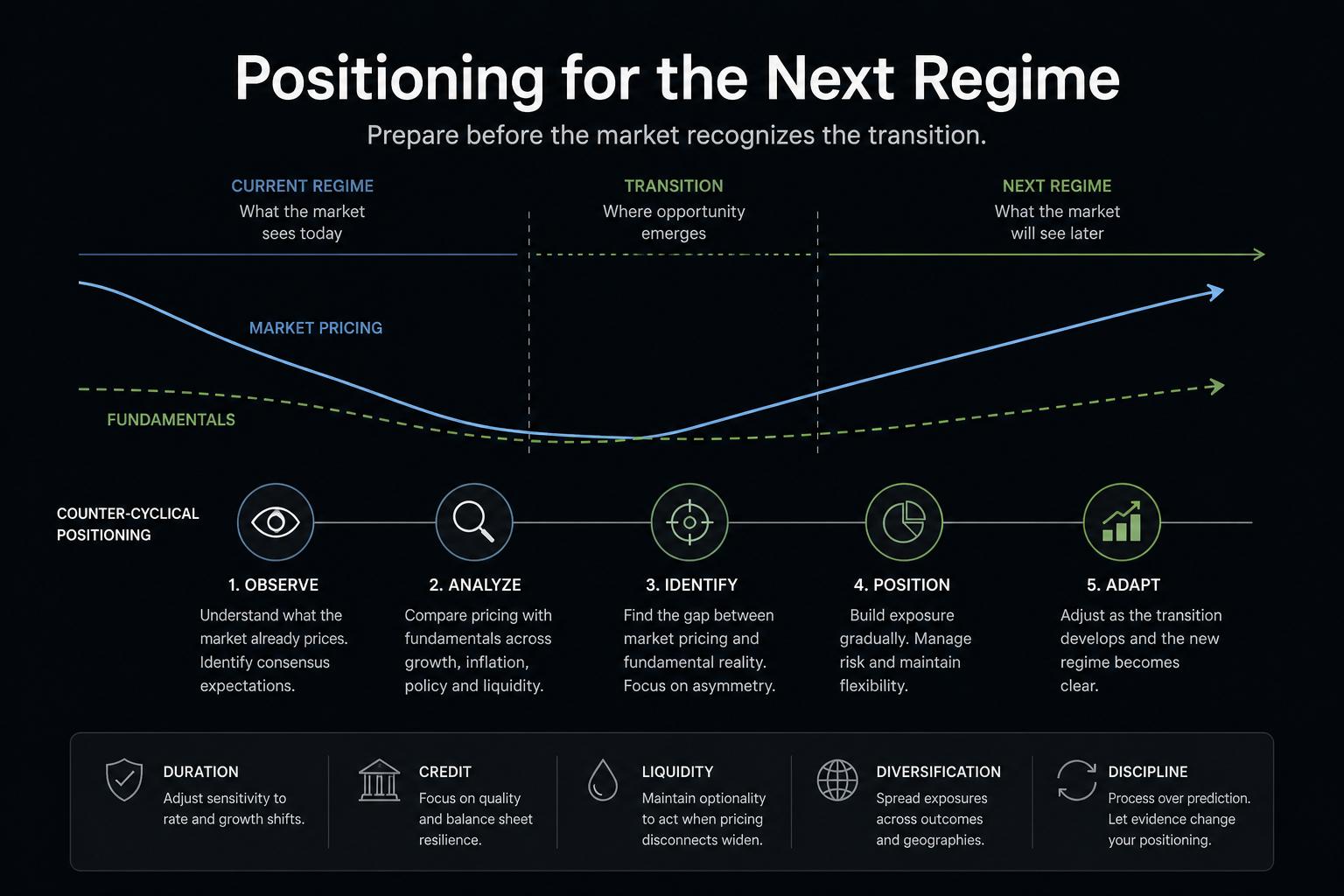
Markets Trade the Transition Before the Destination
Economic regimes are usually recognized retrospectively. Markets do not have that luxury. Bond investors continuously attempt to price where inflation, growth and monetary policy will be months or years into the future. As a result, some of the largest movements in fixed income occur during the transition between regimes rather than after the new environment has become established.
Consider the transition from persistent inflation toward slower growth. Policy rates may still be high, inflation may remain above target and central banks may continue communicating a restrictive stance. Yet longer-term government bonds can begin rallying if investors conclude that monetary tightening will eventually weaken demand and inflation. The economic data can therefore continue describing the old regime while market prices increasingly reflect the next one.
The opposite can occur when an extended low-inflation environment begins breaking down. Long-term yields may rise well before central banks increase policy rates because investors are already demanding greater inflation compensation and a higher term premium. Investors waiting for official policy confirmation may consequently arrive after a substantial portion of the repricing has occurred.
The Four Forces Behind a Regime
A practical way to think about market regimes is through four interacting forces: growth, inflation, monetary policy and liquidity. None operates independently. Strong growth combined with rising inflation produces a very different fixed-income environment from weak growth accompanied by falling inflation, even if headline interest rates initially appear similar. Monetary policy adds another dimension because central banks react to the first two forces with a delay. Policy can remain restrictive after inflation begins falling or accommodative after inflation pressure starts building. Liquidity conditions can amplify these transitions through bank reserves, money markets, government issuance and investor positioning.
The important counter-cyclical question is therefore not simply whether growth is strong or weak today. It is whether the direction of these forces is beginning to change and whether market pricing already reflects that transition.
Positioning Before Rate Cuts
One of the most common examples involves the transition from monetary tightening toward easing. Investors often assume that the opportunity in government bonds begins when a central bank actually cuts interest rates. Historically, however, bond markets frequently begin repricing well before the first cut because yields incorporate expectations for future policy.
This creates an important distinction between policy confirmation and market opportunity. If investors wait until economic weakness is undeniable and rate cuts have begun, long-duration yields may already have fallen substantially. Conversely, buying duration simply because policy rates are high can be premature if inflation remains persistent and the market continues repricing the terminal rate upward.
Counter-cyclical positioning therefore requires examining whether restrictive policy is beginning to affect inflation, employment, credit creation and economic activity while comparing those developments with what the yield curve already discounts. The opportunity becomes more compelling when economic momentum is deteriorating faster than the expected policy path embedded in market prices.
Duration as a Regime Position
Duration is one of the most direct ways bond investors express a view on the next macroeconomic regime. Longer-duration bonds are more sensitive to changes in yields, meaning they can benefit significantly when markets begin pricing lower inflation, weaker growth or easier future monetary policy. The same sensitivity makes them vulnerable when inflation or the term premium continues rising.
This makes duration positioning fundamentally different from simply buying bonds because yields appear high. A counter-cyclical investor needs to consider both the starting yield and the economic environment that could drive future yield changes.
When inflation is slowing, monetary conditions are restrictive and growth indicators are weakening, gradually extending duration can represent positioning for the next regime before central banks formally acknowledge it. When inflation expectations are rising and fiscal supply is placing persistent pressure on long-term yields, shortening duration may provide greater resilience even if long bonds initially appear inexpensive.
Credit Requires a Different Clock
Government bonds and corporate credit do not necessarily reach their most attractive points simultaneously. During the early stages of an economic slowdown, government yields can decline while credit spreads widen. The duration component of corporate bonds may benefit from falling rates, but deteriorating credit conditions can offset that gain. This means positioning for the next regime requires separating interest-rate exposure from credit exposure. A weakening economy may initially favor high-quality government duration while lower-quality credit remains vulnerable to declining earnings, tighter lending standards and refinancing pressure.
Later in the cycle, the opportunity can shift. Once spreads have widened sufficiently and corporate fundamentals begin stabilizing, credit can offer more attractive compensation even though economic headlines remain poor. The sequence matters: the asset that benefits first from a regime transition is not necessarily the asset that offers the best opportunity later in the transition.
The Yield Curve as a Transition Mechanism
The yield curve provides valuable information about how investors are pricing the next regime. An inversion can indicate expectations that restrictive monetary policy will eventually give way to lower rates, but the signal becomes more informative when the curve begins changing shape. A bull steepening, where shorter-term yields decline faster than longer-term yields, can accompany expectations for monetary easing. A bear steepening can instead reflect rising inflation risk, fiscal concerns or a higher term premium. The same movement in the headline 10-year yield can therefore have very different implications depending on what is happening across the rest of the curve.
For counter-cyclical positioning, the shape and direction of the curve can be more informative than any single yield. It reveals not only where rates are today, but how investors are redistributing expectations across time.
Liquidity Can Signal the Transition
Regime changes are also reflected in the movement of liquidity through the financial system. Deposits, money market funds, Treasury bills, central-bank facilities and reserve balances can shift as relative yields and monetary conditions change and these movements matter because financial liquidity influences how easily markets absorb risk. A restrictive policy regime accompanied by declining system liquidity can amplify volatility and forced selling. Conversely, improving liquidity can support risk assets before the macroeconomic data visibly recover.
For counter-cyclical investors, liquidity is therefore not a standalone timing signal. It is another layer of evidence that can confirm or contradict the story being told by yields, credit spreads and economic indicators.
Positioning Is Not Prediction
The greatest mistake in regime investing is treating a plausible scenario as a certainty. Economies can remain in transitional states far longer than expected, inflation can reaccelerate and central banks can change direction as new information arrives. A portfolio built entirely around one forecast can therefore become extremely vulnerable even when the underlying thesis eventually proves correct.
Positioning is different. Instead of making a binary bet on a recession or soft landing, investors can adjust exposures gradually as the balance of evidence changes. Duration can be extended incrementally, credit quality can be increased before economic deterioration becomes severe, and liquidity can be preserved when valuations do not yet compensate for uncertainty.
This approach accepts that the exact turning point cannot be known. The objective is to improve the portfolio’s asymmetry as the probability distribution of future outcomes changes.
What Is Already Priced?
Perhaps the most important question when positioning for a new regime is not what will happen, but what the market already expects to happen and a recession forecast has limited investment value if bond yields and credit spreads already discount a severe downturn. Likewise, predicting rate cuts offers little advantage if the yield curve already prices aggressive easing. Markets can even move in the opposite direction after an apparently favorable event because the event was less extreme than what investors had anticipated.
Counter-cyclical positioning therefore requires comparing the investor’s view with the implied market view. Opportunity exists when there is a meaningful difference between the two and the potential reward from that difference exceeds the risk of being wrong.
Building Exposure Gradually
Regime transitions rarely provide a single perfect entry point. Prices can overshoot, reverse and overshoot again as investors repeatedly reassess incoming information. Gradual positioning can therefore be more robust than attempting to identify the exact turning point and an investor expecting disinflation and eventual monetary easing might initially increase exposure to high-quality intermediate-duration bonds rather than immediately maximizing duration. If inflation continues weakening and policy becomes increasingly restrictive relative to economic conditions, duration can be extended further. Credit exposure can be added later if spreads begin compensating sufficiently for recession risk.
This staged approach turns regime positioning into a process rather than a prediction. Each adjustment reflects additional evidence while preserving the ability to respond if the original thesis changes.
When the Consensus Begins to Turn
The transition becomes particularly interesting when market behavior changes before the narrative does. Yields may stop rising after stronger inflation data, credit spreads may stabilize despite weaker economic releases or the yield curve may begin steepening even while central banks maintain restrictive guidance. Such behavior can indicate that the market has already absorbed much of the information supporting the prevailing regime. When negative news stops producing new lows, or positive news stops producing new highs, the relationship between information and price is changing.
These moments do not provide certainty, but they can reveal that the asymmetry of the previous regime is beginning to disappear. For counter-cyclical investors, that shift can matter more than waiting for economists or policymakers to formally declare that the environment has changed.
Conclusion
Positioning for the next regime is one of the most important applications of counter-cyclical investing. Markets anticipate economic transitions before they become obvious in official data, which means waiting for complete confirmation can result in entering only after much of the repricing has occurred. Acting too early, however, can expose investors to significant losses while the existing regime persists. The solution is not better certainty. It is better positioning. By examining growth, inflation, monetary policy, liquidity, the yield curve, credit conditions and—most importantly—what markets already price, investors can gradually adjust exposure as the balance of probabilities changes.
The objective is not to predict the exact moment when one regime ends and another begins. It is to construct exposure so that when the transition eventually becomes visible to everyone else, the portfolio does not need to begin adapting from zero.