
Bond Auction Tail Explained
What Auction Pricing Reveals About Demand for Government Debt
Introduction
Government bond auctions are among the most important recurring events in sovereign debt markets. Treasuries, gilts, Bunds and other government securities are regularly sold to investors through auctions, and the results can provide an immediate indication of how strong or weak demand is for newly issued debt.
One of the most closely watched signals is the auction tail. It measures the difference between the yield at which the auction clears and the yield at which the bond was trading immediately before the auction. A seemingly small difference of only a few basis points can tell traders a great deal about investor demand, dealer balance sheets and the willingness of the market to absorb new government borrowing.
What Is an Auction Tail?
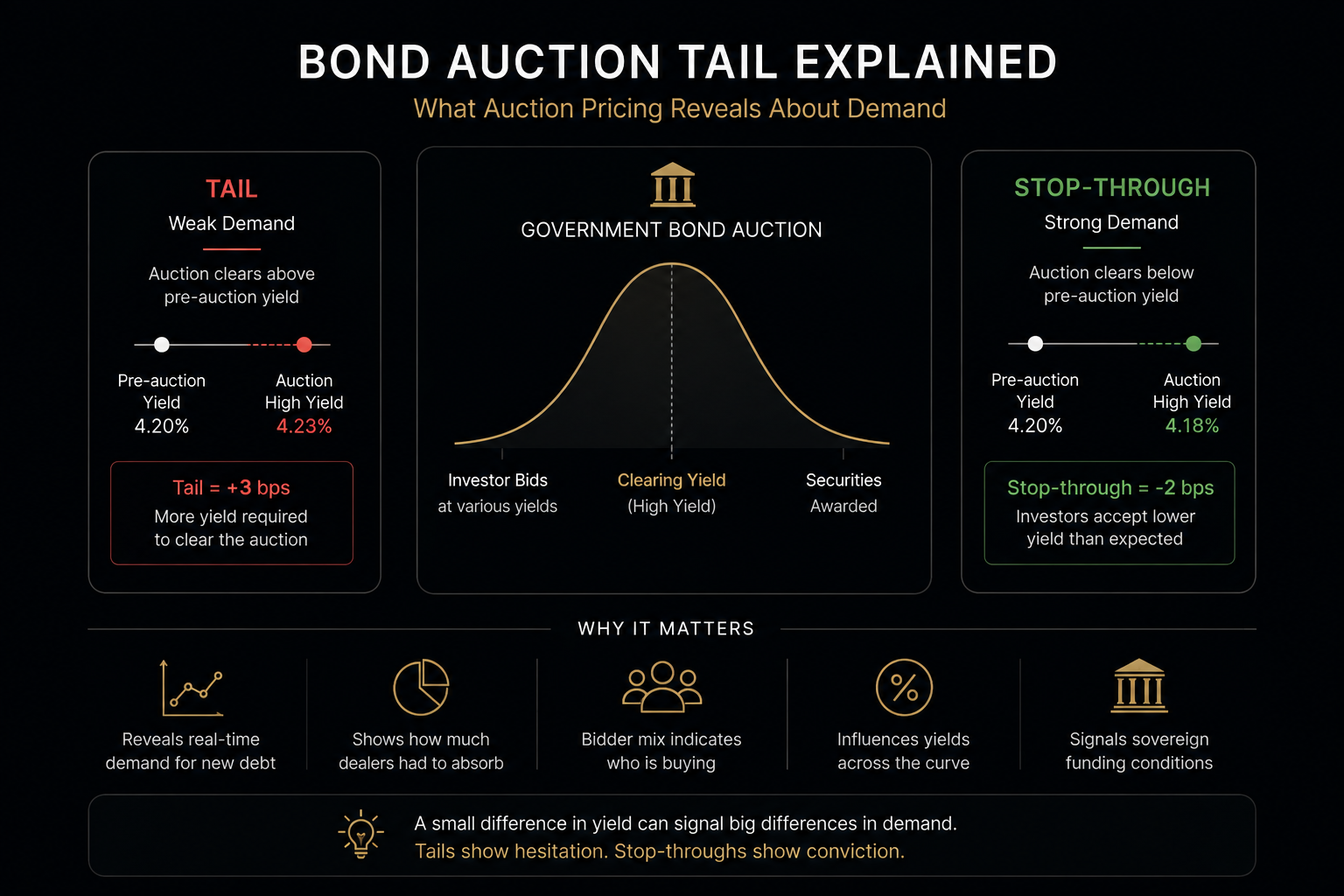
Before a government bond auction takes place, the security being issued or a comparable existing security already has an implied market yield. This pre-auction level is often called the when-issued yield in the U.S. Treasury market. Suppose the market expects a new 10-year Treasury to clear at 4.20%. The auction then produces a high yield of 4.23%. The auction has effectively cleared three basis points above the pre-auction market level.
That difference is referred to as a three-basis-point tail and a tail generally indicates that investors demanded a slightly higher yield than the market had expected in order to absorb the available supply. The larger the tail, the weaker the auction may appear.
The opposite is known as a stop-through. If the auction clears at 4.18% when the market expected 4.20%, the auction stopped through by two basis points. This generally signals stronger-than-expected demand.
Why a Few Basis Points Matter
A difference of two or three basis points may appear insignificant, but government bond auctions can involve tens of billions of dollars of securities. The clearing yield therefore provides a powerful real-time signal about the market’s willingness to finance the government at prevailing rates. A large tail can suggest that investors were reluctant to buy at the price implied before the auction. Dealers may have had to absorb more supply than expected, or investors may have demanded additional compensation because of volatility, inflation concerns or an already heavy issuance calendar.
A strong stop-through can indicate the opposite. Investors may have viewed the offered yield as attractive, creating more demand than the market had anticipated. For this reason, auction results can move bond prices within seconds.
The Role of the When-Issued Market
The auction tail only makes sense relative to a benchmark, and that benchmark is often the when-issued market and before a newly issued Treasury is formally delivered, investors can trade the security on a forward basis. This creates a market-implied yield before the auction occurs. The when-issued yield therefore represents the market’s collective estimate of where the new bond should trade.
The auction result can then be compared with this level and if the auction clears close to the when-issued yield, demand was broadly consistent with expectations. A meaningful deviation can indicate that demand was either stronger or weaker than the market had priced immediately beforehand.
This makes the auction tail more informative than simply looking at the absolute auction yield.
Bid-to-Cover Is Not Enough
Auction analysis often focuses on the bid-to-cover ratio, which compares the total amount of bids submitted with the amount of securities offered. A bid-to-cover ratio of 2.5 means investors submitted bids worth two and a half times the available supply. While useful, this number can sometimes be misleading. A high bid-to-cover ratio does not automatically mean that investors were willing to buy aggressively at attractive prices. Large volumes of bids can be submitted at yields far above the final clearing level.
The auction tail provides additional information because it focuses on the actual price required to clear the auction and this is why professional bond traders typically examine several indicators together: the tail or stop-through, bid-to-cover ratio, dealer allocation, indirect bidder participation and direct bidder participation.
Who Buys Government Bond Auctions?
Auction demand comes from several groups, and the composition of buyers can matter almost as much as the headline result. In U.S. Treasury auctions, primary dealers act as major intermediaries and are often expected to absorb securities not purchased by other investors. A particularly high dealer allocation can therefore be interpreted as a sign that end-investor demand was weaker than expected.
Indirect bidders often include foreign central banks, international institutions and investment managers bidding through intermediaries. Strong indirect participation can therefore be interpreted as evidence of healthy institutional or overseas demand.
Direct bidders submit bids directly to the Treasury and can include domestic institutional investors such as asset managers and pension funds.
No single category provides a complete picture, but shifts in the distribution of allocations can reveal how the investor base is responding to government issuance.
Why Auction Tails Can Move Markets
A weak auction does not affect only the security being sold. It can influence the wider yield curve because the result provides new information about the price investors require to absorb government debt. If a 10-year auction produces a large tail, the 10-year yield may immediately rise. Nearby maturities can move as traders reassess relative value across the curve, while futures markets can react simultaneously.
Repeated weak auctions can have broader significance. They may suggest that issuance is beginning to exceed investor demand at prevailing yields, potentially requiring higher rates to attract buyers and this is particularly important during periods when governments are running large fiscal deficits and issuing substantial quantities of new debt.
Auction Tails and Sovereign Funding Pressure
Auction tails can also be viewed through the lens of sovereign financing and a government can usually issue debt as long as investors are willing to purchase it, but the price at which they are willing to do so matters. If auctions repeatedly require higher yields than secondary markets imply, the government’s marginal cost of financing can gradually increase.
One weak auction does not constitute a funding crisis. Technical factors, market volatility and temporary positioning can all influence individual results. But a persistent pattern of weak demand can become an important signal.
This makes auction data especially relevant when combined with maturity schedules, refinancing requirements and the overall volume of government issuance.
Reading an Auction in Context
Auction results should never be interpreted in isolation. A two-basis-point tail during a highly volatile trading session may mean something very different from the same tail during calm market conditions. Investors should consider the size of the auction, recent issuance volumes, movements in yields before the auction, the broader economic environment and the behavior of similar securities.
The same applies to stop-throughs. An unusually strong result can sometimes reflect short positioning or temporary scarcity rather than a fundamental increase in long-term investor demand. The most useful interpretation therefore comes from comparing the result with both market expectations and historical auction patterns.
Conclusion
The auction tail is a small number with potentially significant information content. By comparing the auction clearing yield with the yield expected immediately beforehand, investors can see whether the market required additional compensation to absorb government debt or whether demand was stronger than anticipated. Combined with bid-to-cover ratios and bidder allocations, it provides a more complete view of the balance between government borrowing and investor demand.
For fixed-income investors, auctions are therefore not simply administrative events in which governments sell bonds. They are recurring price-discovery mechanisms that reveal how much the market is willing to charge for financing the state.