
What Is Passive Investing?
Understanding how investors seek long-term market returns through low-cost and diversified strategies.
Introduction
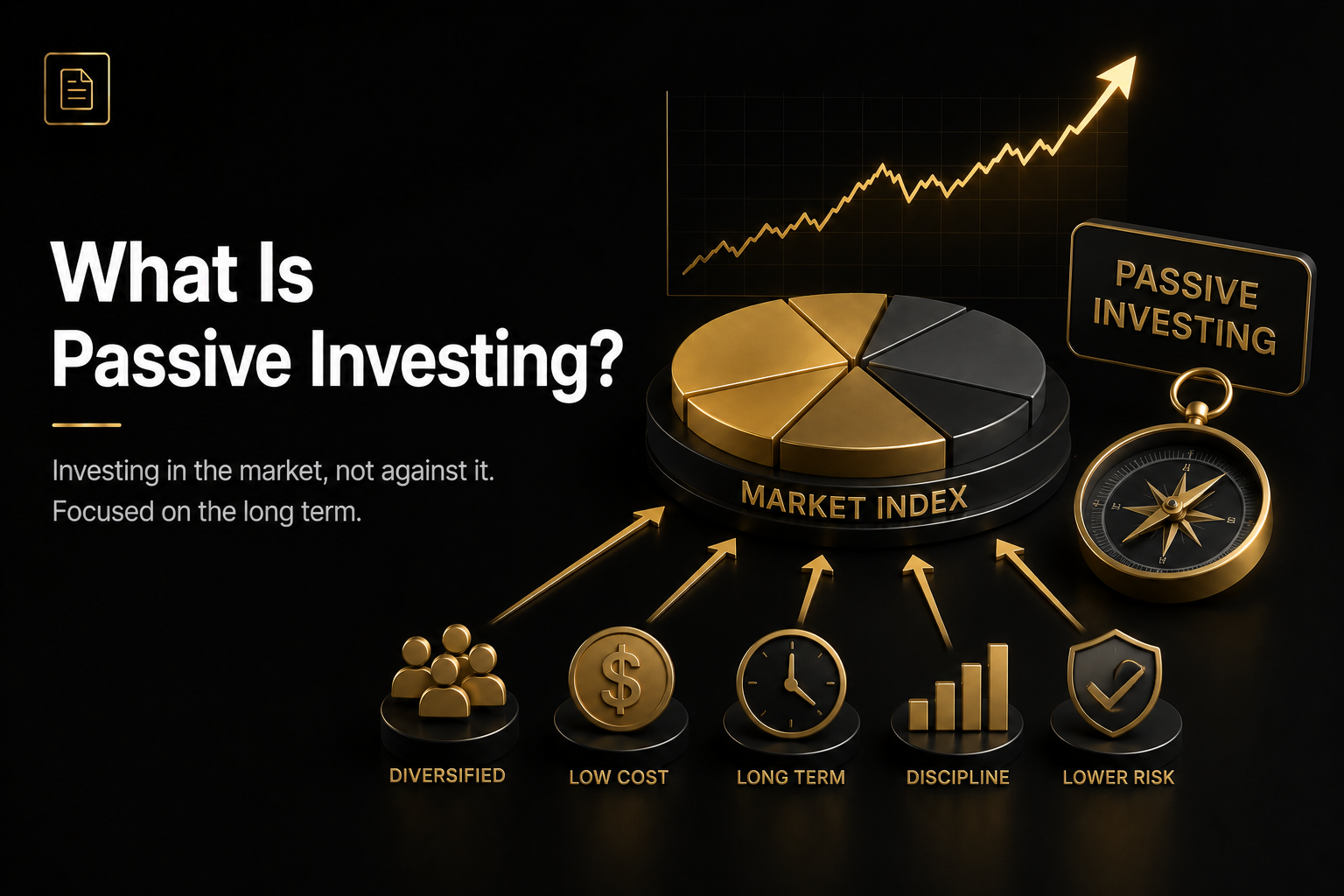
Passive investing is an investment approach that aims to match the performance of a market rather than outperform it. Instead of actively selecting individual securities or attempting to time the market, passive investors seek broad exposure through diversified funds that track market indexes.
The focus is on long-term participation rather than short-term predictions.
How Does Passive Investing Work?
Passive investing typically involves investing in:
Index Funds
ETFs
Broad Market Funds
Bond Funds
International Funds
These investments are designed to track the performance of a benchmark, such as the S&P 500 or MSCI World Index.
Why Is Passive Investing Popular?
Passive investing has grown in popularity because it offers:
Diversification
Low costs
Simplicity
Transparency
Long-term market exposure
Many investors view passive investing as a disciplined approach that reduces the need for frequent trading and market forecasting.
Passive Investing vs Active Investing
Passive Investing
Focuses on:
Tracking the market
Lower fees
Long-term investing
Broad diversification
Active Investing
Focuses on:
Selecting individual securities
Attempting to outperform benchmarks
Market timing
More frequent portfolio adjustments
Neither approach guarantees success, and both involve risks.
Advantages of Passive Investing
Lower Costs
Passive funds generally have lower expense ratios because they require less active management.
Diversification
Broad market funds provide exposure to many companies and sectors.
Simplicity
Passive investing removes much of the complexity associated with selecting individual investments.
Long-Term Discipline
Passive investors typically focus on long-term wealth creation rather than short-term market movements.
Risks of Passive Investing
Passive investing does not eliminate risk.
Investors remain exposed to:
Market Risk
Passive funds decline when the overall market declines.
Economic Risk
Recessions and financial crises can affect broad market indexes.
Concentration Risk
Some indexes may become heavily weighted toward certain sectors or companies.
Inflation Risk
Inflation can reduce real returns over time.
Passive Investing and Compound Growth
Passive investing is often combined with:
Dollar-Cost Averaging
Dividend Reinvestment
Asset Allocation
Rebalancing
Together, these principles can support long-term wealth accumulation through compounding and disciplined investing.
Common Misconceptions
Passive investing does not mean doing nothing.
Portfolios still require:
Asset allocation decisions
Periodic rebalancing
Risk management
Long-term discipline
Passive investing focuses on participation rather than prediction.
Key Takeaways
✓ Passive investing aims to track markets rather than outperform them.
✓ Index funds and ETFs are common passive investment vehicles.
✓ Passive investing emphasizes diversification and low costs.
✓ Long-term discipline is a central principle of passive investing.
✓ Passive investing has become one of the most widely used investment approaches worldwide.