
Banco Central do Brasil (BCB)
Exploring Brazil’s Central Bank and Its Role in Monetary Policy, Inflation and Bond Markets
Introduction
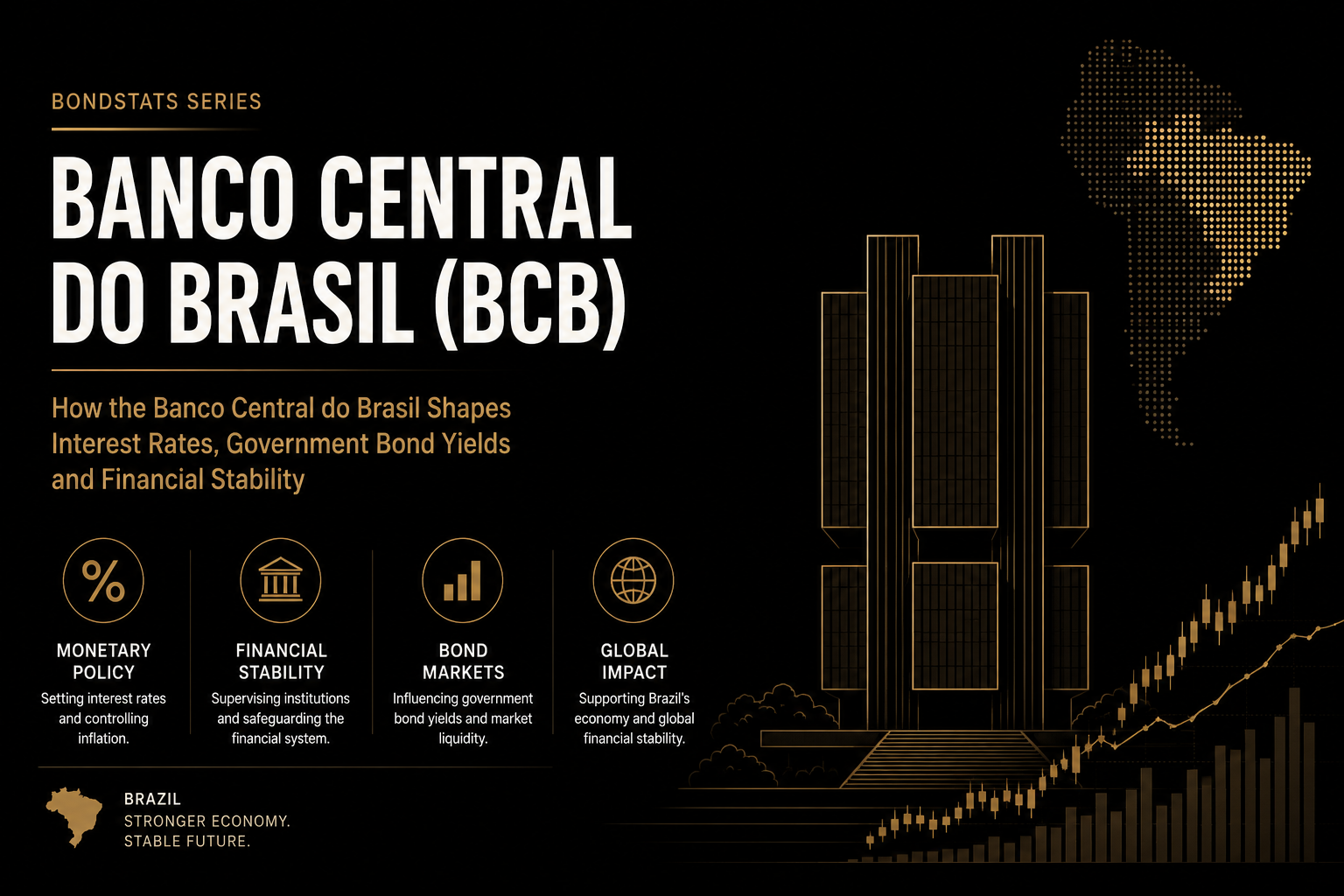
The Banco Central do Brasil (BCB) is the central bank of Brazil and one of the most influential monetary authorities in Latin America. As the institution responsible for maintaining price stability, regulating the financial system, and safeguarding the Brazilian real, the BCB plays a crucial role in shaping interest rates, government bond yields, and financial stability across South America’s largest economy.
Because Brazil has one of the world’s largest emerging-market bond markets, the Banco Central do Brasil is closely watched by investors around the globe.
The History of the BCB
The Banco Central do Brasil was established in 1964 to modernize Brazil’s monetary system and strengthen financial supervision and since its creation, the BCB has played a key role in reducing inflation, stabilizing the Brazilian currency, and developing one of the largest financial systems in the emerging world. Today, the bank is recognized for its transparent monetary policy and increasingly independent decision-making.
Main Responsibilities
The Banco Central do Brasil is responsible for:
Maintaining price stability.
Conducting monetary policy.
Issuing the Brazilian Real (BRL).
Supervising financial institutions.
Managing foreign exchange reserves.
Promoting financial stability.
Supporting efficient payment systems.
These responsibilities help strengthen confidence in Brazil’s financial markets and banking system.
Monetary Policy
The Banco Central do Brasil primarily conducts monetary policy using:
Selic Rate.
Open Market Operations.
Reserve Requirements.
Liquidity management.
Forward guidance.
Foreign exchange interventions.
Changes in the Selic Rate influence borrowing costs, inflation expectations, exchange rates, and Brazilian government bond yields.
The BCB and Bond Markets
Brazil operates one of the largest sovereign bond markets among emerging economies.
The Banco Central do Brasil influences bond markets through:
Interest rate decisions.
Liquidity operations.
Inflation management.
Government securities operations.
Market communication.
Its policy decisions are closely monitored by investors seeking exposure to emerging-market fixed-income assets.
Digital Innovation
The Banco Central do Brasil has become internationally recognized for modernizing Brazil’s financial infrastructure and its introduction of the Pix instant payment system has transformed domestic payments, while ongoing work on a Digital Real (Drex) reflects Brazil’s commitment to financial innovation.
These initiatives have positioned Brazil among the leading emerging economies in digital finance.
Why the BCB Matters
The Banco Central do Brasil’s decisions influence:
Brazilian government bond yields.
Inflation expectations.
The Brazilian Real (BRL).
Banking liquidity.
Latin American financial markets.
Emerging-market capital flows.
As Brazil continues to expand its role in global trade and finance, the BCB remains one of the most important central banks in the emerging world.
Key Facts
Founded: 1964
Headquarters: Brasília, Brazil
Currency: Brazilian Real (BRL)
Primary Objective: Price and financial stability
Key Tools: Selic Rate, Open Market Operations, Reserve Requirements
Global Importance: One of Latin America’s largest and most influential central banks
Conclusion
The Banco Central do Brasil plays a central role in maintaining economic stability within Latin America’s largest economy. Through its management of monetary policy, financial regulation, and payment system innovation, the BCB influences government bond markets, inflation, and investor confidence both domestically and internationally. As Brazil’s financial markets continue to develop, understanding the Banco Central do Brasil is increasingly important for anyone following emerging-market debt and global fixed-income investing.