
What Real Interest Rates Signal
Understanding how real interest rates influence borrowing, investment, inflation, bonds, and financial markets.
Introduction
Interest rates influence nearly every part of the economy but however, investors often focus on a more important measure:
Real interest rates
Real interest rates adjust nominal interest rates for inflation and help reveal the true cost of borrowing and the real return on investment.
Because they influence everything from bonds and currencies to gold and risk assets, real interest rates are among the most important signals in financial markets.
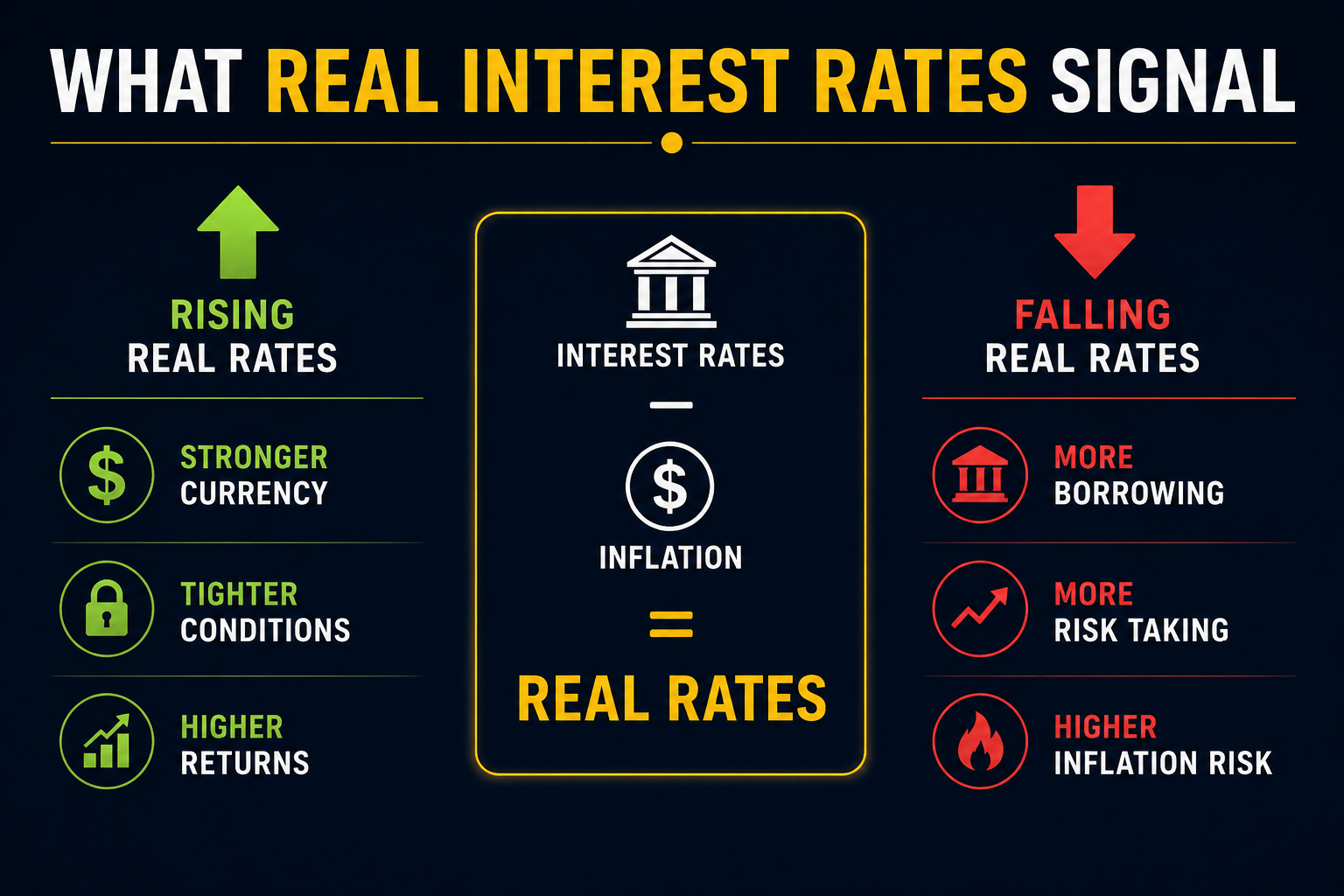
What Are Real Interest Rates?
Real interest rates are calculated by subtracting inflation from nominal interest rates.
Formula
Real Interest Rate = Nominal Interest Rate − Inflation Rate
Example:
Interest Rate = 5%
Inflation = 3%
Real Interest Rate = 2%
This represents the actual increase in purchasing power.
What Rising Real Interest Rates Signal
Higher real rates often signal tighter financial conditions.
More Attractive Fixed Income Returns
Investors can earn stronger inflation-adjusted returns.
Tighter Monetary Conditions
Borrowing becomes more expensive in real terms.
Lower Inflation Pressure
Higher real rates can slow demand.
Stronger Currency Support
Higher real yields may attract international capital.
Signals
📈 Tighter financial conditions
📈 Stronger currency support
📈 Higher real returns
📈 Reduced inflation pressure
What Falling Real Interest Rates Signal
Lower real rates often signal easier financial conditions.
Increased Borrowing
Credit becomes more attractive.
Greater Risk Appetite
Investors may seek higher-return assets.
Support for Economic Growth
Lower financing costs can stimulate activity.
Reduced Fixed Income Appeal
Inflation-adjusted returns may decline.
Signals
📉 Easier financial conditions
📉 Stronger risk appetite
📉 Increased borrowing
📉 Higher inflation risks
Why Investors Watch Real Rates
Real interest rates influence:
Government Bonds
Gold
Equities
Currencies
Capital Flows
They help investors understand whether financial conditions are becoming tighter or looser.
Real Rates and the Monetary System
Real interest rates sit at the intersection of:
Inflation
Interest Rates
Monetary Policy
Economic Growth
Because they combine both inflation and borrowing costs, they often provide a clearer picture of financial conditions than nominal rates alone.
Key Takeaway
Real interest rates signal the true cost of money after inflation while rising real rates often reflect tighter financial conditions and stronger purchasing-power returns.
Falling real rates often support borrowing, risk-taking, and economic activity.
Understanding real interest rates helps explain movements across bonds, currencies, commodities, and financial markets.