
Banco de México (Banxico)
How Banco de México Shapes Interest Rates, Government Bond Yields and Financial Stability
Introduction
Banco de México (Banxico) is the central bank of Mexico and the institution responsible for maintaining price stability and preserving the purchasing power of the Mexican Peso. Through its management of monetary policy, inflation, financial stability, and payment systems, Banxico plays a critical role in shaping government bond yields and one of Latin America’s largest economies.
As Mexico is a major manufacturing hub and one of the United States’ largest trading partners, Banxico’s policy decisions are closely monitored by global investors and fixed-income markets.
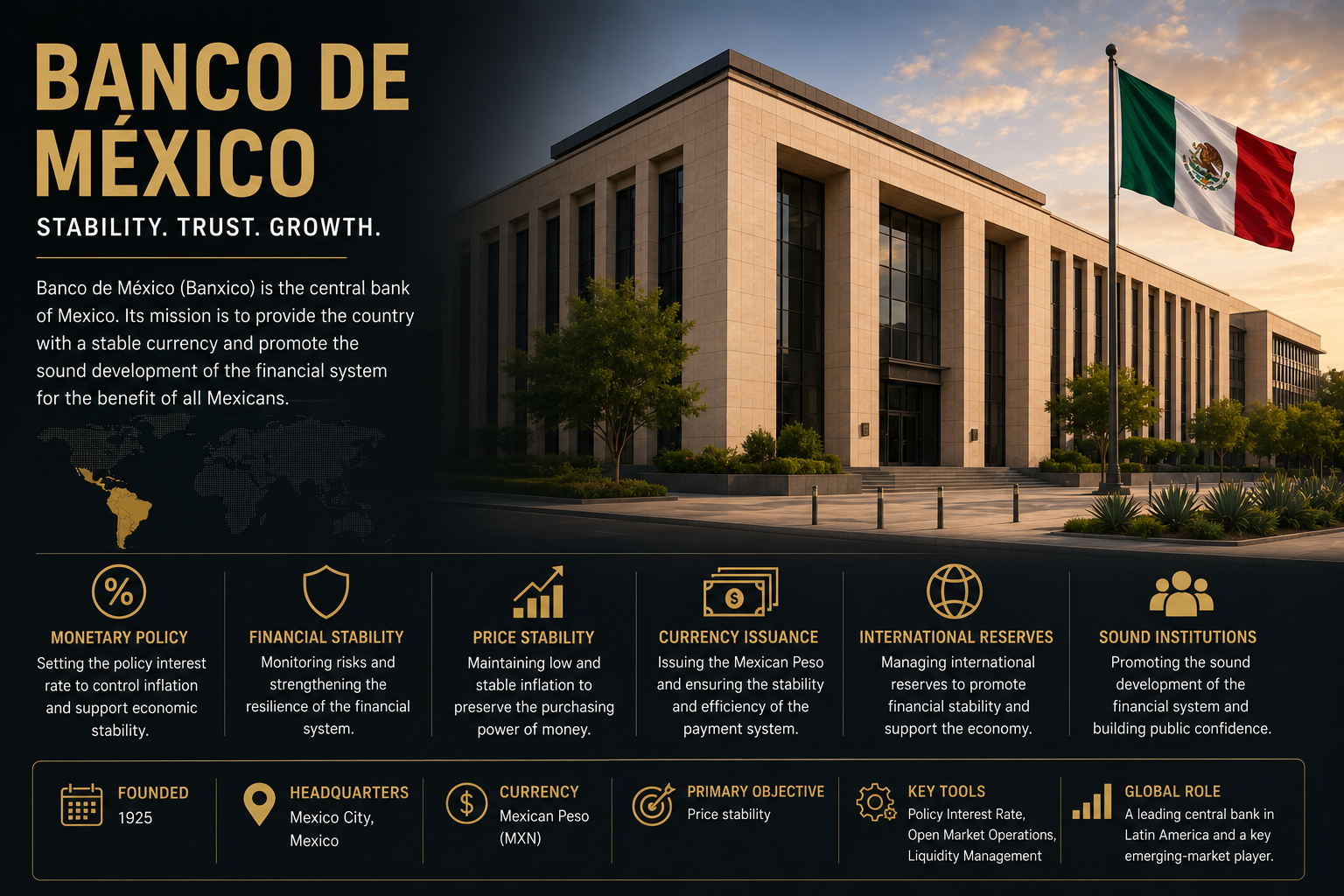
The History of Banco de México
Banco de México was established in 1925 to provide Mexico with a modern and independent central banking system but over the past century, the bank has guided the country through economic reforms, financial crises, periods of inflation, and increasing integration into global financial markets.
Today, Banxico is widely recognized for its commitment to inflation targeting, policy transparency, and financial stability.
Main Responsibilities
Banco de México is responsible for:
Maintaining price stability.
Conducting monetary policy.
Issuing the Mexican Peso (MXN).
Promoting financial stability.
Managing international reserves.
Supporting secure payment systems.
Encouraging the sound development of the financial system.
These responsibilities help strengthen confidence in Mexico’s economy and financial markets.
Monetary Policy
Banco de México conducts monetary policy using several key instruments, including:
Policy Interest Rate.
Open Market Operations.
Liquidity management.
Foreign exchange operations.
Reserve management.
Forward guidance.
Changes in the policy rate influence borrowing costs, inflation expectations, exchange rates, and Mexican government bond yields.
Banco de México and Bond Markets
Mexico has one of the largest and most liquid sovereign bond markets in Latin America.
Banco de México influences bond markets through:
Interest rate decisions.
Inflation management.
Liquidity operations.
Monetary policy communication.
Financial stability measures.
Its decisions are closely followed by both domestic and international fixed-income investors.
Mexico’s Financial System
Mexico’s financial sector plays a key role in regional and global markets.
Banco de México supports financial resilience by:
Monitoring systemic risks.
Maintaining payment system efficiency.
Managing international reserves.
Supporting banking sector stability.
Strengthening market confidence.
Its policies contribute to the long-term stability of one of Latin America’s largest economies.
Why Banco de México Matters
Banco de México’s decisions influence:
Mexican government bond yields.
Inflation expectations.
The Mexican Peso (MXN).
Latin American financial markets.
Banking liquidity.
International investor confidence.
As Mexico continues to expand its role in global manufacturing and trade, Banxico remains one of the most influential central banks in emerging markets.
Key Facts
Founded: 1925
Headquarters: Mexico City, Mexico
Currency: Mexican Peso (MXN)
Primary Objective: Price stability
Key Tools: Policy Interest Rate, Open Market Operations, Liquidity Management
Global Importance: One of Latin America’s leading central banks and a key institution in emerging-market finance
Conclusion
Banco de México plays a fundamental role in preserving monetary stability within one of the world’s largest emerging economies. Through its influence on inflation, interest rates, government bond markets, and financial system resilience, Banxico remains a cornerstone of Latin American finance and an institution closely followed by investors seeking insight into sovereign debt and global fixed-income markets.