
Do Rising Interest Rates Always Hurt Bonds?
Understanding Why Higher Rates Don’t Tell the Whole Story
Introduction
One of the most common beliefs in financial markets is that rising interest rates are always bad for bonds. The relationship appears straightforward: when interest rates increase, existing bond prices generally decline. This inverse relationship is one of the first concepts investors learn. While this principle is correct, it tells only part of the story.
The impact of rising interest rates depends on several factors, including bond maturity, duration, reinvestment opportunities, inflation expectations, and the speed at which interest rates change. Looking only at price movements can create a misleading picture of how bonds actually perform over time.
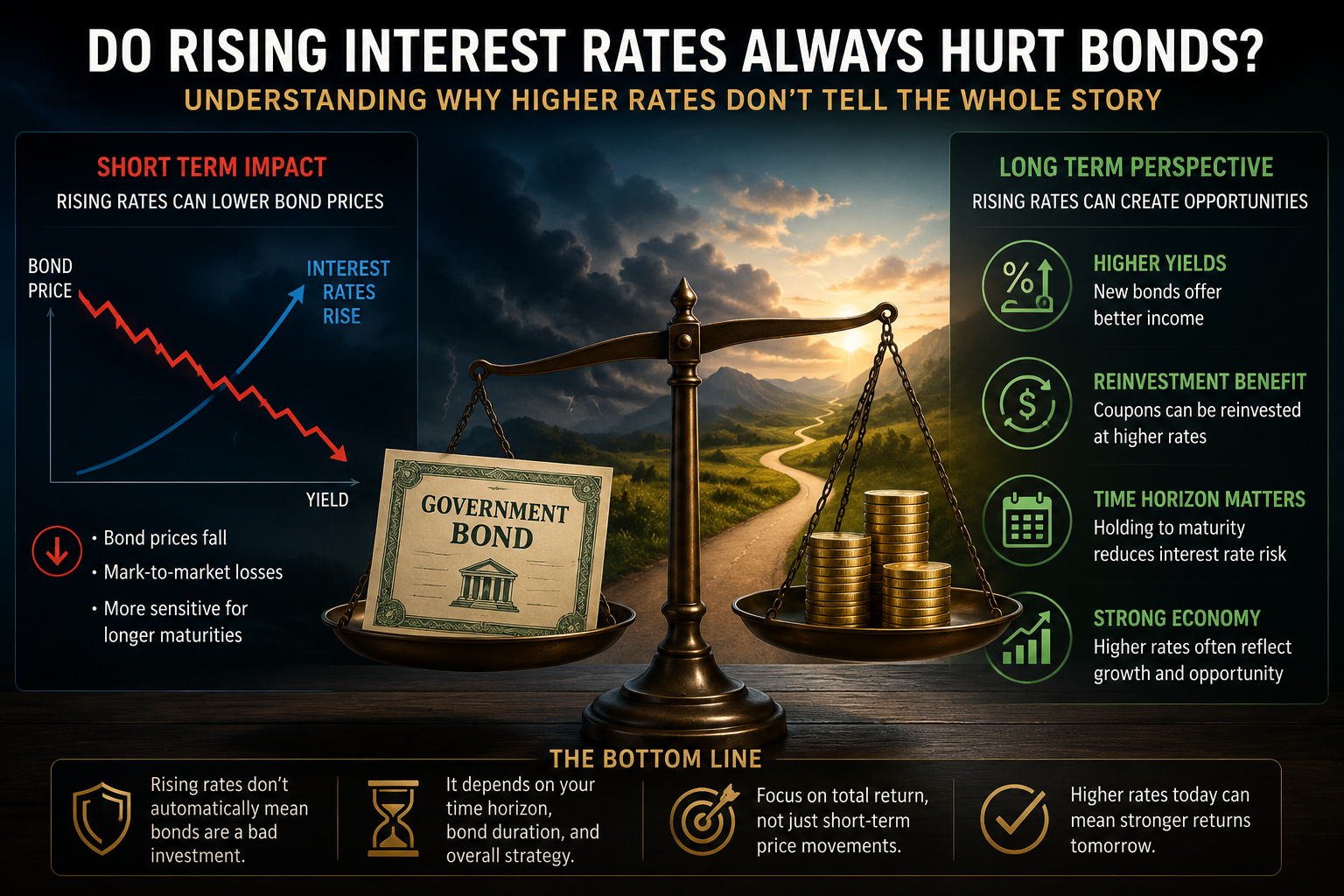
Why the Myth Exists
Bond prices move inversely to yields. When newly issued bonds offer higher interest rates, older bonds with lower coupons become less attractive, causing their market prices to decline. This relationship is fundamental to fixed income investing and explains why rising yields often coincide with falling bond prices.
However, focusing exclusively on short-term price movements ignores several important dynamics.
Time Changes Everything
Investors who hold bonds until maturity continue receiving their contractual coupon payments and, assuming no default, receive their principal back at maturity. Although market prices fluctuate, long-term investors may benefit from reinvesting coupon payments at higher interest rates. Over time, these higher reinvestment rates can partially or even fully offset the initial price decline.
For investors with long investment horizons, rising interest rates can eventually become beneficial rather than harmful.
Duration Matters
Not all bonds react equally to changing interest rates.
Long-term government bonds typically experience larger price movements because their cash flows extend further into the future and short-term bonds generally fluctuate much less, making them less sensitive to rising yields.
Duration—not simply maturity—is one of the most important measures of interest rate risk.
Why Rising Rates Can Be Positive
Higher interest rates often reflect stronger economic growth, rising inflation expectations, or a return to more normal monetary conditions. Although existing bond prices may initially fall, future investors gain access to higher yields, improving long-term income potential.
Pension funds, insurance companies, and long-term savers frequently benefit from environments where yields are sustainably higher.
The Myth
Rising interest rates usually reduce existing bond prices in the short term and they do not automatically make bonds poor investments. The long-term impact depends on investment horizon, duration, reinvestment opportunities, portfolio objectives, and broader economic conditions.
Understanding these differences provides a far more balanced perspective than the common assumption that higher rates are simply “bad for bonds.”
Key Takeaways
Rising interest rates generally lower existing bond prices.
Long-term investors may benefit from higher reinvestment yields.
Duration determines how sensitive a bond is to changing interest rates.
Higher yields improve future income opportunities.
Rising rates are not automatically negative—they depend on the investor’s objectives and time horizon.