
EURO STOXX 50
How the EURO STOXX 50 Tracks the Leading Blue-Chip Companies of the Eurozone
Introduction
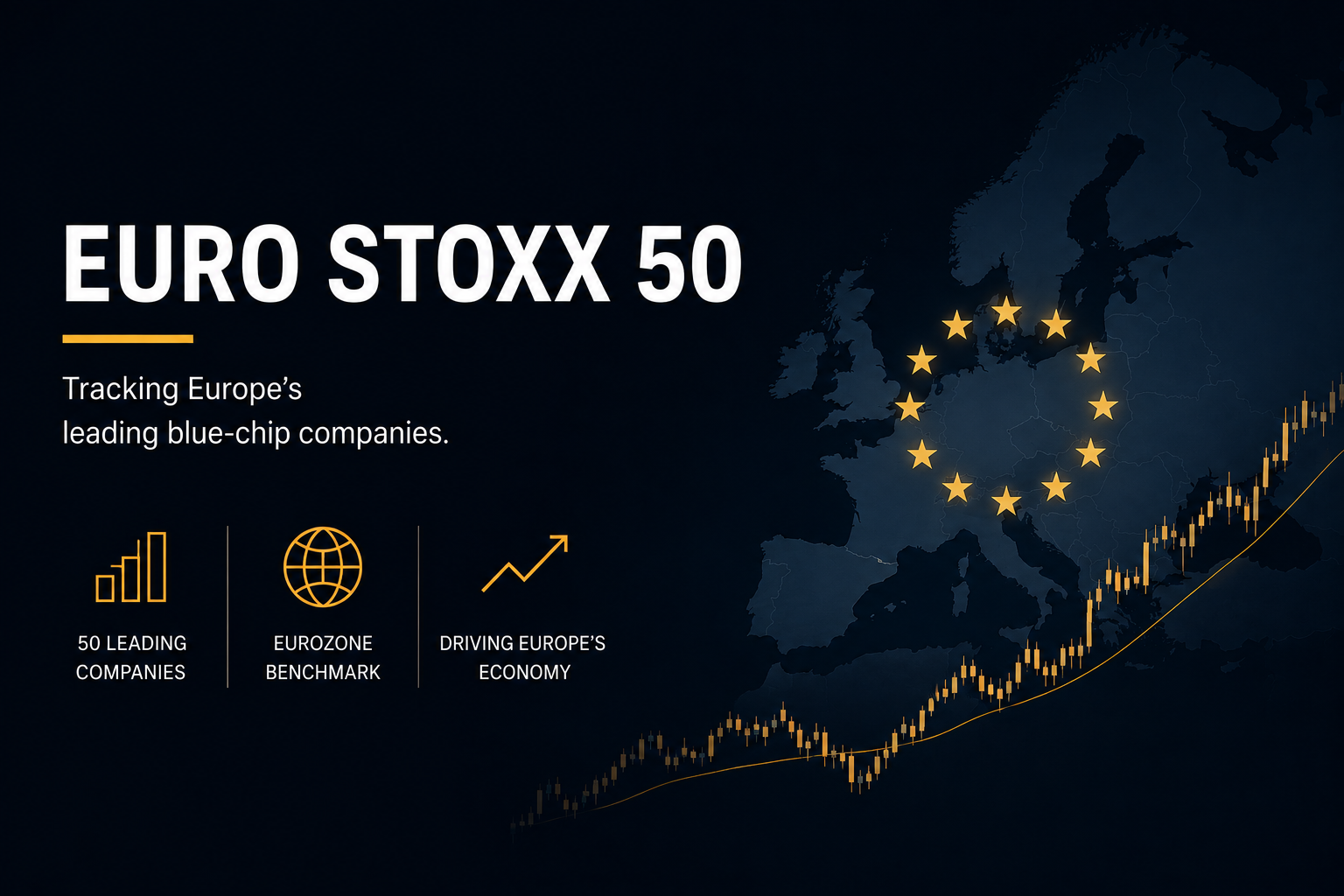
The EURO STOXX 50 is one of Europe’s most important stock market indices, measuring the performance of 50 leading blue-chip companies from countries that use the euro. It represents some of the largest and most influential corporations across multiple industries, making it the primary benchmark for the Eurozone equity market.
For investors seeking exposure to continental Europe, the EURO STOXX 50 provides a diversified snapshot of the region’s economic strength and corporate performance.
The History of the EURO STOXX 50
The EURO STOXX 50 was introduced in 1998 by STOXX Ltd. ahead of the launch of the euro and it was designed to create a unified benchmark for Europe’s largest publicly traded companies within the Eurozone and has since become one of the world’s most widely followed European equity indices.
Today, the index is widely used by institutional investors, ETF providers, and asset managers across the globe.
How the EURO STOXX 50 Works
The index tracks the 50 largest blue-chip companies from Eurozone member states based on free-float market capitalization.
Major countries represented include:
France
Germany
Netherlands
Spain
Italy
Belgium
Finland
The index spans multiple sectors, including financial services, industrials, healthcare, consumer goods, energy, and technology.
Why the EURO STOXX 50 Matters
The EURO STOXX 50 is widely used to:
Measure Eurozone equity performance.
Benchmark European investment portfolios.
Support ETFs and index funds.
Track corporate earnings.
Monitor investor sentiment.
Assess the strength of the Eurozone economy.
It is considered the leading benchmark for large-cap Eurozone equities.
The EURO STOXX 50 and Global Markets
Movements in the EURO STOXX 50 often reflect:
European economic growth.
Corporate earnings.
European Central Bank policy.
Global trade.
Investor confidence.
International capital flows.
Because many constituent companies operate globally, the index is closely connected to international economic developments.
Advantages of the EURO STOXX 50
The index offers several advantages:
Broad exposure to Eurozone blue-chip companies.
High liquidity.
Free-float market-cap weighting.
Strong sector diversification.
International recognition.
Long performance history.
These characteristics have made it one of Europe’s most important investment benchmarks.
Key Facts
Launched: 1998
Companies: 50
Weighting Method: Free-Float Market Capitalization
Coverage: Leading Eurozone Blue-Chip Companies
Known For: Benchmark of the Eurozone Equity Market
Global Importance: One of Europe’s most widely followed stock market indices
Conclusion
The EURO STOXX 50 provides investors with direct exposure to the largest and most influential companies across the Eurozone. By representing multiple industries and economies within the single-currency area, the index serves as a key benchmark for European equity investing and offers valuable insight into the performance of one of the world’s largest economic regions.