
Do Bond Investors Benefit When Interest Rates Rise?
Why Higher Rates Can Create Both Opportunities and Losses in Fixed Income Markets
Introduction
It is often assumed that rising interest rates are good news for bond investors. After all, higher rates mean newly issued bonds offer more attractive yields, increasing future income for investors entering the market.
While this statement contains some truth, it overlooks an important distinction. Existing bonds and newly issued bonds respond very differently to rising interest rates. For investors who already hold bonds, higher rates typically reduce the market value of their portfolios. For those investing fresh capital, however, rising yields may improve future return potential.
Whether higher interest rates are beneficial therefore depends on an investor’s objectives, investment horizon, and portfolio structure rather than on interest rates alone.
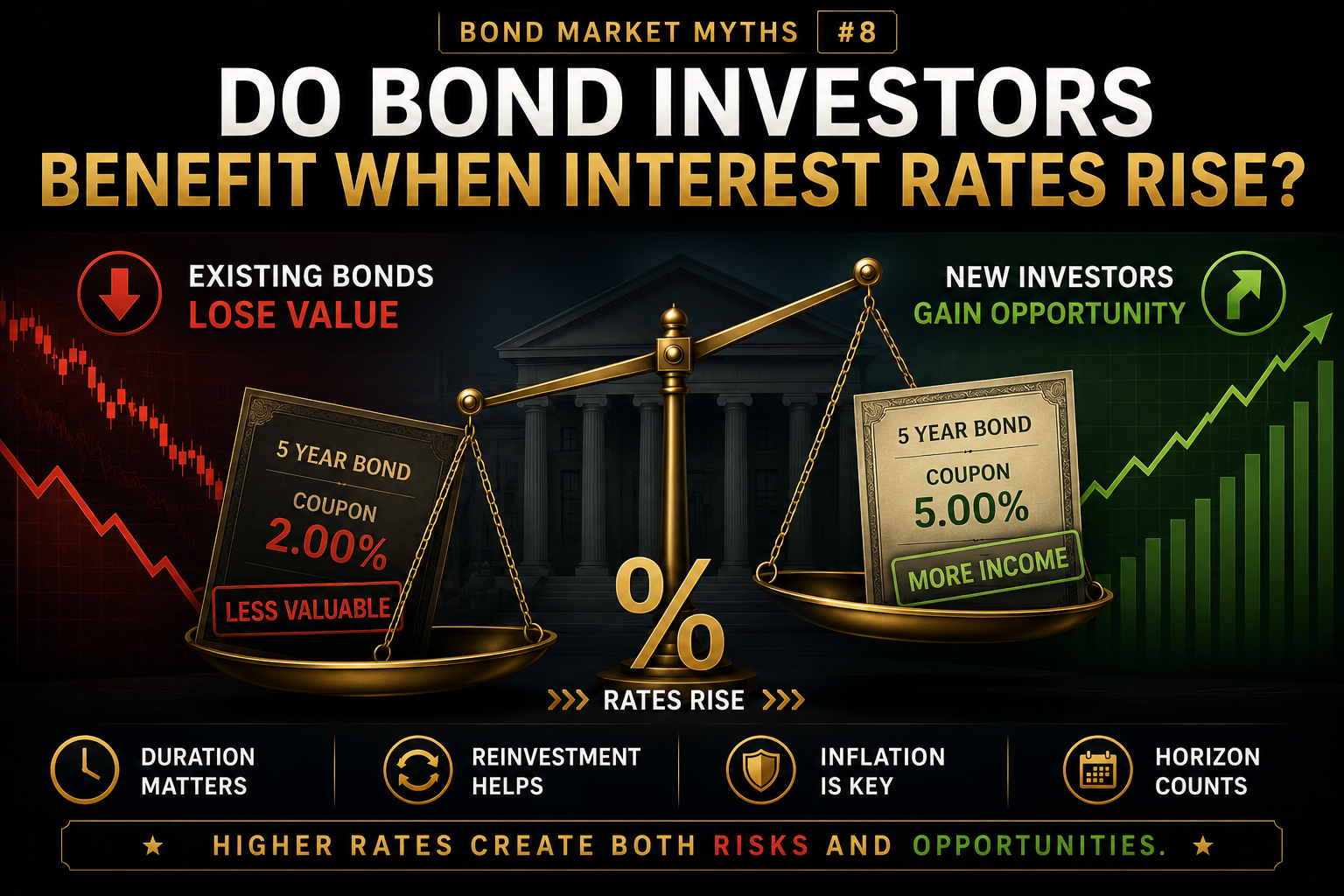
Existing Bonds Lose Value
Bond prices and interest rates move in opposite directions and when newly issued government bonds begin offering higher yields, existing bonds with lower coupons become less attractive. Their market prices decline until their effective yields align with prevailing interest rates.
This price adjustment is one of the fundamental principles of fixed income investing. The longer a bond’s maturity, the more sensitive it generally becomes to changes in interest rates.
New Investors Face Different Conditions
Investors purchasing bonds after yields have risen often benefit from stronger future income and higher coupon payments increase expected cash flow, while reinvested interest payments also generate greater returns over time.
For long-term investors building positions gradually, periods of rising yields may create attractive entry opportunities despite short-term market volatility.
Duration Matters
Not every bond reacts equally to interest rate movements and short-term government bonds generally experience relatively small price changes because they mature quickly. Long-term bonds, by contrast, can decline substantially when interest rates rise due to their greater duration.
Understanding duration is often more important than simply predicting the direction of interest rates.
Reinvestment Can Offset Early Losses
Investors who hold high-quality bonds until maturity often recover temporary price declines through higher reinvestment rates over time. As coupons are reinvested into newly issued securities offering higher yields, long-term portfolio income gradually increases.
For patient investors, this process can partially or completely offset the initial impact of rising rates.
Inflation Changes the Picture
Higher interest rates are frequently introduced to combat rising inflation and if inflation remains elevated despite higher nominal yields, investors may continue experiencing weak real returns.
What ultimately matters is not only the level of interest rates, but also whether they exceed inflation over the investment horizon.
Bond Funds Behave Differently
Individual bonds and bond funds do not always produce identical outcomes but a bond held until maturity has a defined repayment date, assuming the issuer does not default. Bond funds continuously buy and sell securities, maintaining a relatively constant duration. Their market value therefore remains exposed to ongoing interest rate movements.
Understanding this distinction is essential when evaluating fixed-income investments.
The Myth Explained
The belief that rising interest rates are always good for bond investors oversimplifies how fixed income markets function. Higher rates generally reduce the value of existing bonds while simultaneously increasing expected returns for future investments. Whether rising yields prove beneficial depends on investment timing, duration, reinvestment opportunities, inflation, and an investor’s time horizon.
There is no universal winner or loser when interest rates rise.
Conclusion
Higher interest rates create both risks and opportunities within bond markets. Existing portfolios may experience temporary losses, while new investments often benefit from improved long-term income potential.
Rather than viewing rising rates as either entirely positive or entirely negative, investors should recognize that the impact depends on portfolio structure, investment horizon, and the ability to reinvest at higher yields. Understanding these dynamics is one of the most important foundations of successful fixed-income investing.