
How Singapore’s Exchange Rate Policy Works
How Singapore manages the value of its currency through a trade-weighted exchange-rate framework designed for a highly open economy.
Introduction
Singapore’s monetary policy system is unusual. While many central banks focus primarily on short-term interest rates, the Monetary Authority of Singapore places the exchange rate at the centre of monetary policy.
The reason is closely connected to Singapore’s economic structure. The country is deeply integrated into global trade, imports many essential goods and is highly exposed to international prices.
As a result, changes in the value of the Singapore dollar can have an important influence on inflation.
For Singapore, the exchange rate is not just a market price. It is the central instrument of monetary policy.
Why the Exchange Rate Matters So Much
Singapore is a small and highly open economy. Food, energy, raw materials, machinery and many intermediate goods come from abroad. When global prices rise, imported inflation can quickly affect households and businesses. The exchange rate can either amplify or reduce part of this pressure.
If the Singapore dollar strengthens, foreign goods generally become cheaper in Singapore-dollar terms than they otherwise would have been. If the currency weakens, imported goods may become more expensive.
This gives the exchange rate a powerful role in the inflation process.
Singapore Does Not Simply Target SGD/USD
A common misunderstanding is that MAS manages the Singapore dollar primarily against the US dollar but it does not.
Singapore trades with many economies across Asia, Europe and the rest of the world. A single bilateral exchange rate therefore provides an incomplete picture.
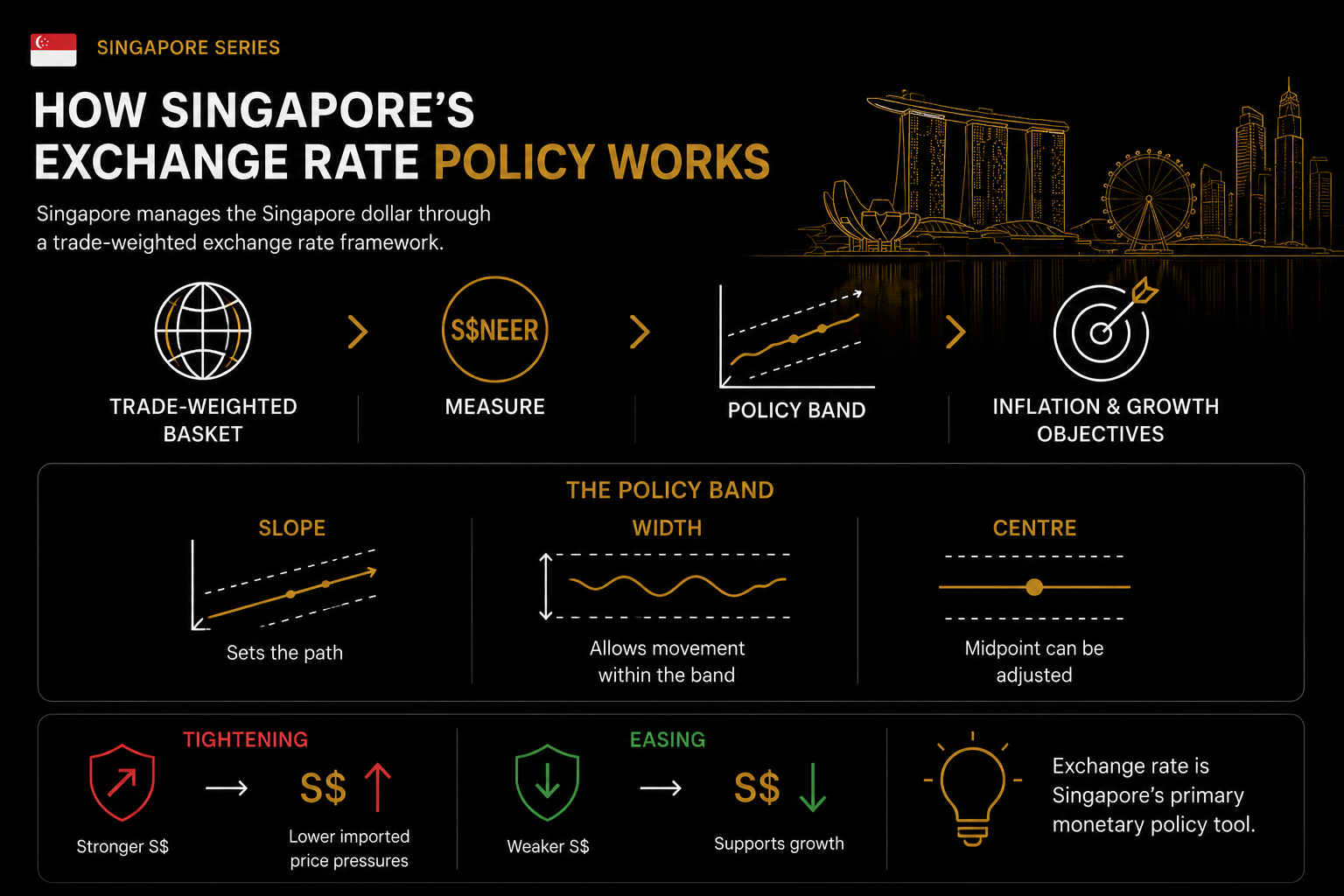
Instead, MAS manages the Singapore dollar against a trade-weighted basket of currencies. This framework is commonly associated with the:
Singapore Dollar Nominal Effective Exchange Rate — S$NEER
The basket reflects Singapore’s broader trade relationships and competitive environment. Its exact composition and weights are not publicly disclosed.
What Is the S$NEER?
The S$NEER measures the value of the Singapore dollar relative to a basket of currencies rather than against one currency alone. This matters because exchange rates can move in different directions at the same time. The Singapore dollar might strengthen against one currency while weakening against another.
A trade-weighted measure provides a broader view of the currency’s external value.
For a globally connected economy, this is more relevant than focusing exclusively on SGD/USD.
The Policy Band
MAS does not normally hold the S$NEER at one exact level. Instead, it allows the effective exchange rate to move within a policy band.
The framework is often explained through three main features:
Slope
The slope influences the intended path of the band over time. A positive appreciation path can support a gradual strengthening of the effective exchange rate, helping to contain imported inflation.
Width
The width determines how much the S$NEER can fluctuate around the broader policy path and a wider band allows more flexibility. A narrower band permits less movement.
Centre
The centre represents the midpoint of the policy band and MAS can re-centre the band when a more significant adjustment in monetary conditions is considered necessary.
Together, these elements give policymakers several ways to adjust monetary policy without using a conventional policy interest rate.
How Monetary Tightening Works
Suppose inflation pressures become stronger and imported costs rise. MAS may tighten policy by adjusting the exchange-rate framework in a direction consistent with a stronger Singapore dollar on a trade-weighted basis.
A stronger currency can reduce the Singapore-dollar cost of imports relative to what it otherwise would have been.
The transmission mechanism therefore looks different from a conventional rate hike:
Traditional system:
Higher policy rate → tighter credit conditions → weaker demand → lower inflation pressure
Singapore system:
Stronger exchange-rate path → lower imported price pressure → reduced inflation pressure
Both systems can pursue price stability, but through different channels.
How Monetary Easing Works
When economic growth weakens and inflation pressure declines, MAS can move toward a more accommodative stance. This may involve adjusting the slope, width or centre of the policy band depending on economic conditions.
The objective is not simply to weaken the currency. It is to calibrate the exchange-rate framework to the outlook for inflation and economic activity.
This distinction is important because Singapore operates a managed monetary system rather than a mechanical currency rule.
Why the Basket Is Secret
MAS does not publicly disclose the exact currencies and weights used in the basket. There are practical reasons for this. Full disclosure could make it easier for market participants to anticipate or exploit the mechanics of the framework.
Instead, policymakers communicate the broader monetary stance while retaining operational flexibility.
This creates a system that is transparent in its general objective but deliberately less transparent in some technical details.
What Moves the Singapore Dollar?
Even within the policy framework, the Singapore dollar remains influenced by global markets.
Important forces include:
international interest rates,
US monetary policy,
global risk sentiment,
capital flows,
regional economic conditions,
inflation expectations,
Singapore’s growth outlook.
MAS therefore operates within a complex global environment. It can shape the monetary framework, but it does not control every market movement.
Why Investors Should Understand the System
For investors, focusing only on interest-rate announcements can create an incomplete picture of Singapore.
Changes in the MAS policy stance may influence:
Singapore dollar expectations,
inflation forecasts,
bond yields,
funding conditions,
asset valuations,
cross-border capital flows.
This is especially important for fixed-income investors because domestic yields remain connected to global financial conditions even though the exchange rate is the primary monetary policy instrument.
Strengths of the Framework
Singapore’s system is closely aligned with the structure of its economy. The exchange rate directly affects imported prices, while a trade-weighted basket reflects the country’s diverse international relationships. The policy band also provides flexibility rather than forcing the currency to remain at one fixed level.
The framework demonstrates an important principle:
Monetary policy works best when its instruments reflect the economy’s actual transmission channels.
Risks and Limitations
The exchange rate cannot solve every economic problem. A stronger Singapore dollar may reduce imported inflation but cannot directly eliminate domestic wage pressure, housing shortages or services inflation. Currency appreciation can also create challenges for exporters and internationally exposed businesses.
Singapore remains vulnerable to global shocks, including recessions, geopolitical tensions and sudden changes in capital flows.
The exchange-rate framework is therefore powerful, but it is not a complete shield against external risk.
Key Takeaways
Singapore manages monetary policy through the exchange rate because its economy is exceptionally open to trade and imported inflation.
MAS focuses on the S$NEER, which measures the Singapore dollar against a trade-weighted basket of currencies. The effective exchange rate is allowed to move within a policy band shaped by its slope, width and centre.
This framework gives Singapore a monetary system designed specifically for its own economic structure rather than copied from larger economies.