
What Credit Spreads Signal
Understanding how the gap between risky and safe borrowing costs reveals confidence, risk, and financial conditions across the economy.
Introduction
Credit spreads are one of the most closely watched indicators in financial markets and they measure the difference between the yield on riskier debt and the yield on safer government bonds. While the concept appears simple, credit spreads provide valuable insight into investor confidence, economic expectations, and financial stability.
When investors become more concerned about risk, credit spreads tend to widen. When confidence improves, spreads often narrow.
Understanding credit spreads helps explain how markets assess risk and why borrowing conditions change throughout the economic cycle.
What Are Credit Spreads?
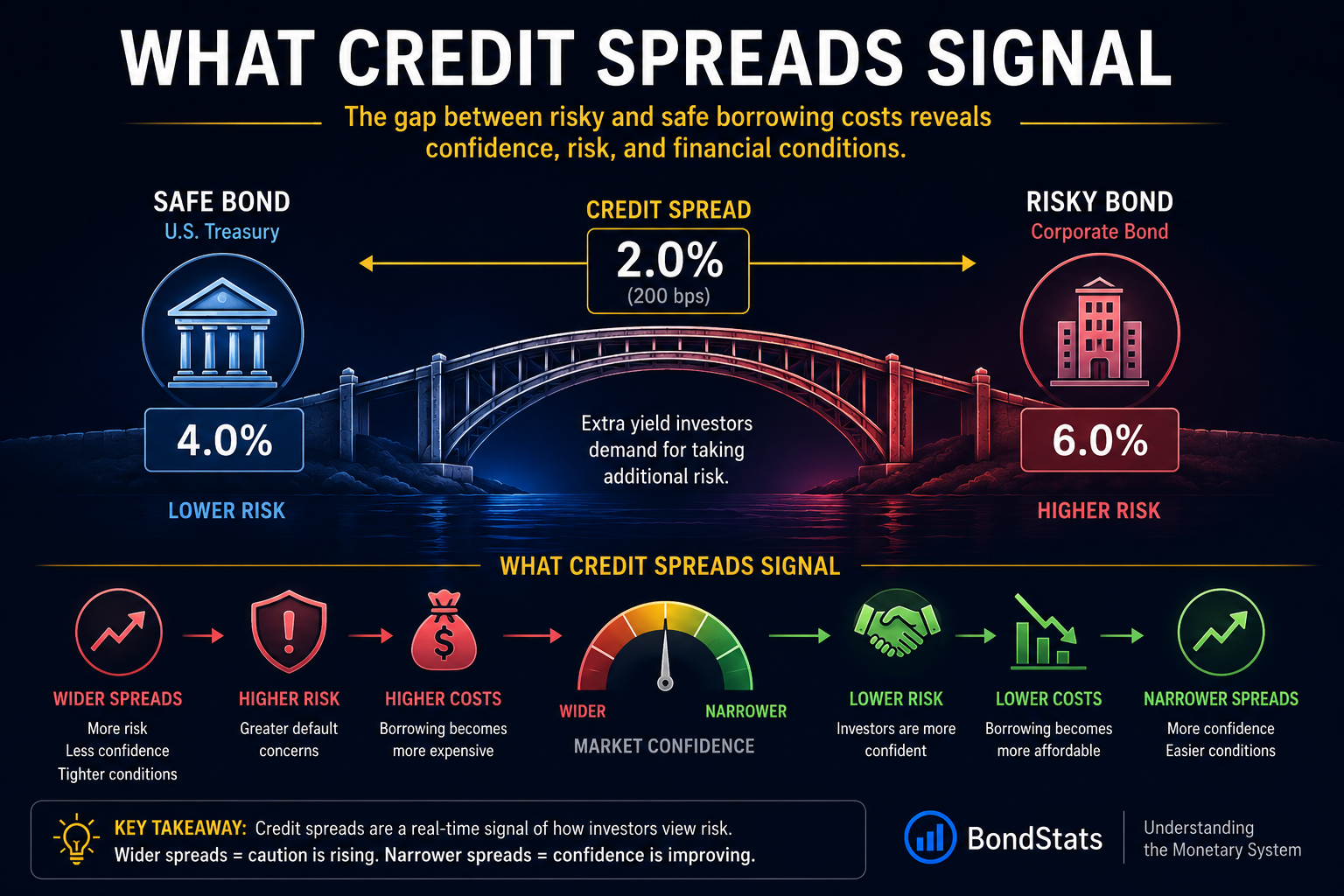
A credit spread is the difference in yield between two bonds with similar maturities but different levels of risk.
For example:
U.S. Treasury Bond: 4.0%
Corporate Bond: 6.0%
Credit Spread = 2.0 percentage points
The additional yield compensates investors for taking on greater risk and the riskier the borrower, the larger the spread investors usually demand.
Why Do Credit Spreads Matter?
Credit spreads reflect how investors view risk.
They help answer important questions:
How confident are investors?
How much risk are markets willing to accept?
How easy is it for companies to borrow?
Are financial conditions tightening or loosening?
Because credit spreads react quickly to changing conditions, they often provide early warning signals about the economy and financial markets.
What Causes Credit Spreads to Widen?
Rising Economic Uncertainty
Investors become more cautious when growth slows or uncertainty increases.
Higher Default Risk
If investors fear that borrowers may struggle to repay debt, they demand higher yields.
Financial Stress
Periods of market stress often trigger sharp increases in credit spreads.
Reduced Liquidity
When market liquidity declines, investors require additional compensation for holding riskier assets.
What Causes Credit Spreads to Narrow?
Strong Economic Growth
Improving business conditions increase confidence.
Lower Perceived Risk
Investors become more comfortable holding corporate and lower-rated debt.
Greater Market Liquidity
Abundant liquidity often encourages risk-taking.
Stable Financial Conditions
Periods of calm typically support tighter spreads.
What Credit Spreads Signal
Wider Spreads Signal
Rising risk aversion
Tightening financial conditions
Increasing economic uncertainty
Higher borrowing costs
Growing concern about defaults
Narrower Spreads Signal
Stronger investor confidence
Easier access to credit
Lower perceived risk
Supportive financial conditions
Greater willingness to take risk
Credit Spreads and the Monetary System
Credit spreads connect financial markets with the broader economy.
When spreads widen:
Borrowing becomes more expensive
Investment may slow
Economic activity can weaken
Financial stress often increases
When spreads narrow:
Credit becomes more accessible
Investment tends to increase
Financial conditions improve
Economic growth may strengthen
For this reason, central banks, investors, and policymakers closely monitor credit spreads.
Key Takeaway
Credit spreads signal how markets perceive risk and by measuring the difference between risky and safe borrowing costs, spreads provide insight into investor confidence, financial conditions, and economic expectations.
When spreads widen, caution is increasing and when spreads narrow, confidence is improving.
Understanding credit spreads helps reveal the financial pressures shaping markets and the broader economy.