
AQR Capital Management: How Quantitative Investing Changed Modern Asset Management
Inside the Data-Driven Hedge Fund That Combined Academic Research with Global Markets
Introduction
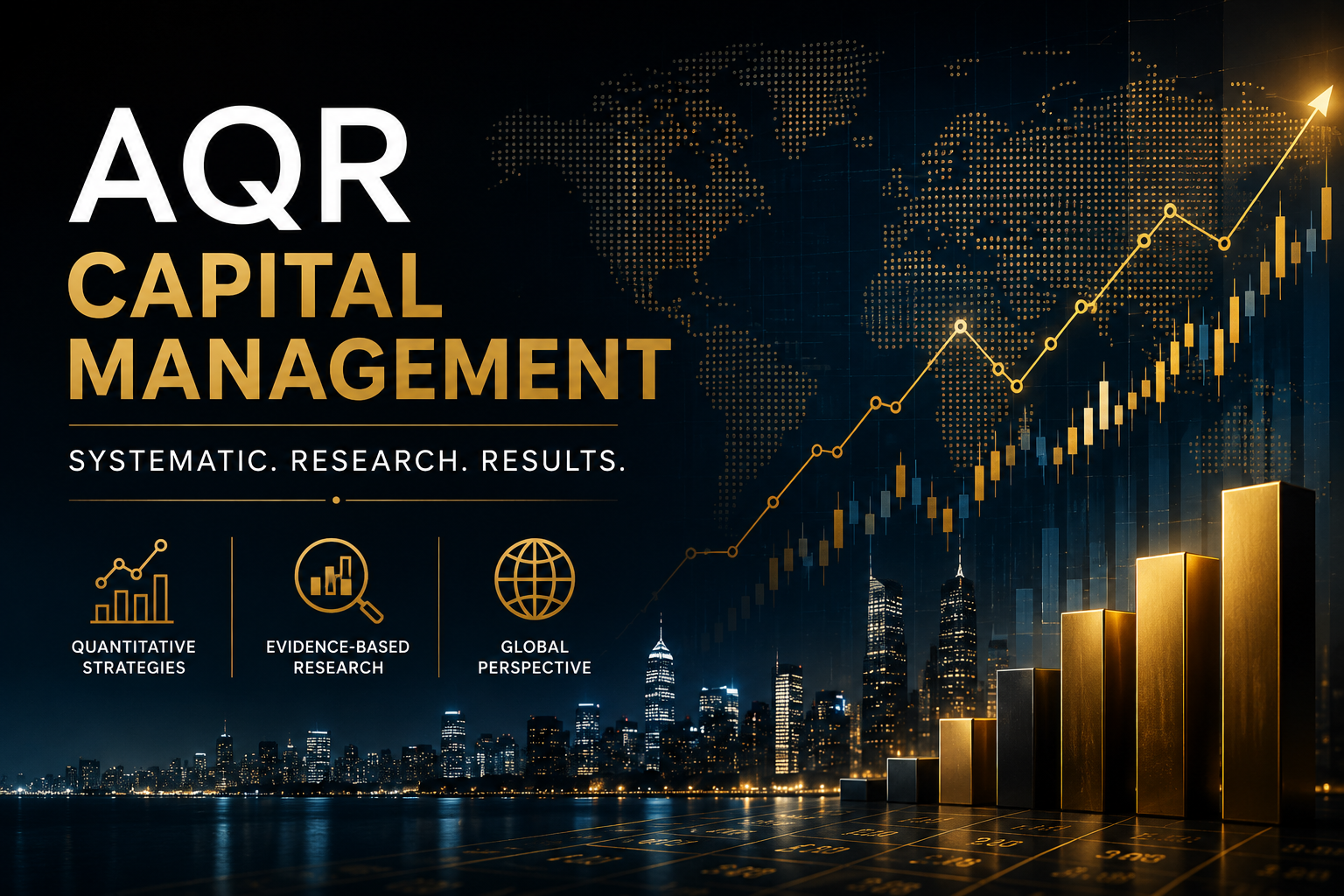
AQR Capital Management has become one of the world’s most respected quantitative investment firms by combining rigorous academic research with systematic portfolio management. Founded in 1998 by Cliff Asness and several colleagues from Goldman Sachs, the firm pioneered the use of factor investing, quantitative models, and empirical financial research on an institutional scale.
Unlike discretionary hedge funds that rely heavily on human judgment, AQR develops investment strategies using decades of historical market data, statistical analysis, and economic theory. Today, the firm manages assets across equities, fixed income, commodities, currencies, and alternative investment strategies for institutions around the world.
From Academic Research to Global Markets
The origins of AQR can be traced to research conducted at the University of Chicago, where modern financial theory significantly influenced the firm’s investment philosophy. Rather than attempting to predict short-term market movements, AQR focuses on identifying long-term patterns that have historically generated excess returns across different asset classes.
Its systematic approach bridges the gap between academic finance and real-world portfolio management.
Quantitative Investing
AQR is best known for its quantitative investment process and instead of relying primarily on subjective opinions, the firm builds mathematical models that evaluate thousands of securities simultaneously. These models analyze valuation, momentum, quality, profitability, volatility, and other measurable characteristics before constructing diversified portfolios.
The goal is consistency, discipline, and the removal of emotional decision-making from the investment process.
Factor Investing
One of AQR’s greatest contributions has been the popularization of factor investing.
Rather than selecting investments individually, portfolios are designed to capture long-term return drivers such as:
Value
Momentum
Quality
Low Risk
Carry
These factors have been extensively studied within financial research and continue to influence institutional portfolio construction worldwide.
Why Bond Markets Matter
Government bond markets play a central role within AQR’s investment framework and interest rates influence discount rates, expected returns, inflation expectations, credit spreads, and portfolio diversification. Many quantitative models incorporate sovereign bond yields when evaluating macroeconomic conditions and cross-asset opportunities.
Because bond markets often react quickly to changes in monetary policy, they provide valuable information that extends far beyond fixed-income investing.
Technology and Data
AQR’s competitive advantage lies in its ability to process enormous quantities of financial data but advanced computing, statistical modeling, and continuous research allow the firm to evaluate global markets objectively rather than emotionally.
As financial markets generate increasingly large datasets, technology has become an essential component of institutional investment management.
Risk Management
Quantitative investing does not eliminate risk and instead, AQR seeks to understand, measure, and diversify risk across multiple factors, asset classes, and geographic regions. The firm continuously evaluates portfolio exposures while adapting models as market conditions evolve.
This disciplined framework helps reduce dependence on any single investment theme.
Influence on Global Investing
AQR has played a significant role in expanding the acceptance of quantitative investing among pension funds, sovereign wealth funds, endowments, and institutional asset managers. Many concepts that were once considered purely academic—such as factor investing and systematic portfolio construction—are now widely used throughout the financial industry.
The firm’s research continues to influence investment professionals around the world.
What This Means for Bond Markets
For BondStats readers, AQR demonstrates that bond markets are far more than a source of income. Government yields influence valuation models, portfolio allocation, inflation expectations, and risk management across virtually every asset class. Quantitative investors therefore treat sovereign bond markets as one of the most important sources of macroeconomic information available.
Conclusion
AQR Capital Management transformed institutional investing by combining academic research with sophisticated quantitative models and disciplined risk management. Its systematic approach illustrates how data, statistical analysis, and economic theory can be integrated into modern portfolio construction.
The firm’s success also reinforces a central principle of BondStats: understanding government bond markets is essential for interpreting the broader financial system. Interest rates, inflation, and sovereign yields continue to shape investment decisions across global markets, making fixed income one of the foundations of modern asset management.