
Norges Bank
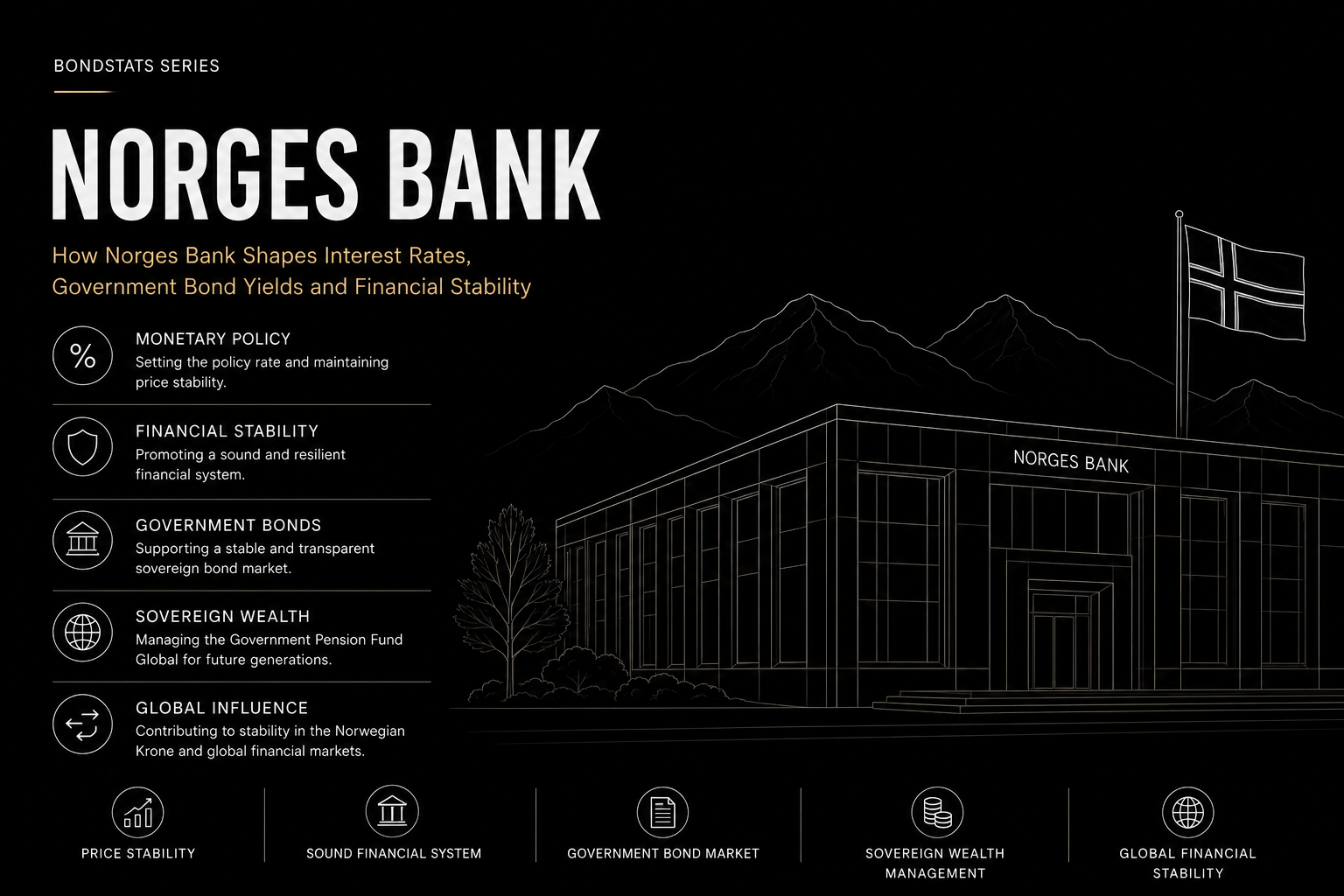
How Norges Bank Shapes Interest Rates, Government Bond Yields and Financial Stability
Introduction
Norges Bank is the central bank of Norway and one of the world’s most respected monetary authorities. Responsible for maintaining price stability, supporting financial stability, and managing key aspects of Norway’s monetary system, Norges Bank plays a crucial role in shaping interest rates, government bond yields, and one of the world’s strongest advanced economies.
Supported by Norway’s significant energy resources and prudent fiscal management, Norges Bank is closely watched by investors seeking insight into sovereign wealth, inflation, and global fixed-income markets.
The History of Norges Bank
Norges Bank was founded in 1816, making it one of Europe’s oldest central banks and for more than two centuries, the bank has overseen Norway’s monetary system through periods of industrialization, economic modernization, and the development of one of the world’s largest sovereign wealth funds.
Today, Norges Bank is recognized for its transparency, independence, and disciplined monetary policy.
Main Responsibilities
Norges Bank is responsible for:
Maintaining price stability.
Conducting monetary policy.
Issuing the Norwegian Krone (NOK).
Promoting financial stability.
Managing foreign exchange reserves.
Overseeing payment systems.
Managing Norway’s Government Pension Fund Global through Norges Bank Investment Management (NBIM).
These responsibilities help preserve confidence in Norway’s financial system and long-term economic stability.
Monetary Policy
Norges Bank conducts monetary policy using several key instruments, including:
Policy Rate.
Open Market Operations.
Liquidity facilities.
Foreign exchange market operations.
Forward guidance.
Changes in the policy rate influence borrowing costs, inflation expectations, exchange rates, mortgage markets, and Norwegian government bond yields.
Norges Bank and Bond Markets
Although Norway’s sovereign bond market is relatively small compared with larger economies, it remains highly respected due to the country’s strong public finances and high credit quality.
Norges Bank influences bond markets through:
Interest rate decisions.
Liquidity management.
Financial stability measures.
Market communication.
Monetary policy implementation.
Its decisions are closely monitored by investors across the Nordic region and international fixed-income markets.
Norway’s Sovereign Wealth Fund
One of Norges Bank’s most distinctive responsibilities is managing the Government Pension Fund Global (GPFG)through Norges Bank Investment Management (NBIM). Funded primarily by petroleum revenues, it is one of the world’s largest sovereign wealth funds and invests globally across equities, fixed income, and real estate. Its scale gives Norway a unique position within international financial markets.
Why Norges Bank Matters
Norges Bank’s decisions influence:
Norwegian government bond yields.
Inflation expectations.
The Norwegian Krone (NOK).
Nordic financial markets.
Sovereign wealth management.
Global capital markets.
Its combination of conservative monetary policy and stewardship of one of the world’s largest sovereign wealth funds makes Norges Bank uniquely influential.
Key Facts
Founded: 1816
Headquarters: Oslo, Norway
Currency: Norwegian Krone (NOK)
Primary Objective: Price and financial stability
Key Tools: Policy Rate, Open Market Operations, Liquidity Facilities
Global Importance: Central bank of Norway and manager of one of the world’s largest sovereign wealth funds
Conclusion
Norges Bank combines more than two centuries of central banking experience with responsibility for one of the world’s largest sovereign wealth funds. Through its management of monetary policy, financial stability, and long-term national wealth, it plays a distinctive role within global finance. Understanding Norges Bank provides valuable insight into sovereign debt markets, central banking, and the relationship between natural resource wealth and long-term economic stability.