
What Liquidity Signals
Understanding how liquidity influences markets, credit, asset prices, and the flow of money throughout the financial system.
Introduction
Liquidity is one of the most important forces in financial markets it affects how easily money can move, how readily assets can be bought and sold, and how smoothly the financial system functions. When liquidity is abundant, borrowing becomes easier, investment activity often increases, and financial conditions tend to support growth.
When liquidity becomes scarce, financial stress can emerge quickly and understanding liquidity helps explain many of the movements that occur across bonds, stocks, currencies, and the broader economy.
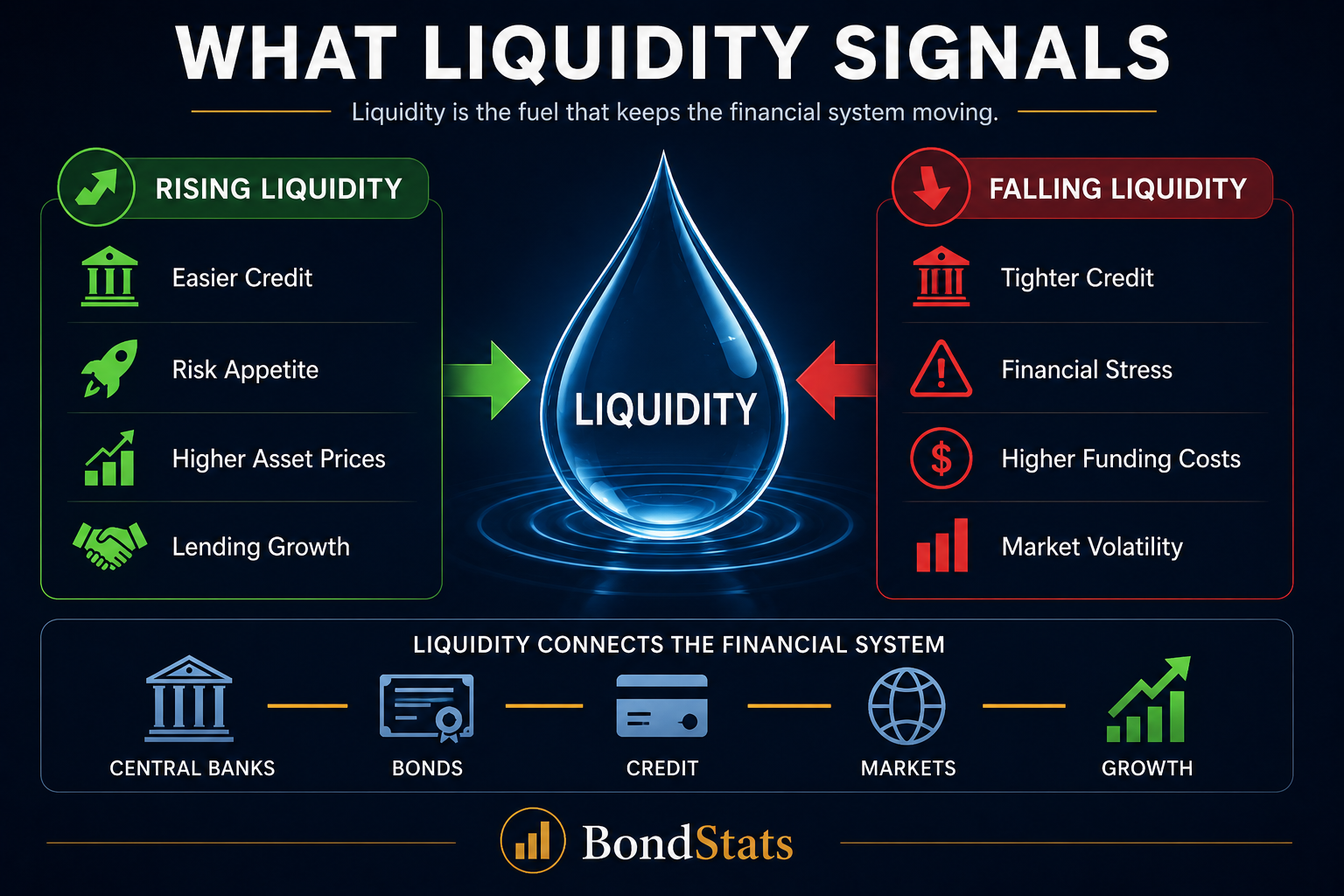
What Is Liquidity?
Liquidity refers to the availability of money and credit within the financial system.
A liquid system allows:
Easy borrowing
Active lending
Efficient trading
Stable financial conditions
Liquidity acts as the fuel that keeps the financial system moving.
What Rising Liquidity Signals
When liquidity increases, financial conditions often become more supportive.
Easier Credit Conditions
Banks and lenders are generally more willing to provide financing.
Increased Investment Activity
Investors often take on more risk when liquidity is plentiful.
Stronger Asset Prices
Additional liquidity can support demand for financial assets.
Improved Market Functioning
Trading conditions tend to become smoother and more efficient.
Signals
📈 Easier credit
📈 Stronger risk appetite
📈 Higher asset prices
📈 Greater financial flexibility
What Falling Liquidity Signals
When liquidity declines, conditions can tighten rapidly.
Reduced Lending
Banks may become more cautious.
Higher Funding Costs
Borrowing becomes more expensive.
Financial Stress
Institutions may struggle to access funding.
Greater Market Volatility
Asset prices often become more sensitive to uncertainty.
Signals
📉 Tighter credit
📉 Reduced risk appetite
📉 Higher volatility
📉 Financial stress
Why Liquidity Matters
Liquidity influences nearly every major financial market.
It affects:
Government bonds
Corporate bonds
Equities
Currencies
Real estate
Credit markets
Because liquidity impacts both risk-taking and financial stability, it is closely monitored by investors and policymakers.
Liquidity and Central Banks
Central banks play an important role in influencing liquidity.
They can affect liquidity through:
Interest rates
Asset purchases
Reserve management
Emergency lending programs
Changes in central bank policy often ripple throughout the entire financial system.
Liquidity and the Monetary System
Liquidity connects all major parts of the monetary system.
It influences:
Commercial banks
Investors
Governments
Financial markets
Economic activity
Periods of abundant liquidity often support expansion and periods of scarce liquidity often reveal vulnerabilities.
Key Takeaway
Liquidity signals the ease with which money and credit can move throughout the financial system and rising liquidity often supports borrowing, investment, and asset prices. Falling liquidity can increase stress, tighten financial conditions, and slow economic activity.
Understanding liquidity helps explain why markets rise, fall, and react to changing monetary conditions.