
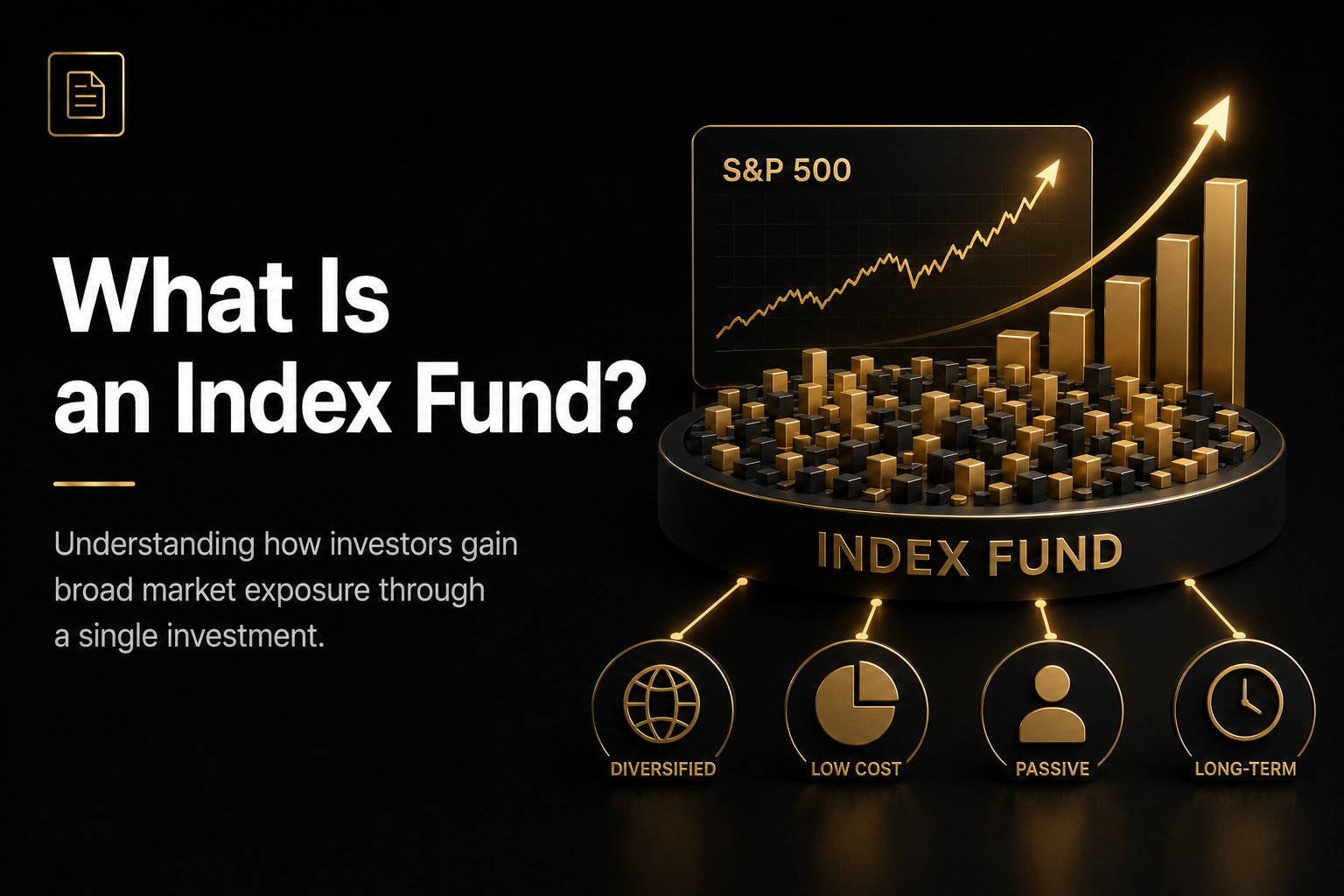
What Is an Index Fund?
Understanding how investors gain broad market exposure through a single investment.
Introduction
An index fund is an investment fund designed to track the performance of a specific market index. Instead of attempting to outperform the market, index funds seek to replicate the returns of a benchmark by holding many of the same securities.
Index funds are widely used for long-term investing because they provide broad diversification and typically have lower costs than actively managed funds.
How Do Index Funds Work?
A market index measures the performance of a group of securities.
Examples include:
S&P 500
Nasdaq-100
MSCI World
FTSE 100
Bloomberg US Aggregate Bond Index
An index fund invests in the securities contained within the benchmark, often in the same proportions but the index changes over time, the fund adjusts its holdings to continue tracking the benchmark.
Why Are Index Funds Popular?
Index funds have become increasingly popular because they offer:
Diversification
Low costs
Transparency
Simplicity
Long-term market exposure
Rather than selecting individual stocks or bonds, investors gain access to an entire market through a single investment.
Types of Index Funds
Stock Index Funds
Track equity benchmarks such as:
S&P 500
MSCI World
Nasdaq-100
These funds provide broad exposure to stock markets.
Bond Index Funds
Track fixed-income benchmarks including:
Treasury Bonds
Corporate Bonds
Aggregate Bond Markets
Bond index funds are commonly used for income and diversification.
International Index Funds
Provide exposure to developed and emerging markets outside an investor’s home country.
Sector Index Funds
Focus on industries such as:
Technology
Healthcare
Energy
Financials
These funds provide targeted market exposure.
Advantages of Index Funds
Broad Diversification
Index funds spread investments across many securities.
Lower Costs
Because they follow predefined benchmarks, index funds generally have lower expense ratios than actively managed funds.
Simplicity
Investors can gain exposure to entire markets through a single fund.
Long-Term Investing
Index funds are commonly used in retirement accounts and long-term wealth-building strategies.
Risks of Index Funds
Index funds are diversified, but they are not risk-free.
Investors should consider:
Market Risk
Index funds decline when the underlying market falls.
Concentration Risk
Some indexes may be heavily weighted toward a few sectors or companies.
Interest Rate Risk
Bond index funds are sensitive to changes in interest rates.
Currency Risk
International index funds may be affected by exchange-rate movements.
Index Funds and Passive Investing
Index funds are closely associated with passive investing but rather than trying to predict which securities will outperform, passive investors seek to capture long-term market returns through broad diversification and low costs.
Key Takeaways
✓ Index funds track the performance of a benchmark index.
✓ They provide broad diversification and low costs.
✓ Index funds can invest in stocks, bonds and international markets.
✓ They are widely used for passive and long-term investing.
✓ Index funds have become one of the most popular investment vehicles worldwide.