
Vanguard
How Vanguard Changed Investing Through Low-Cost Index Funds and Long-Term Ownership.
Introduction
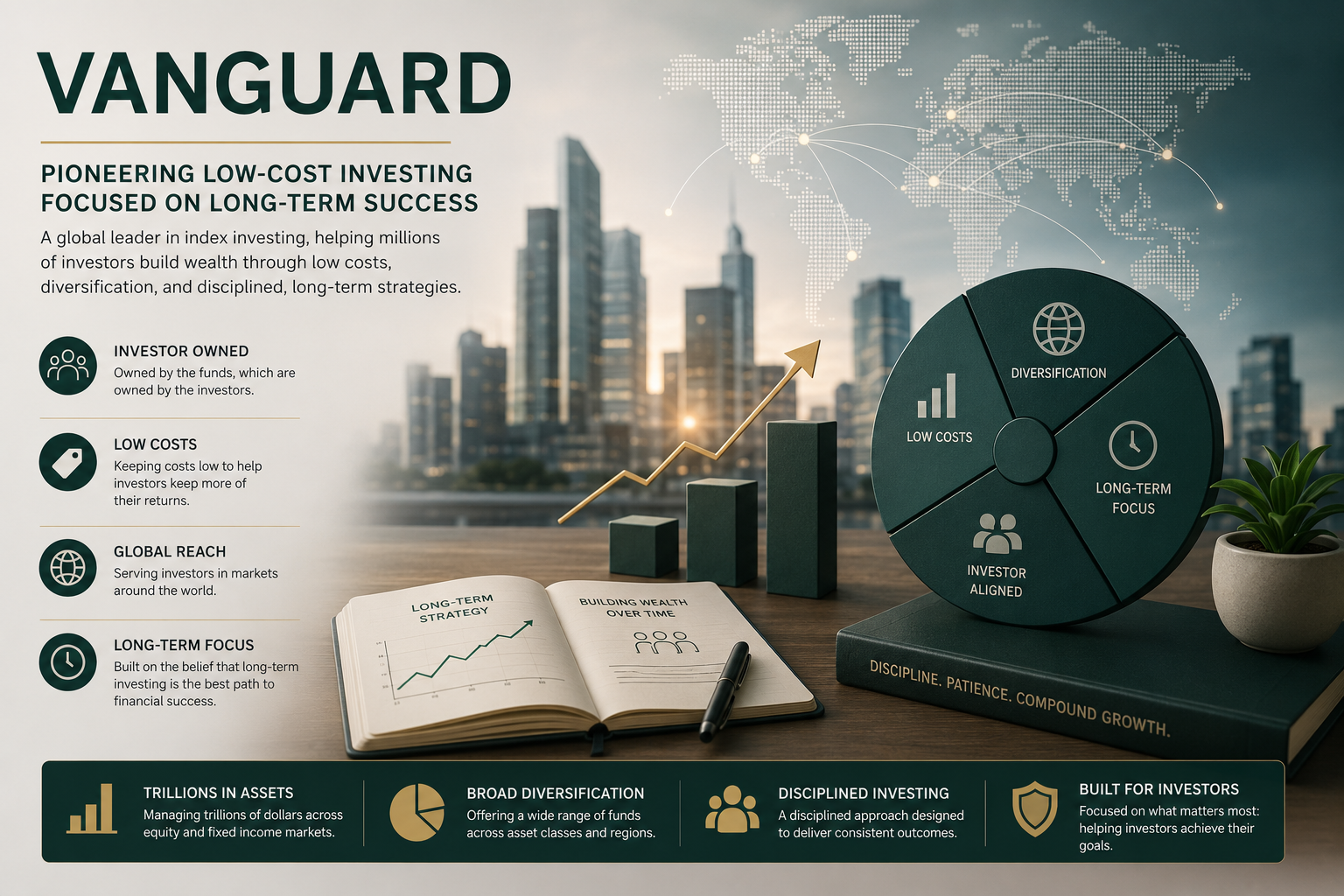
Vanguard is one of the world’s most influential asset management companies and a pioneer of modern index investing. Although it rarely makes headlines like investment banks or hedge funds, its impact on global financial markets is enormous. By promoting low-cost investing and long-term wealth creation, Vanguard has fundamentally changed how millions of individuals and institutions invest.
Today, Vanguard manages trillions of dollars across equity and fixed-income markets, making it one of the largest investment firms in the world.
The History of Vanguard
Vanguard was founded in 1975 by John C. Bogle, who believed that investment costs were one of the biggest obstacles to long-term investor success. His vision challenged the traditional asset management industry, where actively managed funds often charged high fees without consistently outperforming the market.
The launch of Vanguard’s first index fund marked the beginning of a new era in investing. Although initially criticized, index investing eventually became one of the fastest-growing segments of the global investment industry.
Vanguard’s Unique Ownership Structure
Unlike most financial institutions, Vanguard operates under a distinctive ownership model. Rather than being publicly traded, the company is owned by its U.S. mutual funds, which are themselves owned by the investors in those funds. This structure is designed to align Vanguard’s interests with those of its clients by emphasizing lower operating costs and long-term value instead of maximizing profits for external shareholders.
This approach has become one of Vanguard’s defining characteristics and has helped establish its reputation as a client-focused investment manager.
Investment Philosophy
Vanguard’s investment philosophy is built around several core principles:
Low investment costs
Broad diversification
Long-term investing
Passive index strategies
Disciplined portfolio management
The company encourages investors to focus on long-term financial goals rather than attempting to predict short-term market movements.
Global Market Influence
Vanguard is among the largest shareholders in thousands of publicly listed companies worldwide. Through its index funds and ETFs, it owns significant stakes across major stock markets while also maintaining extensive investments in global government and corporate bond markets. Because of its scale, Vanguard plays an important role in corporate governance through shareholder voting and engagement with company management.
Its investment decisions also influence capital flows across global financial markets, particularly as passive investing continues to gain popularity.
Vanguard and Fixed Income Markets
While Vanguard is widely known for equity index funds, it is also one of the world’s largest providers of fixed-income investment products.
Its bond funds invest across:
Government bonds
Investment-grade corporate bonds
Municipal bonds
International bonds
Short-term fixed income
Inflation-protected securities
These funds provide investors with diversified exposure to global bond markets while supporting efficient access to fixed-income investing.
Why Vanguard Matters
Vanguard transformed investing by proving that lower costs can significantly improve long-term investment outcomes. Its commitment to passive investing, diversification, and investor-focused principles has reshaped the global asset management industry.
As one of the world’s largest investment firms, Vanguard continues to influence financial markets through its ownership positions, corporate governance activities, and growing role in both equity and fixed-income investing.
Conclusion
Vanguard has fundamentally transformed the investment industry by making low-cost, long-term investing accessible to millions of people worldwide. Its pioneering role in index investing, unique ownership structure, and emphasis on broad diversification have reshaped how individuals and institutions build wealth.
Today, Vanguard remains one of the world’s most influential asset managers, with a significant presence across both equity and fixed-income markets. As passive investing continues to grow and global capital markets evolve, the firm’s commitment to cost efficiency, transparency, and long-term investment principles is likely to remain a defining force in the financial industry for decades to come.