
Bank of Canada (BoC)
Understanding the Central Bank Behind the Canadian Dollar and Canada’s Financial System
Introduction
The Bank of Canada (BoC) is the central bank of Canada and one of the world’s leading monetary authorities. As the institution responsible for maintaining price stability and confidence in the Canadian dollar, the BoC plays a vital role in shaping monetary policy, government bond markets, and the country’s financial system.
Canada’s strong banking sector, sound fiscal framework, and highly rated sovereign debt have made the Bank of Canada an influential institution within global fixed-income markets.
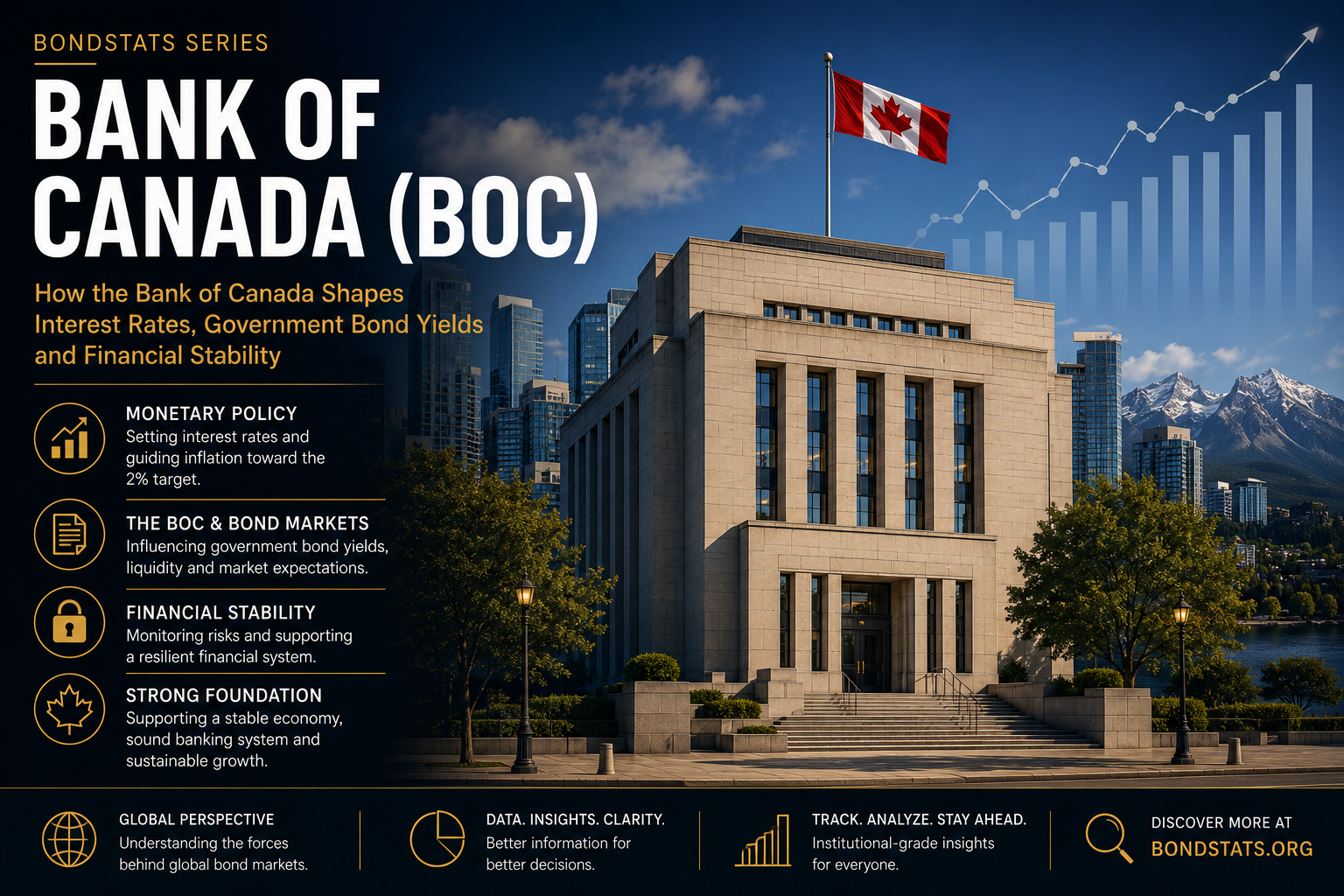
The History of the Bank of Canada
The Bank of Canada was established in 1935 to provide Canada with an independent central bank capable of managing monetary policy and financial stability. Initially founded as a privately owned institution, it became a Crown corporation in 1938. Since then, the BoC has played a central role in guiding the Canadian economy through periods of inflation, financial crises, and economic expansion.
Today, the Bank of Canada is recognized internationally for its transparent communication and inflation-targeting framework.
Main Responsibilities
The Bank of Canada is responsible for:
Maintaining price stability.
Conducting monetary policy.
Issuing Canadian banknotes.
Promoting financial system stability.
Managing Canada’s foreign exchange reserves.
Acting as the government’s fiscal agent.
Supporting efficient payment systems.
These responsibilities help maintain confidence in Canada’s financial markets and economy.
Monetary Policy
The Bank of Canada conducts monetary policy using several key instruments, including:
Policy Interest Rate.
Overnight Rate Target.
Open Market Operations.
Quantitative Easing (QE).
Quantitative Tightening (QT).
Forward Guidance.
Changes in the policy rate influence borrowing costs, mortgage rates, business investment, and Canadian government bond yields.
The BoC and Bond Markets
Canada operates one of the world’s most respected sovereign bond markets.
The Bank of Canada influences government bond yields through:
Interest rate decisions.
Government bond purchase programs.
Liquidity operations.
Balance sheet management.
Market communication.
Because Canadian government bonds are widely held by institutional investors, BoC policy decisions are closely monitored across global fixed-income markets.
Why the BoC Matters
The Bank of Canada’s decisions influence:
Canadian government bond yields.
Inflation expectations.
Mortgage markets.
Banking liquidity.
The Canadian dollar.
International investor confidence.
As one of the G7 central banks, the BoC plays an important role in maintaining financial stability both domestically and internationally.
Canada’s Financial System
Canada is widely recognized for having one of the world’s most stable banking systems.
The Bank of Canada works alongside financial regulators to:
Promote financial resilience.
Monitor systemic risks.
Support payment infrastructure.
Ensure market stability.
Strengthen confidence during periods of financial stress.
This stable financial framework has contributed to Canada’s reputation as one of the safest developed economies for investors.
Key Facts
Founded: 1935
Headquarters: Ottawa, Canada
Currency: Canadian Dollar (CAD)
Primary Objective: Price and financial stability
Key Tools: Policy Rate, Overnight Rate Target, QE, QT, Open Market Operations
Global Importance: One of the G7’s leading central banks and a key participant in global bond markets
Conclusion
The Bank of Canada has earned a strong international reputation through its commitment to transparent monetary policy, financial stability, and prudent economic management. Its influence extends beyond Canada’s borders, shaping government bond markets, investor expectations, and capital flows across the global financial system. For anyone seeking to understand sovereign debt, inflation, and fixed-income investing, the Bank of Canada remains one of the world’s most important central banks.