
MSCI World Index
How the MSCI World Index Tracks Developed Markets Around the Globe
Introduction
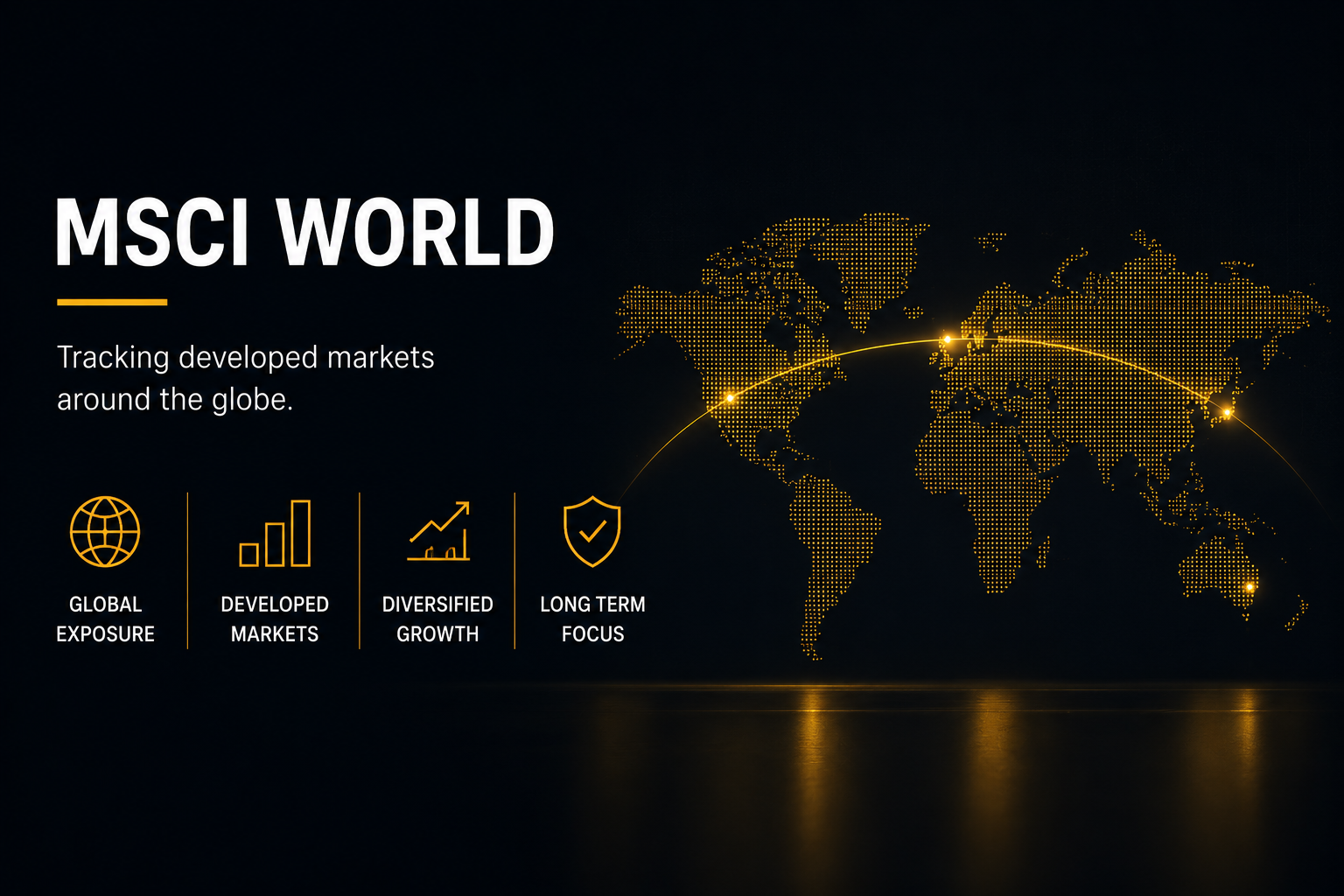
The MSCI World Index is one of the world’s most widely followed global equity benchmarks. It measures the performance of large- and mid-cap companies across developed economies, providing investors with broad exposure to international stock markets through a single index.
Although often viewed as a “global” benchmark, the MSCI World focuses exclusively on developed markets, making it a key reference for international portfolio diversification.
The History of the MSCI World
The MSCI World Index was launched in 1969 by MSCI Inc. to provide a standardized benchmark for global equity investing and over the decades, it has become one of the most important international stock market indices and is widely used by institutional investors, pension funds, ETF providers, and asset managers around the world.
Today, trillions of dollars are benchmarked against MSCI indices.
How the MSCI World Works
The MSCI World tracks large- and mid-cap companies from 23 developed countries, including:
United States
Japan
United Kingdom
Canada
France
Germany
Switzerland
Australia
Netherlands
Sweden
The index is free-float market-capitalization weighted, meaning larger publicly available companies have a greater impact on performance.
Why the MSCI World Matters
The MSCI World is widely used to:
Benchmark global equity portfolios.
Measure developed market performance.
Support ETFs and index funds.
Diversify international investments.
Compare portfolio performance.
Track long-term global economic growth.
Its broad diversification makes it one of the world’s most important investment benchmarks.
The MSCI World and Global Markets
Movements in the MSCI World reflect:
Developed market performance.
Global investor sentiment.
International capital flows.
Corporate earnings trends.
Economic growth.
Long-term equity market performance.
Because the United States represents the largest share of the index, U.S. market movements have a significant influence on overall performance.
Advantages of the MSCI World
The index offers several advantages:
Broad international diversification.
Exposure to developed economies.
Transparent methodology.
High liquidity.
Global recognition.
Long performance history.
These characteristics have made it one of the world’s most popular benchmarks for long-term investing.
Key Facts
Launched: 1969
Coverage: Large- and Mid-Cap Companies
Countries: 23 Developed Markets
Weighting Method: Free-Float Market Capitalization
Known For: Global Developed Market Benchmark
Global Importance: One of the world’s most widely followed international stock market indices
Conclusion
The MSCI World Index provides investors with comprehensive exposure to developed equity markets through a single, globally diversified benchmark. By tracking thousands of companies across North America, Europe, and the Asia-Pacific region, it offers valuable insight into international market performance and long-term economic growth. For investors seeking broad global diversification, the MSCI World remains one of the most influential and widely used equity indices in the financial industry.