
What Is Volatility?
Understanding how price fluctuations influence risk and investment returns.
Introduction
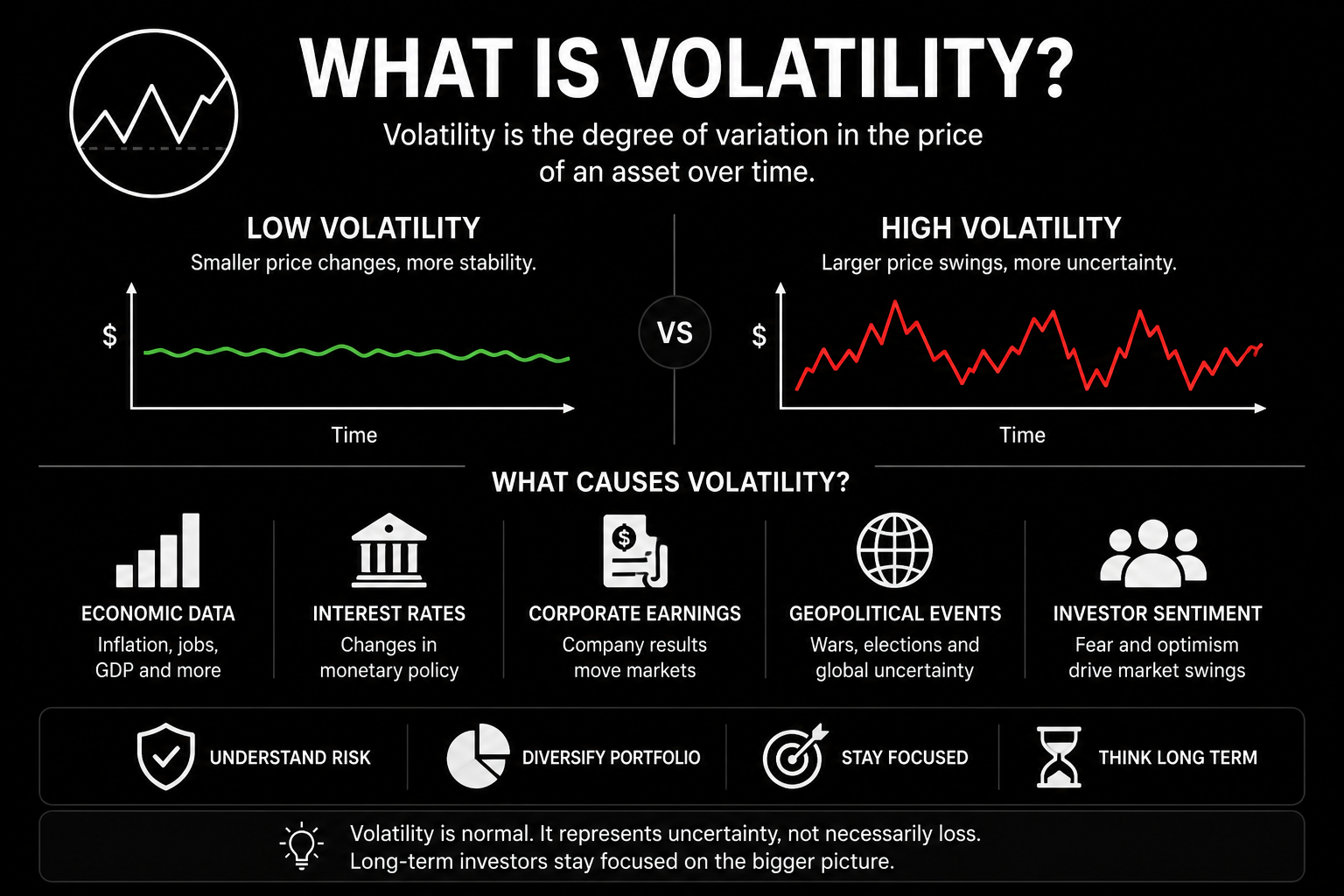
Volatility refers to the degree of variation in the price of an asset over time. It measures how much prices move, either upward or downward, and is often used as an indicator of risk and uncertainty.
Higher volatility generally means larger price swings, while lower volatility implies more stable price movements.
Why Does Volatility Matter?
Volatility helps investors:
Understand risk
Measure uncertainty
Evaluate portfolio stability
Compare investments
Manage expectations
Price fluctuations are a normal part of financial markets and do not necessarily indicate permanent losses.
What Causes Volatility?
Several factors can influence volatility:
Economic Data
Inflation, employment reports and GDP growth can affect market expectations.
Interest Rates
Changes in monetary policy often influence stock and bond prices.
Corporate Earnings
Company results can lead to significant price movements.
Geopolitical Events
Wars, elections and global uncertainties may increase volatility.
Investor Sentiment
Fear and optimism can amplify market swings.
High Volatility vs Low Volatility
High Volatility
Characterized by:
Large price movements
Higher uncertainty
Greater risk
Potentially higher returns
Low Volatility
Characterized by:
Smaller price changes
Greater stability
Lower risk
More predictable behavior
Volatility and Different Asset Classes
Stocks
Typically experience higher volatility.
Bonds
Generally exhibit lower volatility than stocks.
Cash
Usually has the lowest volatility.
Commodities
Can experience significant price fluctuations depending on supply and demand conditions.
Volatility and Long-Term Investing
Short-term volatility is common, but long-term investors often focus on:
Diversification
Asset Allocation
Risk Management
Discipline
Time Horizon
Volatility represents uncertainty, not necessarily loss.
Common Misconceptions
Volatility is not the same as risk and temporary market fluctuations do not automatically imply poor long-term outcomes.
Periods of volatility are a natural part of investing and have occurred throughout financial history.
Key Takeaways
✓ Volatility measures the magnitude of price fluctuations.
✓ Higher volatility usually means greater uncertainty.
✓ Stocks tend to be more volatile than bonds and cash.
✓ Economic events and investor sentiment can influence volatility.
✓ Understanding volatility helps investors manage risk and maintain long-term discipline.