
Reserve Bank of New Zealand (RBNZ)
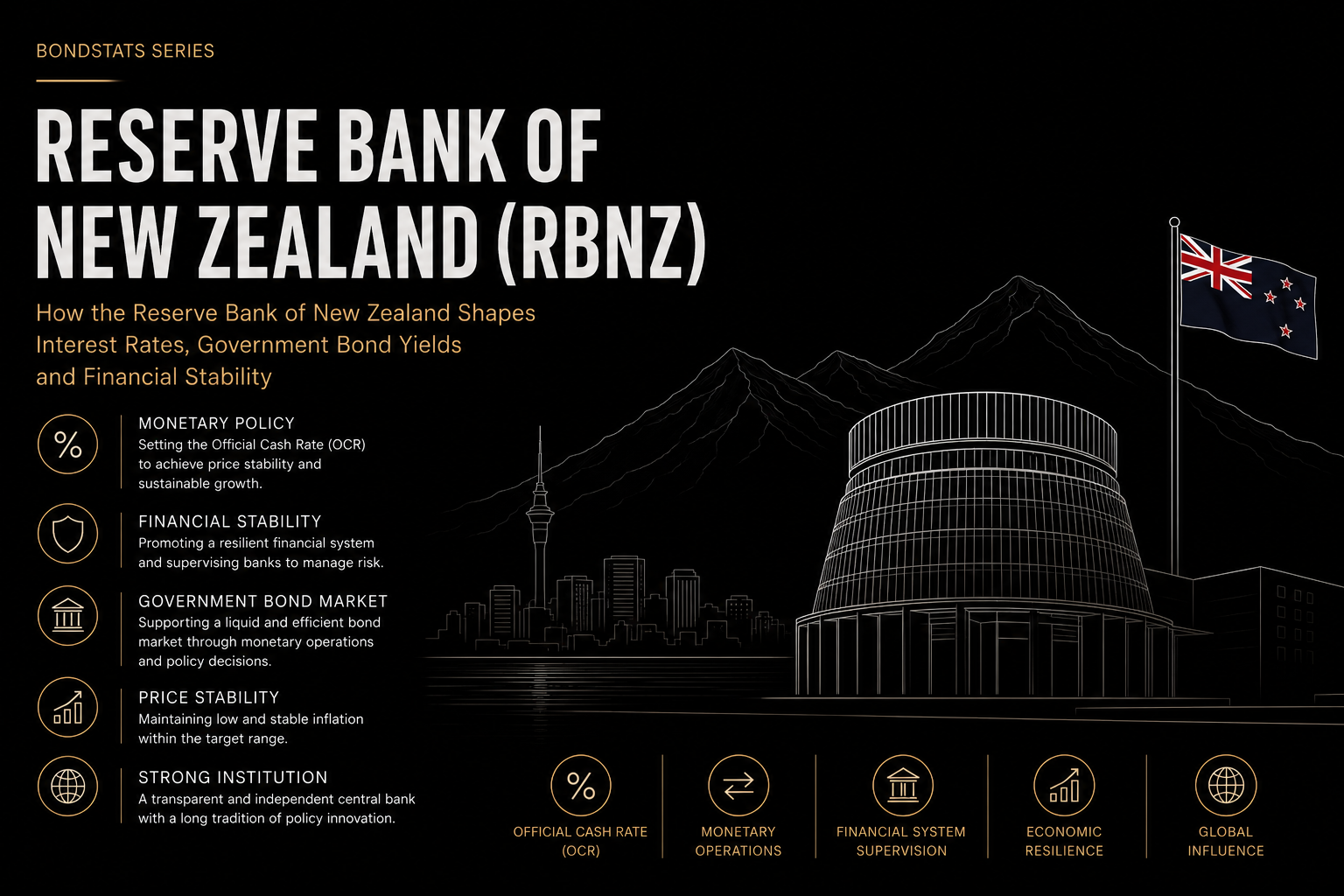
How the Reserve Bank of New Zealand Shapes Interest Rates, Government Bond Yields and Financial Stability
Introduction
The Reserve Bank of New Zealand (RBNZ) is the central bank of New Zealand and one of the world’s most respected monetary authorities. Responsible for maintaining price stability, promoting financial system resilience, and supporting sustainable economic growth, the RBNZ plays a central role in shaping interest rates, government bond yields, and the broader economy.
Although New Zealand is a relatively small economy, the RBNZ is internationally recognized for pioneering modern inflation-targeting monetary policy, influencing central banking practices around the world.
The History of the RBNZ
The Reserve Bank of New Zealand was established in 1934, becoming the country’s central bank with responsibility for issuing currency and managing monetary policy. In the late 1980s, New Zealand became one of the first countries to formally adopt an inflation-targeting framework, a model that has since been adopted by many central banks worldwide.
Today, the RBNZ remains one of the most transparent and innovative central banks globally.
Main Responsibilities
The Reserve Bank of New Zealand is responsible for:
Maintaining price stability.
Conducting monetary policy.
Issuing the New Zealand Dollar (NZD).
Promoting financial stability.
Supervising banks and deposit takers.
Supporting efficient payment systems.
Managing foreign exchange reserves.
These responsibilities help ensure confidence in New Zealand’s financial system and long-term economic stability.
Monetary Policy
The Reserve Bank of New Zealand primarily conducts monetary policy using:
Official Cash Rate (OCR).
Open Market Operations.
Liquidity management.
Forward guidance.
Large-scale asset purchases (when required).
Changes in the Official Cash Rate influence borrowing costs, mortgage rates, inflation expectations, exchange rates, and New Zealand government bond yields.
The RBNZ and Bond Markets
New Zealand operates a highly regarded sovereign bond market supported by strong institutions and prudent fiscal management.
The RBNZ influences bond markets through:
Interest rate decisions.
Government bond purchases.
Liquidity operations.
Monetary policy communication.
Financial stability measures.
Its decisions are closely monitored by investors throughout the Asia-Pacific region.
Financial Stability
The Reserve Bank of New Zealand works to strengthen the resilience of the financial system by:
Supervising banks.
Monitoring systemic risks.
Maintaining payment system security.
Promoting financial resilience.
Supporting confidence during periods of market stress.
This contributes to New Zealand’s reputation as one of the world’s most stable financial systems.
Why the RBNZ Matters
The Reserve Bank of New Zealand’s decisions influence:
New Zealand government bond yields.
Inflation expectations.
The New Zealand Dollar (NZD).
Banking liquidity.
Asia-Pacific financial markets.
International investor confidence.
Its pioneering approach to inflation targeting has had a lasting influence on modern central banking.
Key Facts
Founded: 1934
Headquarters: Wellington, New Zealand
Currency: New Zealand Dollar (NZD)
Primary Objective: Price and financial stability
Key Tools: Official Cash Rate (OCR), Open Market Operations, Liquidity Management
Global Importance: Pioneer of modern inflation-targeting monetary policy
Conclusion
The Reserve Bank of New Zealand has earned a global reputation for innovation, transparency, and disciplined monetary policy. Through its management of interest rates, financial stability, and sovereign bond markets, the RBNZ continues to influence both New Zealand’s economy and broader discussions on central banking. As one of the pioneers of inflation targeting, its policies remain closely followed by economists, investors, and policymakers around the world.