
Inter-American Development Bank (IDB)
Connecting Global Capital with Latin American Development
Introduction
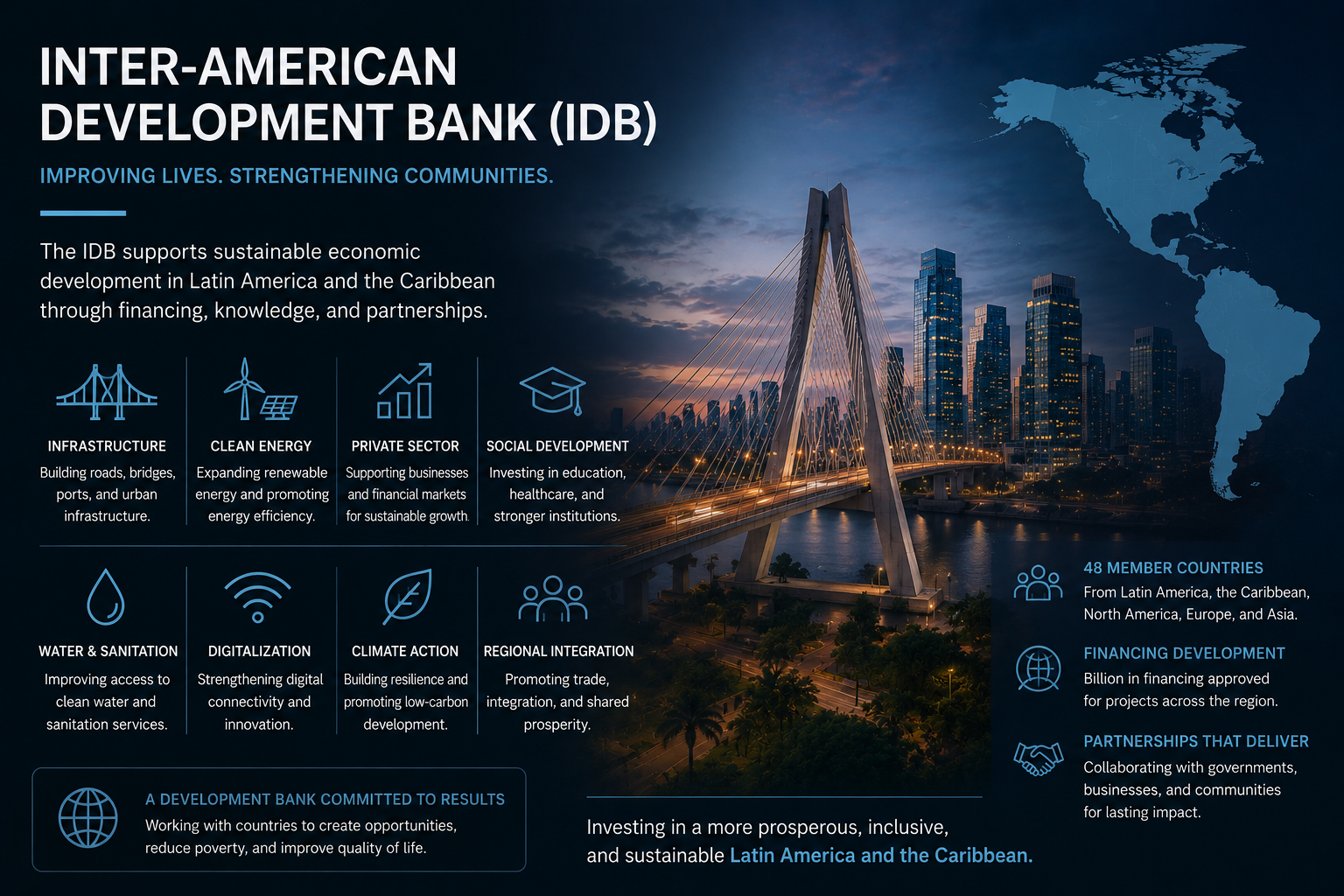
The Inter-American Development Bank (IDB) is a multilateral development bank focused primarily on Latin America and the Caribbean. Established in 1959 and headquartered in Washington, D.C., the IDB provides financing and technical assistance for governments, businesses, and development projects throughout the region.
Its activities cover infrastructure, energy, financial markets, digitalization, education, healthcare, institutional development, and regional economic integration.
History and Development
The IDB was established in 1959 following growing demand for a dedicated institution capable of financing long-term economic development across Latin America. It became the first major regional development bank of its kind and subsequently influenced the creation of similar multilateral institutions elsewhere.
Over the decades, the IDB’s mandate has expanded alongside the economic transformation of Latin America and the Caribbean.
Institutional Role
The IDB provides financing and expertise across numerous areas, including:
Transportation infrastructure
Energy and electricity networks
Water and sanitation
Digital infrastructure
Education and healthcare
Financial-sector development
Climate resilience
Institutional reform
Regional economic integration
Its financing includes loans, guarantees, grants, and technical assistance.
Infrastructure and Economic Development
Infrastructure remains an important component of the IDB’s activities and latin America requires substantial long-term investment in transportation networks, electricity grids, ports, urban infrastructure, water systems, and digital connectivity. By providing long-term financing, the IDB can support projects that may be difficult to fund exclusively through domestic government budgets or private capital markets.
The IDB and Bond Markets
The IDB is also an important supranational bond issuer because it raises much of the capital required for its lending operations through international debt markets rather than relying solely on contributions from member governments. The bank issues securities across different currencies, maturities, and markets, attracting institutional investors seeking exposure to highly rated supranational debt.
Capital raised from investors is subsequently used to finance development projects across Latin America and the Caribbean.
Local Capital Markets
Beyond issuing its own bonds, the IDB supports the development of financial and capital markets within its borrowing member countries and deeper domestic bond markets can provide governments and companies with additional sources of long-term financing while reducing dependence on foreign-currency borrowing.
This is particularly relevant in a region that has historically experienced periods of currency volatility and external debt stress.
Governance and Membership
The IDB is owned by its member countries, which include countries from Latin America and the Caribbean as well as North America, Europe, and Asia.
Its governance structure includes:
Board of Governors
Board of Executive Directors
President
Executive management
Borrowing member countries from Latin America and the Caribbean collectively hold significant voting influence within the institution.
International Importance
The IDB occupies an important position in the financial architecture of Latin America and its projects connect governments, private investors, international institutions, and global capital markets while addressing long-term investment requirements throughout the region.
The institution also provides economic research and technical expertise that influence policy discussions across Latin American economies.
Why the IDB Matters
For BondStats, the IDB is particularly relevant because it illustrates the connection between supranational bonds, emerging-market finance, infrastructure investment, and sovereign development. Its ability to raise capital internationally and redirect those funds toward regional investment demonstrates how multilateral institutions can act as intermediaries between global bond investors and developing economies.
Conclusion
The Inter-American Development Bank has played a significant role in Latin American and Caribbean development since 1959 and through infrastructure financing, financial-sector development, technical assistance, and international bond issuance, it connects regional development needs with global sources of capital. For fixed-income investors, the IDB also represents an important part of the supranational bond market and demonstrates how institutional borrowing can transform global savings into long-term investment across emerging economies.