
How Singapore Balances Its Budget
Why constitutional rules make Singapore one of the world’s most fiscally disciplined governments.
Introduction
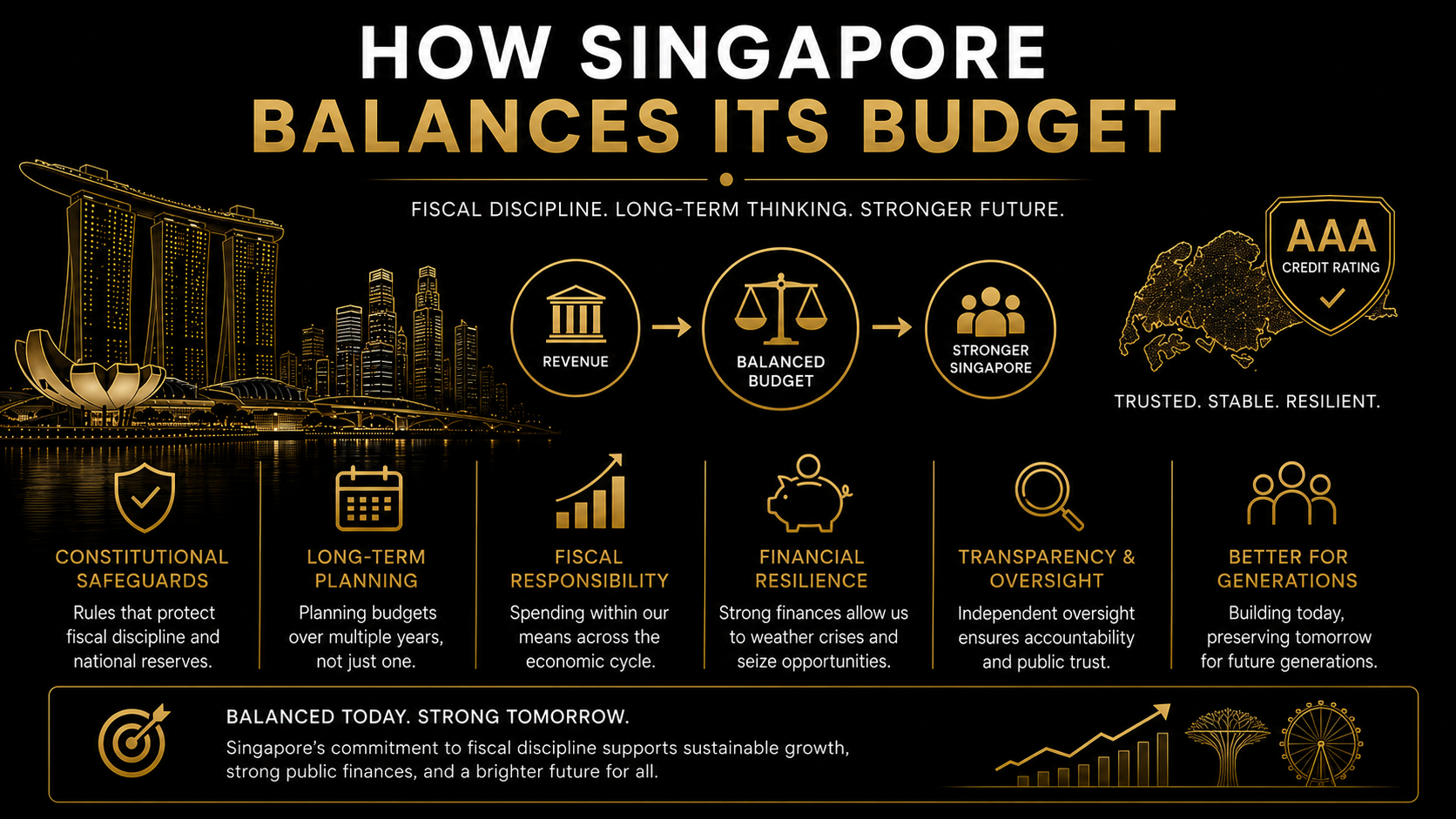
Most governments regularly run budget deficits and finance public spending through borrowing. Singapore follows a very different approach. The country’s fiscal framework is built around constitutional rules that promote balanced budgets, long-term planning, and responsible financial management.
This approach has helped Singapore maintain strong public finances for decades while preserving wealth for future generations.
Singapore treats fiscal discipline as a long-term national strategy rather than a short-term political objective.
What Is a Balanced Budget?
A balanced budget means that government revenue is generally sufficient to cover government spending over a defined period. Unlike countries that rely heavily on persistent borrowing, Singapore aims to ensure that public finances remain sustainable throughout the economic cycle.
Temporary deficits may occur during economic downturns or national emergencies, but long-term fiscal balance remains the objective.
Constitutional Fiscal Rules
Singapore’s Constitution places important limits on government spending.
Key principles include:
Fiscal responsibility
Protection of past reserves
Long-term budget planning
Independent oversight
Transparency in public finances
These safeguards reduce the risk of excessive borrowing and protect national wealth.
Why This Matters
Strong fiscal discipline provides several important advantages.
It helps Singapore:
Maintain investor confidence
Preserve its AAA credit rating
Respond to financial crises
Reduce borrowing costs
Support long-term economic stability
As a result, Singapore consistently ranks among the world’s strongest sovereign borrowers.
Budget Planning Over the Long Term
Rather than focusing only on annual results, Singapore plans public finances across multiple years.
This long-term perspective allows policymakers to:
Prepare for demographic changes
Invest in infrastructure
Build financial resilience
Manage economic shocks
Long-term planning has become a defining feature of Singapore’s fiscal model.
A Model of Fiscal Sustainability
Singapore demonstrates that responsible budgeting is not only about limiting spending.
It also involves:
Building financial reserves
Investing national assets wisely
Maintaining institutional credibility
Thinking beyond political cycles
Together, these principles support one of the strongest public finance systems in the world.
Key Takeaways
Singapore follows a long-term approach to balanced budgets.
Constitutional safeguards protect fiscal discipline.
Budget planning supports long-term sustainability rather than short-term politics.
Strong public finances reinforce investor confidence and economic stability.
Fiscal discipline remains a cornerstone of Singapore’s economic success.