
What Interest Rates Signal
Understanding how interest rates influence borrowing, saving, inflation, investment, and economic growth.
Introduction
Interest rates are often called the price of money and they influence how much households spend, how businesses invest, how governments borrow, and how investors allocate capital. Because interest rates affect nearly every part of the financial system, they provide one of the clearest signals about economic conditions and monetary policy.
Understanding interest rates helps explain how money moves throughout the economy.
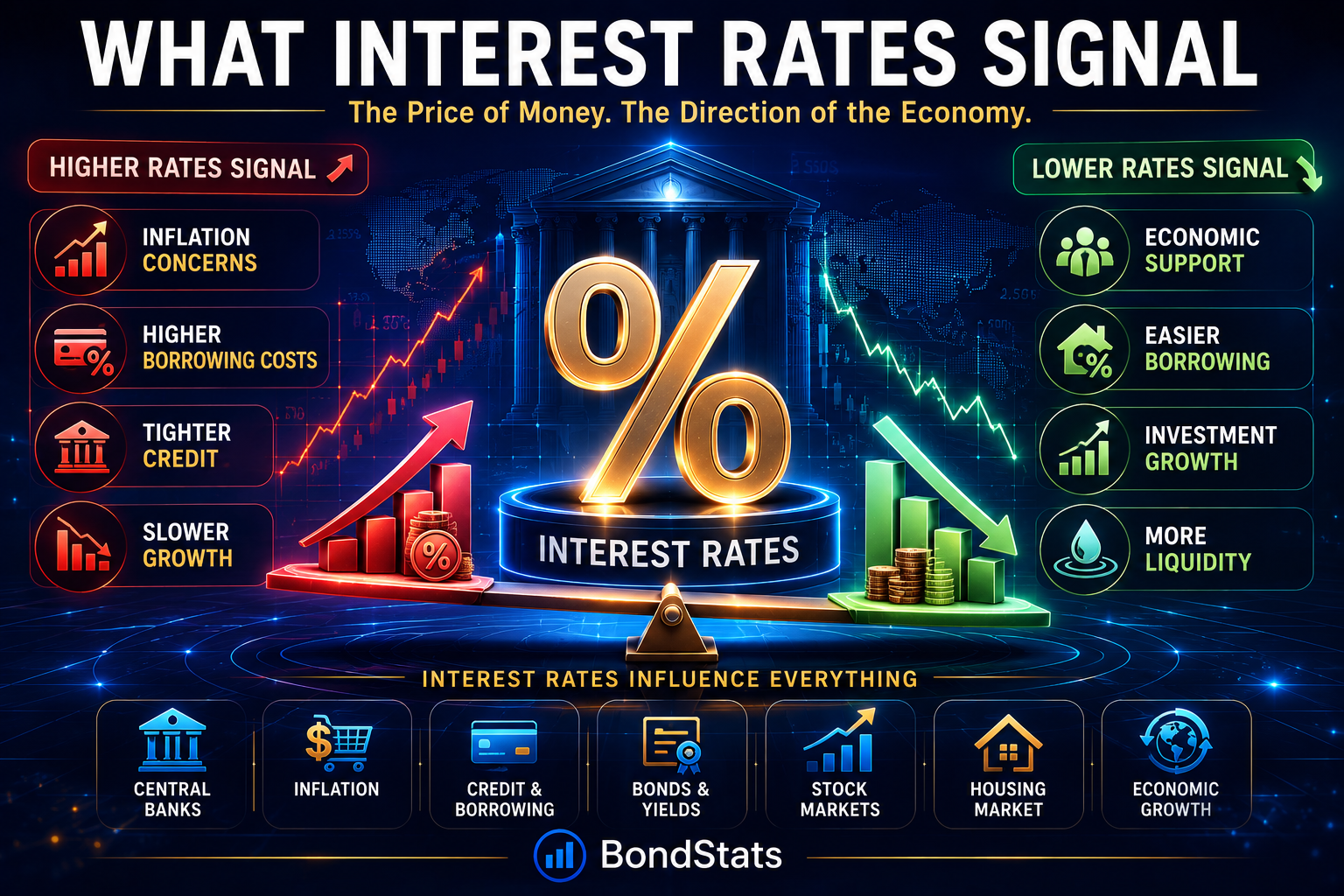
What Are Interest Rates?
An interest rate is the cost of borrowing money or the return earned for lending money.
Interest rates influence:
Loans
Mortgages
Government bonds
Corporate bonds
Savings accounts
Financial markets
Changes in rates affect both borrowers and investors.
What Higher Interest Rates Signal
Higher interest rates often signal that policymakers are attempting to slow economic activity or control inflation.
When rates rise:
Borrowing becomes more expensive
Spending may slow
Credit growth weakens
Inflation pressures may ease
Signals
📈 Inflation concerns
📈 Tighter monetary policy
📈 Slower credit growth
📈 Higher borrowing costs
What Lower Interest Rates Signal
Lower interest rates are often used to support economic activity.
When rates fall:
Borrowing becomes cheaper
Spending may increase
Investment becomes more attractive
Credit conditions improve
Signals
📉 Economic support
📉 Easier financial conditions
📉 Stronger credit growth
📉 Lower borrowing costs
Why Investors Watch Interest Rates
Interest rates influence the valuation of nearly all financial assets.
They affect:
Bond yields
Stock valuations
Housing markets
Currency values
Capital flows
As a result, markets closely monitor interest rate expectations.
Interest Rates and the Monetary System
Interest rates connect central bank policy to the broader economy.
Changes in rates influence:
Commercial banks
Government borrowing
Financial markets
Inflation
Economic growth
Because of this, interest rates sit at the center of the monetary system.
Key Takeaway
Interest rates signal the direction of monetary policy and the balance between economic growth and inflation and higher rates often reflect tighter financial conditions.
Lower rates often reflect efforts to support growth and liquidity. Understanding interest rates helps explain how money, credit, and investment move throughout the economy.