
The S$NEER Policy Band Explained
Understanding the slope, width and centre of Singapore’s unique monetary policy framework.
Introduction
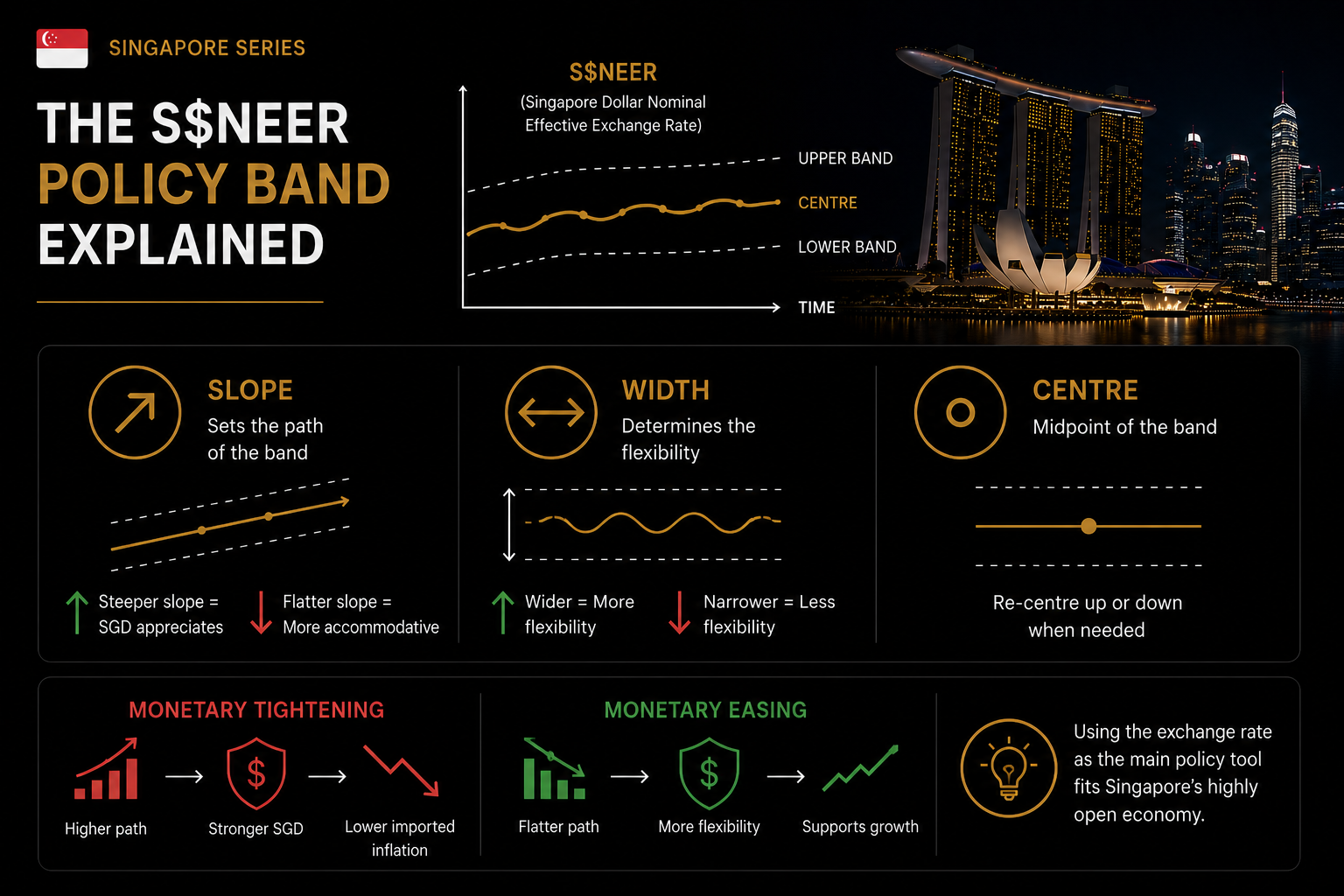
Singapore’s monetary policy is centred on the Singapore Dollar Nominal Effective Exchange Rate (S$NEER) rather than a traditional policy interest rate. Instead of fixing the exchange rate at one level, the Monetary Authority of Singapore (MAS) allows it to move within a policy band. This gives policymakers flexibility while helping maintain price stability.
The policy band is built around three components:
Slope
Width
Centre
Understanding these three elements is the key to understanding Singapore’s entire monetary framework.
Think of the S$NEER policy band as guardrails rather than a fixed exchange rate.
Slope
The slope determines the direction of the policy band over time. A steeper upward slope allows the Singapore dollar to gradually appreciate, helping reduce imported inflation.
A flatter slope signals a more neutral policy stance and if inflation becomes persistent, MAS may increase the slope to tighten monetary conditions.
Width
The width determines how much the Singapore dollar may fluctuate inside the policy band. A wider band provides greater flexibility during periods of market uncertainty.
A narrower band keeps exchange-rate movements more contained. MAS adjusts the width only when broader economic conditions require additional flexibility.
Centre
The centre is the midpoint of the policy band. When economic conditions change significantly, MAS can re-centre the entire band higher or lower. This represents a larger adjustment than simply changing the slope.
Recentring is used less frequently than other policy changes.
Why Use a Policy Band?
Unlike a fixed exchange rate, the policy band allows market forces to operate while keeping the currency within an overall monetary framework. This balance helps Singapore respond to changing economic conditions without abandoning exchange-rate stability.
Monetary Tightening
When inflation is rising:
Higher appreciation path
Stronger Singapore dollar
Lower imported inflation
Tighter monetary conditions
Monetary Easing
When economic growth slows:
Flatter appreciation path
More flexibility
Supports economic activity
Accommodative monetary conditions
Why It Works
Singapore imports much of its food, energy and industrial inputs and because imported goods are so important, changes in the exchange rate have a direct effect on domestic prices.
Using the exchange rate as the main policy tool therefore fits Singapore’s highly open economy.
Key Takeaways
• MAS manages the Singapore dollar through the S$NEER policy band.
• The framework is built around Slope, Width and Centre.
• The objective is price stability, not a fixed exchange rate.
• The system gives Singapore flexibility while maintaining monetary credibility.