
Can the Yuan Challenge the U.S. Dollar?
Exploring Whether China’s Currency Could One Day Rival the World’s Leading Reserve Currency
Introduction
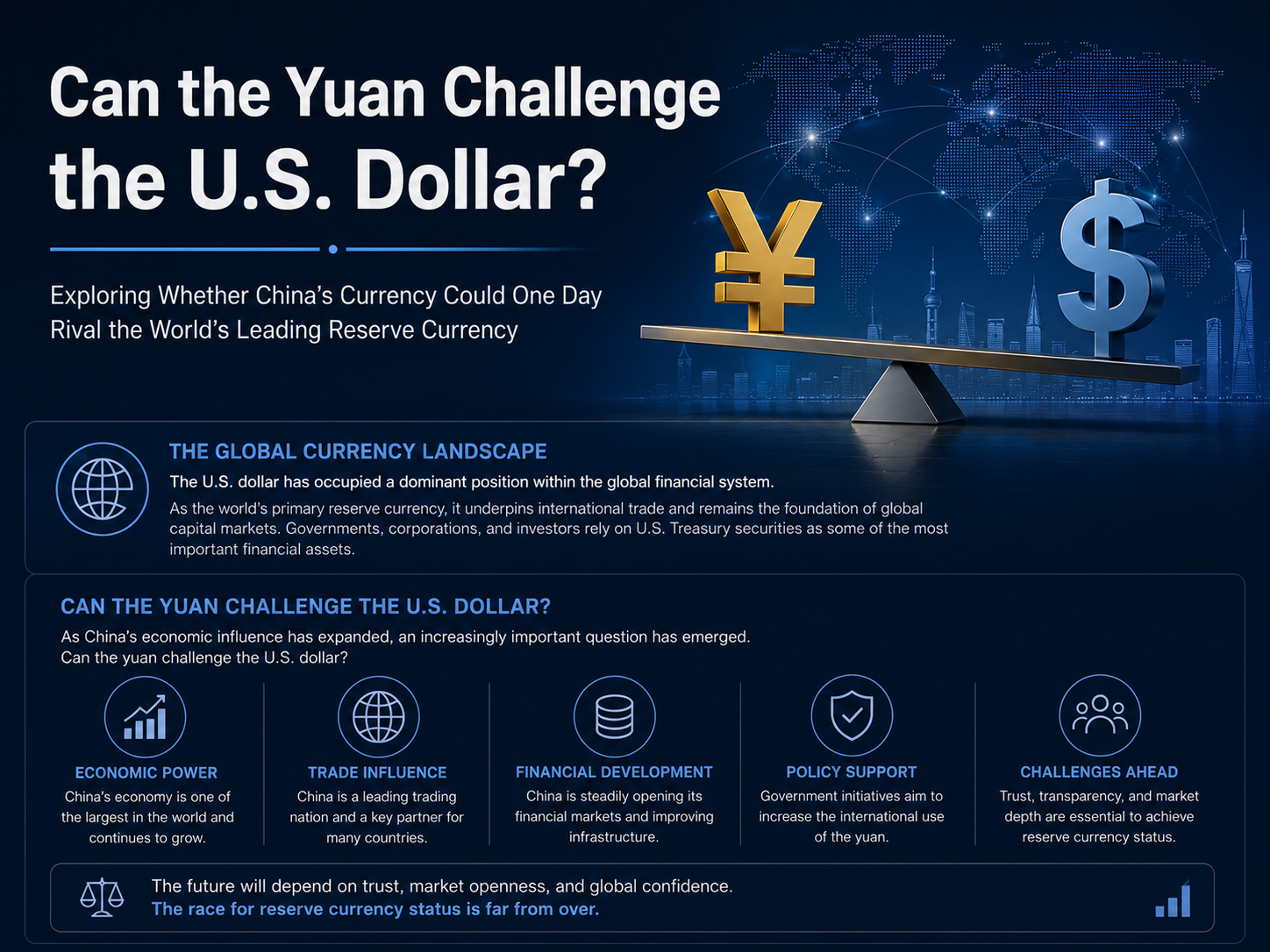
For decades, the U.S. dollar has occupied a dominant position within the global financial system.
It serves as the world’s primary reserve currency, underpins international trade, and remains the foundation of global capital markets. Governments hold dollar reserves, corporations conduct business in dollars, and investors rely on U.S. Treasury securities as some of the most important financial assets in the world.
As China’s economic influence has expanded, an increasingly important question has emerged:
Can the yuan challenge the U.S. dollar?
The answer is complex. While China’s economy is enormous and its global influence continues to grow, reserve currency status depends on far more than economic size alone.
What Makes a Reserve Currency?
A reserve currency is a currency that governments, central banks, and international institutions hold as part of their official reserves.
Reserve currencies are used for:
International trade
Cross-border payments
Foreign exchange reserves
Global investment
Commodity pricing
To achieve reserve currency status, investors must trust not only the currency itself but also the financial system supporting it.
Why the Dollar Dominates
The dollar’s position rests on several foundations:
The size of the U.S. economy
Deep capital markets
Rule of law
Institutional stability
Treasury market liquidity
Global investor confidence
Perhaps most importantly, the United States offers the world’s largest and most liquid government bond market and investors can deploy enormous amounts of capital into Treasury securities with relative ease.
China’s Growing Influence
China has become one of the world’s largest economies and trading nations and as a result, the yuan’s international role has gradually expanded
China has promoted yuan usage through:
Trade agreements
Cross-border settlements
Currency swap arrangements
Financial market reforms
International investment initiatives
The objective is to increase the currency’s role within global finance.
The Bond Market Challenge
One of the biggest obstacles involves bond markets but reserve currencies require deep and accessible sovereign debt markets.
Investors want:
Liquidity
Transparency
Legal certainty
Reliable market access
While China’s bond market is one of the largest in the world, foreign participation remains significantly lower than in U.S. Treasury markets.
Many international investors still view access and transparency as areas where improvement is needed.
Capital Controls Matter
Another important difference involves capital mobility. Most reserve currency systems allow investors to move capital freely.
China continues to maintain various forms of capital controls designed to support:
Financial stability
Exchange rate management
Economic policy objectives
While these controls provide policymakers with flexibility, they may also limit the yuan’s appeal as a global reserve asset.
The Role of Trust
Reserve currencies ultimately depend on confidence.
Investors evaluate:
Legal protections
Market openness
Policy predictability
Financial stability
Institutional credibility
Economic size alone is not enough and trust remains one of the most important factors influencing reserve currency adoption.
Could the Yuan Gain Market Share?
The more realistic question may not be whether the yuan replaces the dollar but instead, investors increasingly ask whether the yuan can capture a larger share of global reserves and transactions.
Several factors support this possibility:
China’s growing trade influence
Expanding bond markets
International investment links
Greater use in regional commerce
Over time, the yuan’s role may continue to expand even if the dollar remains dominant.
The Geopolitical Dimension
Currency systems are closely linked to geopolitics and as competition between major powers increases, some countries have sought to reduce dependence on the dollar.
This has encouraged interest in:
Reserve diversification
Local currency trade settlement
Alternative payment systems
China has positioned the yuan as one potential beneficiary of these trends.
Why Investors Should Care
The future role of the yuan could influence:
Foreign exchange markets
Sovereign debt markets
Global capital flows
Reserve allocations
International trade
Even modest shifts in reserve currency preferences can affect trillions of dollars in global financial activity.
BondStats Research Insight
China’s economic scale provides a strong foundation for greater international use of the yuan. However, reserve currency status depends on trust, capital mobility, market depth, and investor confidence. The challenge is not simply becoming larger than the United States. The challenge is building a financial ecosystem capable of supporting global reserve demand.
Final Thoughts
The yuan has already become far more important than it was a generation ago and china’s economy, trade relationships, and financial markets have expanded dramatically, increasing the currency’s global relevance.
Yet reserve currencies are built over decades, not years.
While the yuan may continue gaining influence within international finance, challenging the dollar requires more than economic strength alone. It requires confidence, openness, liquidity, and a financial system trusted by investors around the world.
For now, the dollar remains dominant but the future of global finance may involve a larger role for the yuan than many investors currently expect.