
What Is ROI?
Understanding how investors measure the profitability and efficiency of an investment.
Introduction
Return on Investment (ROI) is a financial metric used to measure the gain or loss generated by an investment relative to its original cost.
ROI helps investors evaluate how effectively capital has been used and compare different investment opportunities.
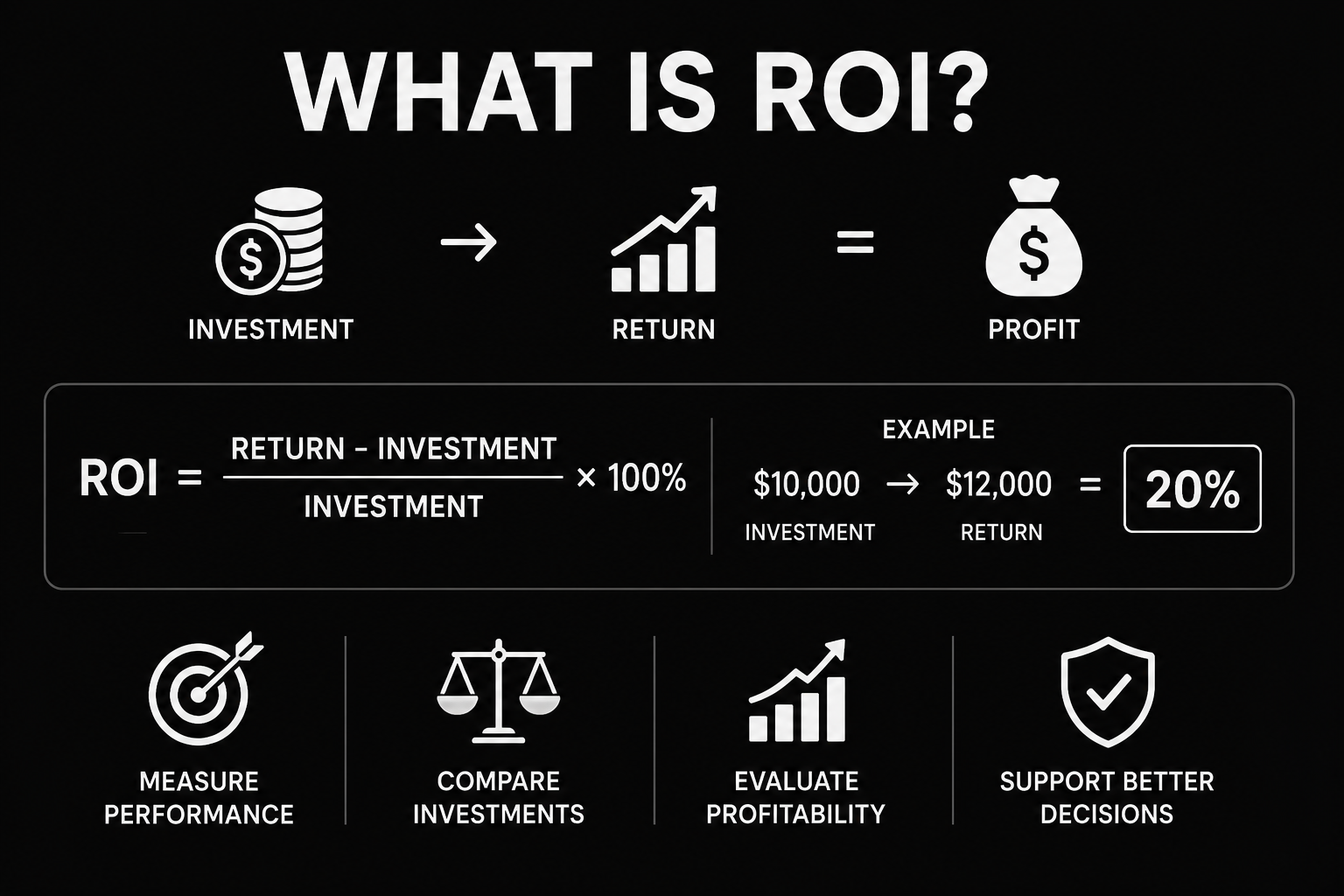
How Is ROI Calculated?
The basic formula is:
ROI = (Investment Gain – Investment Cost) ÷ Investment Cost × 100
For example:
Initial Investment: $10,000
Value After Investment: $12,000
Profit = $2,000
ROI = 20%
A positive ROI indicates a gain, while a negative ROI represents a loss.
Why Does ROI Matter?
ROI helps investors:
Measure investment performance
Compare opportunities
Evaluate profitability
Support decision making
Understand risk and reward
It is one of the most widely used performance metrics in finance.
Where Is ROI Used?
ROI can be applied to:
Stocks
Evaluating capital gains and dividend income.
Bonds
Measuring total returns from coupons and price changes.
Real Estate
Assessing property appreciation and rental income.
Businesses
Evaluating projects and capital expenditures.
Personal Finance
Comparing savings, investments and other financial decisions.
Advantages of ROI
Simplicity
ROI is easy to calculate and understand.
Comparability
Investors can compare investments across different asset classes.
Performance Measurement
ROI provides a standardized measure of profitability.
Decision Support
ROI helps investors identify efficient uses of capital.
Limitations of ROI
ROI does not account for:
Time
A 20% return over one year is very different from a 20% return over ten years.
Risk
Two investments with identical ROI may involve very different levels of risk.
Inflation
Nominal returns may not reflect changes in purchasing power.
Cash Flows
ROI does not consider the timing of income received during an investment.
ROI and Long-Term Investing
ROI is often combined with:
Compound Interest
Annualized Returns
Risk Management
Asset Allocation
Portfolio Performance Analysis
Understanding ROI helps investors focus on profitability while considering broader factors such as time horizon and risk.
Common Misconceptions
A high ROI does not automatically mean an investment is superior.
Investors should also consider:
Risk
Volatility
Time horizon
Diversification
Liquidity
ROI is an important metric, but it should not be viewed in isolation.
Key Takeaways
✓ ROI measures the profitability of an investment.
✓ It compares gains or losses relative to the original investment cost.
✓ ROI is widely used across investing, business and personal finance.
✓ ROI helps investors compare opportunities and evaluate performance.
✓ Time and risk should always be considered alongside ROI.