
Introduction to Risk Management
Understand how financial risks are identified, measured, monitored and managed — from market volatility and credit exposure to liquidity and concentration risk.
Introduction
Risk is an unavoidable part of finance and every investment decision involves uncertainty. Asset prices can fall. Interest rates can change. Borrowers can default. Markets can become illiquid. Currencies can move unexpectedly. Portfolios that appear diversified can still contain hidden concentrations.
Risk management is the structured process of identifying, assessing, measuring, monitoring and responding to these uncertainties and its purpose is not to eliminate all risk.
That would be impossible.
Instead, effective risk management aims to understand:
What can go wrong,
How likely it may be,
How severe the consequences could become,
How different risks interact,
And what actions may reduce vulnerability.
What Is Financial Risk?
Financial risk is the possibility that an uncertain event or market development produces an adverse financial outcome.
A simple way to think about risk is:
Risk = Uncertainty + Exposure + Potential Consequence
Consider an investor holding a long-duration bond and the uncertainty may be the future path of interest rates. The exposure is the investor’s sensitivity to those rate changes and the consequence may be a decline in the bond’s market value if yields rise.
Risk therefore depends on more than the existence of uncertainty. It also depends on how exposed you are.
Why Risk Management Matters
A portfolio can generate strong returns and still be poorly constructed. Imagine two portfolios that both returned 10% last year.
Portfolio A
Broadly diversified,
Moderate volatility,
Multiple asset classes,
Limited concentration.
Portfolio B
Dominated by one sector,
Dependent on a small number of positions,
Highly sensitive to one economic scenario.
The historical return is identical but the underlying risk structure is not.
This is why return alone provides an incomplete picture of investment quality.
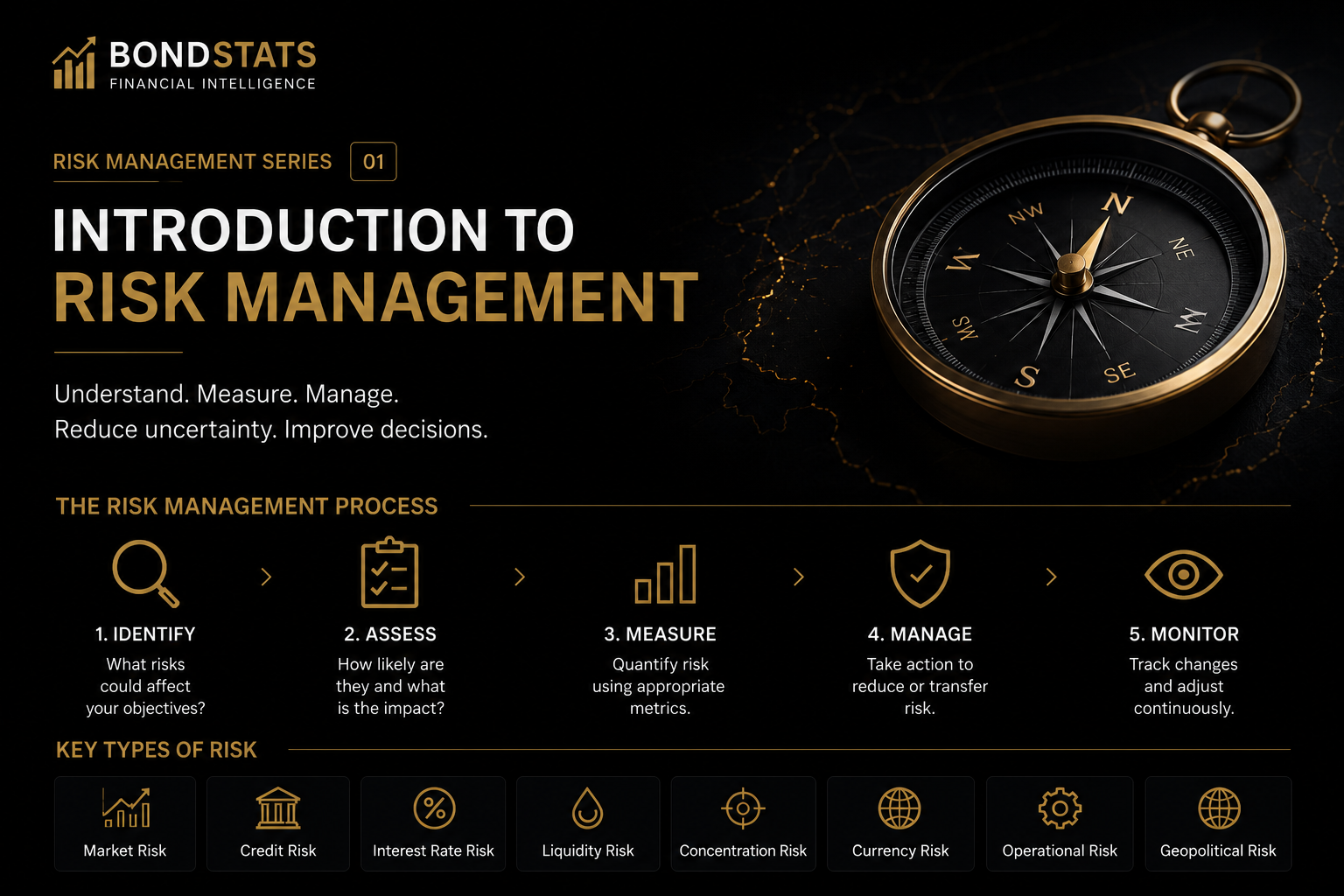
The Core Risk Management Process
A practical risk management framework can be divided into five stages.
1. Identify
What risks exist?
Examples include:
market risk,
credit risk,
interest-rate risk,
liquidity risk,
currency risk,
concentration risk,
operational risk,
geopolitical risk.
The first challenge is recognizing exposures before they become losses.
2. Assess
How important is each risk?
A risk may be:
highly likely but low impact,
unlikely but catastrophic,
temporary,
structural,
isolated,
interconnected.
Assessment adds context.
3. Measure
Where possible, risk should be quantified.
Common measures include:
volatility,
beta,
duration,
Value at Risk,
Expected Shortfall,
maximum drawdown,
credit spreads,
concentration ratios,
stress-test losses.
No single metric captures every form of risk.
4. Manage
Possible responses include:
diversification,
hedging,
reducing exposure,
position limits,
increasing liquidity,
rebalancing,
accepting the risk.
Importantly, accepting risk can itself be a deliberate decision.
5. Monitor
Risk changes continuously.
A portfolio that appears balanced today may become concentrated tomorrow because:
one asset rises sharply,
correlations change,
volatility increases,
liquidity deteriorates,
macroeconomic conditions shift.
Risk management is therefore a process, not a one-time calculation.
The Major Types of Financial Risk
Market Risk
The possibility of losses caused by movements in market prices.
Examples:
falling equity prices,
rising bond yields,
commodity shocks,
exchange-rate movements.
Credit Risk
The possibility that a borrower or counterparty fails to meet its obligations.
This is especially important in:
corporate bonds,
sovereign debt,
bank lending,
derivatives.
Interest-Rate Risk
The sensitivity of asset values to changes in interest rates. Long-duration bonds are generally more sensitive to yield changes than short-duration bonds.
Liquidity Risk
The possibility that an asset cannot be sold quickly at a reasonable price. An investment may appear stable until many market participants attempt to exit simultaneously.
Concentration Risk
The danger of excessive exposure to:
one company,
one sector,
one country,
one currency,
one asset class,
one economic scenario.
A portfolio can contain many holdings and still be concentrated.
Currency Risk
The possibility that exchange-rate movements affect investment returns.
Operational Risk
Losses caused by failures involving:
people,
processes,
systems,
cybersecurity,
internal controls.
Risk Is Not the Same as Volatility
This distinction matters and volatility measures the magnitude of price fluctuations.
Risk is broader.
A low-volatility investment may still contain:
default risk,
liquidity risk,
leverage risk,
political risk,
hidden concentration.
Similarly, a volatile asset is not automatically unsuitable.
The relevant question is:
What kind of risk exists, and does it fit the investor’s objectives, horizon and capacity for loss?
Diversification and Risk
Diversification is one of the most widely used risk-management techniques.
The basic principle is simple:
Do not depend excessively on a single source of return but genuine diversification requires more than owning many assets.
Ten technology stocks may still represent one dominant exposure, several bond funds may hold similar issuers and multiple global ETFs may overlap heavily.
Effective diversification examines the underlying risk drivers, not merely the number of positions.
Risk Tolerance vs Risk Capacity
These concepts are different.
Risk tolerance describes how much uncertainty or loss an investor is emotionally willing to accept.
Risk capacity describes how much loss the investor can financially withstand.
An investor may feel comfortable taking large risks while having limited financial capacity to absorb losses and a good risk management considers both.
A Simple Example
Imagine a portfolio:
60% global equities
25% bonds
10% cash
5% commodities
At first glance, it appears diversified.
But further analysis might reveal:
most equity exposure is concentrated in US technology,
bonds have very long duration,
commodity exposure depends on one metal,
currency exposure is heavily concentrated in USD.
The lesson:
Asset allocation is only the beginning of risk analysis and true risk management looks beneath portfolio labels.
Key Takeaways
Risk cannot be eliminated completely.
Risk management is a continuous process.
Return alone does not describe portfolio quality.
Different risks require different measurements.
Volatility is only one dimension of risk.
Diversification should focus on underlying exposures.
Risk tolerance and risk capacity are not the same.
Good risk management begins with understanding what you actually own.