
What Is Capital Gain?
Understanding how investors earn profits when the value of an investment increases.
What Is a Capital Gain?
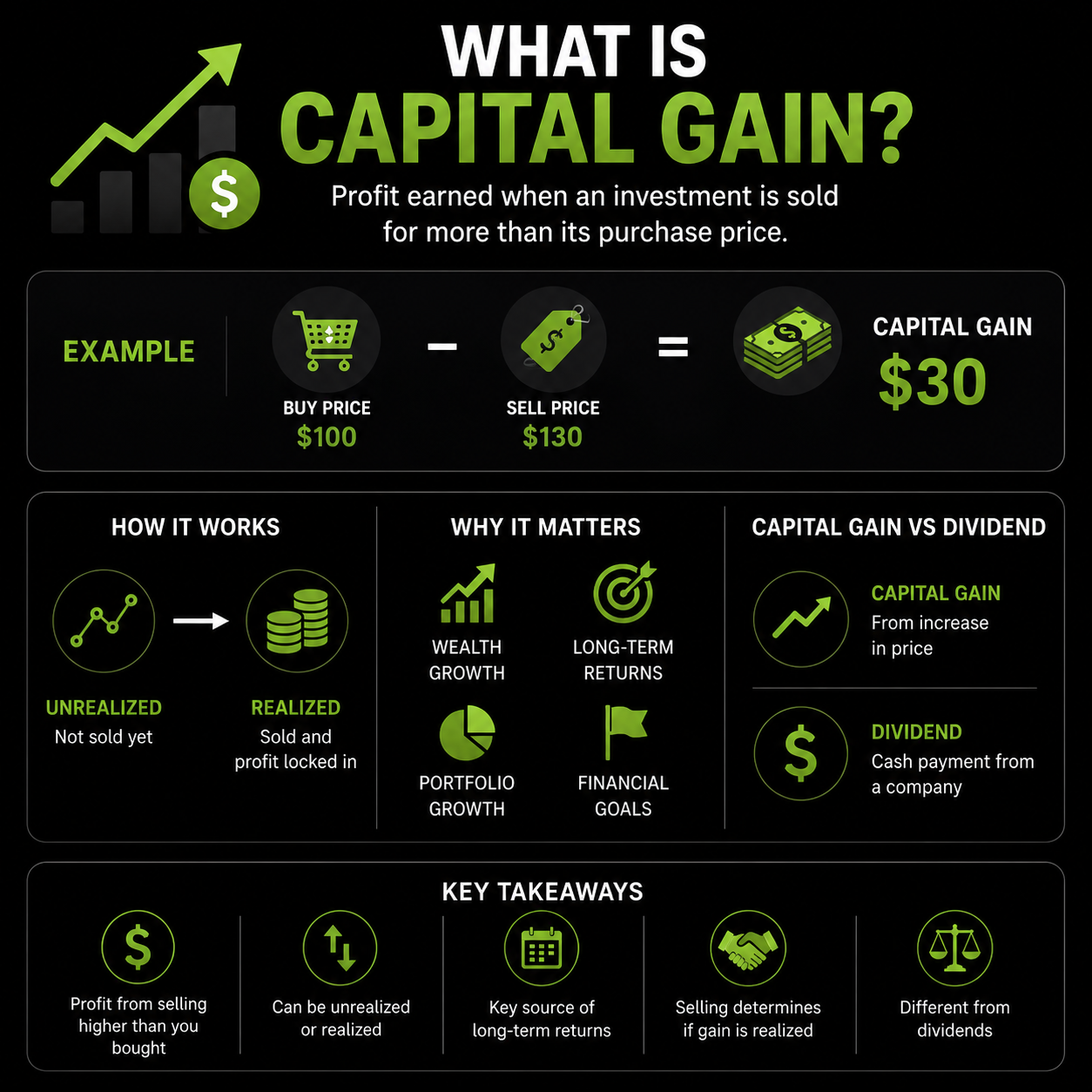
A capital gain is the profit earned when an investment is sold for a higher price than it was originally purchased and the gain is calculated as the difference between the purchase price and the selling price.
For example, if you buy a stock for $100 and sell it for $130, your capital gain is $30.
How Does a Capital Gain Work?
A capital gain only becomes realized when the investment is sold but as long as you continue to own the investment, any increase in value is considered an unrealized gain.
Types of Capital Gains
Unrealized Capital Gain
An investment has increased in value, but it has not yet been sold.
Realized Capital Gain
The investment has been sold, and the profit has been locked in.
Why Capital Gains Matter
Capital gains are one of the primary ways investors build wealth over time.
They contribute to:
Portfolio growth
Long-term wealth creation
Investment returns
Financial goals
Capital Gain vs Dividend
A capital gain comes from an increase in an investment’s price and a dividend is a cash payment distributed by a company to its shareholders.
Some investments generate both capital gains and dividend income.
Common Misconceptions
A higher investment price does not automatically mean you have earned a capital gain but the gain is only realized when the investment is sold.
Key Takeaways
✓ A capital gain is the profit from selling an investment for more than its purchase price.
✓ Gains can be unrealized or realized.
✓ Capital gains are a key source of long-term investment returns.
✓ Selling an investment determines whether a gain becomes realized.
✓ Capital gains and dividends are different sources of investment income.