
Hong Kong Monetary Authority (HKMA)
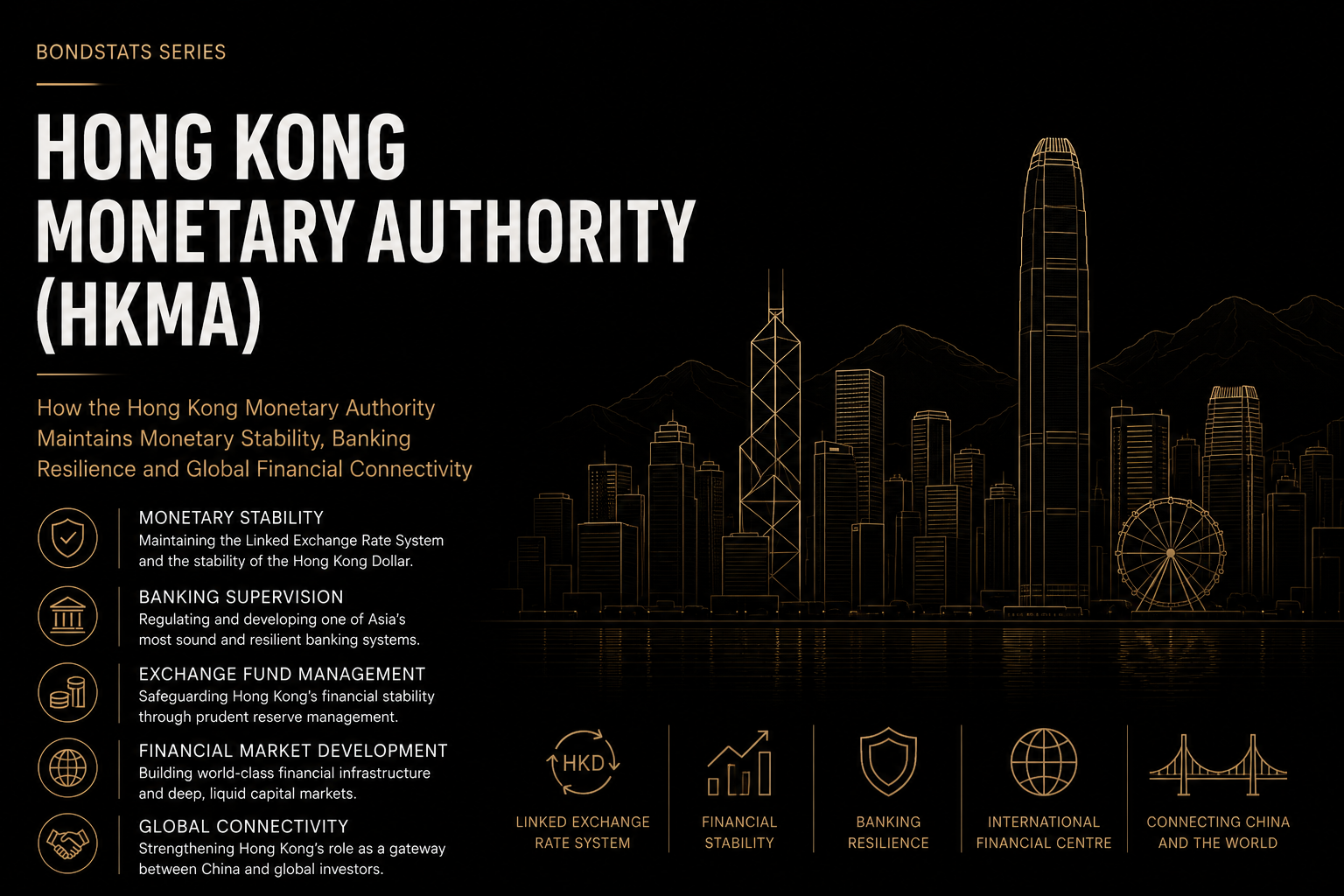
How the Hong Kong Monetary Authority Maintains Monetary Stability, Banking Resilience and Global Financial Connectivity
Introduction
The Hong Kong Monetary Authority (HKMA) is the central banking institution of Hong Kong and one of the world’s most influential financial authorities. Although it is not a central bank in the traditional sense, the HKMA performs many of the same functions, including maintaining monetary stability, supervising banks, managing foreign exchange reserves, and safeguarding one of the world’s leading international financial centres.
As the gateway between Mainland China and global capital markets, the HKMA plays a unique and strategic role in international finance.
The History of the HKMA
The Hong Kong Monetary Authority was established in 1993 through the merger of the Office of the Exchange Fund and the Office of the Commissioner of Banking. Since its creation, the HKMA has overseen Hong Kong’s banking system while maintaining confidence in the Hong Kong dollar under the Linked Exchange Rate System.
Today, it is regarded as one of Asia’s most respected financial authorities.
Main Responsibilities
The Hong Kong Monetary Authority is responsible for:
Maintaining monetary stability.
Managing the Linked Exchange Rate System.
Supervising banks.
Managing Hong Kong’s Exchange Fund.
Promoting financial stability.
Developing financial market infrastructure.
Supporting Hong Kong’s role as an international financial centre.
These responsibilities help maintain confidence in Hong Kong’s financial system and global competitiveness.
The Linked Exchange Rate System
One of the HKMA’s defining responsibilities is maintaining the Linked Exchange Rate System (LERS) and under this framework, the Hong Kong Dollar (HKD) is linked to the U.S. Dollar (USD) within a defined trading band.
The HKMA uses foreign exchange operations and liquidity management to maintain the stability of the exchange rate, making Hong Kong one of the world’s most successful currency board systems.
The HKMA and Bond Markets
Hong Kong operates one of Asia’s most sophisticated financial markets.
The HKMA supports bond markets through:
Liquidity management.
Exchange Fund Bills and Notes.
Financial market infrastructure.
Banking supervision.
Capital market development.
As Hong Kong continues to serve as a bridge between China and international investors, its debt markets remain an important component of global finance.
Hong Kong as a Global Financial Gateway
Hong Kong plays a unique role in connecting international investors with Mainland China.
The HKMA supports this position by promoting:
Cross-border capital flows.
Offshore Renminbi (CNH) markets.
International banking.
Financial innovation.
Stable monetary conditions.
Its work has helped establish Hong Kong as one of the world’s leading international financial centres.
Why the HKMA Matters
The HKMA’s decisions influence:
Hong Kong’s banking system.
The Hong Kong Dollar (HKD).
Asian capital markets.
Cross-border investment.
Offshore Renminbi markets.
Global financial stability.
Because of Hong Kong’s strategic position within international finance, the HKMA remains one of Asia’s most important monetary authorities.
Key Facts
Founded: 1993
Headquarters: Hong Kong
Currency: Hong Kong Dollar (HKD)
Primary Objective: Monetary and financial stability
Key Framework: Linked Exchange Rate System (HKD–USD)
Global Importance: One of the world’s leading financial authorities and a gateway between China and international capital markets
Conclusion
The Hong Kong Monetary Authority occupies a unique position within the global financial system. By maintaining the stability of the Hong Kong dollar, supervising one of Asia’s largest banking sectors, and supporting Hong Kong’s role as a bridge between Mainland China and international markets, the HKMA has become one of the world’s most influential monetary authorities. Understanding the HKMA is essential for anyone following global finance, Asian capital markets, and international fixed-income investing.