
Why Singapore’s Bond Market Uses Reopenings Instead of Constantly Creating
How Reopening Existing SGS Issues Builds Liquidity, Creates Benchmark Bonds and Strengthens the Sovereign Yield Curve
Introduction
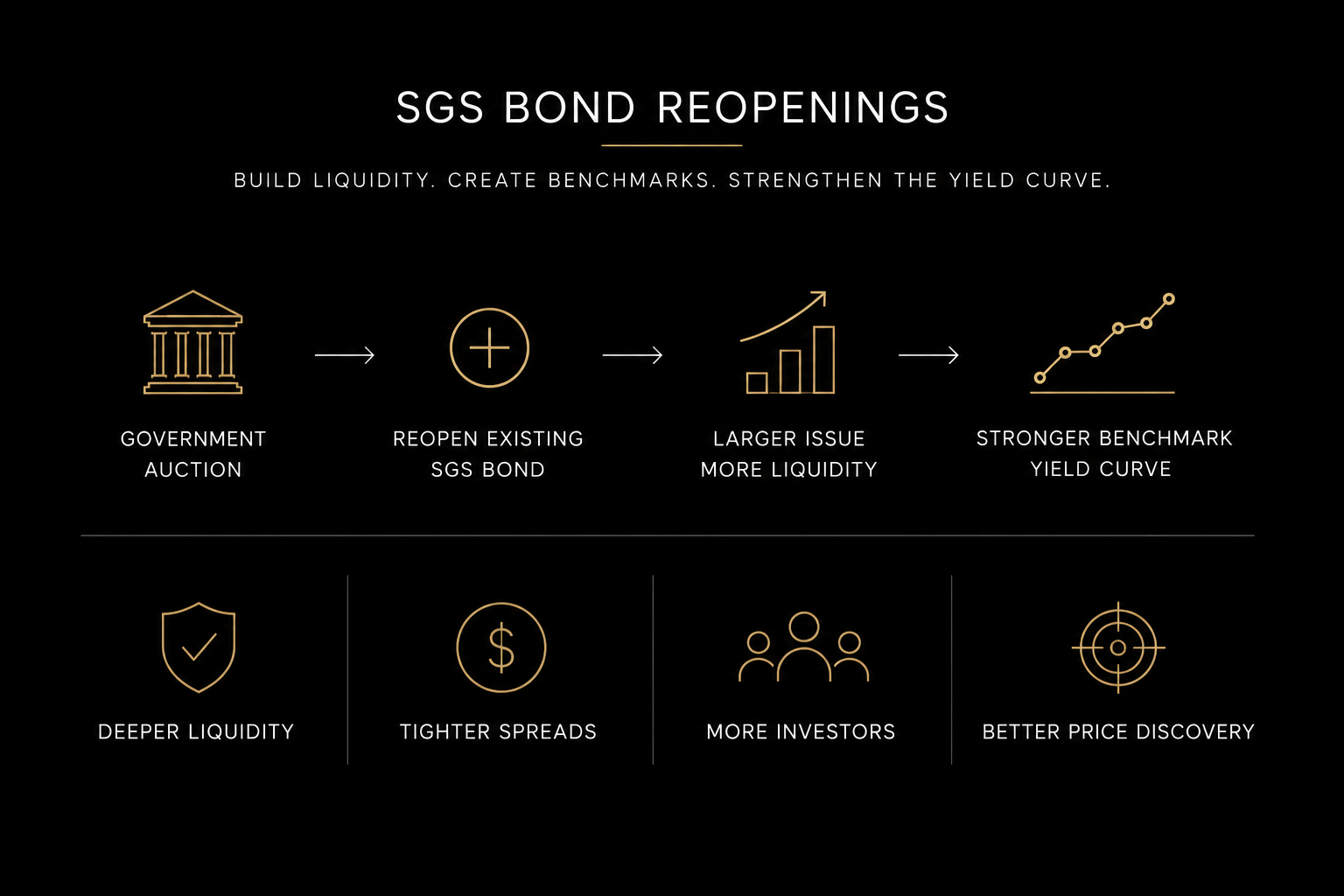
When governments need to raise additional funding, they do not always create an entirely new bond. In Singapore, the government can instead reopen an existing Singapore Government Security, issuing more of the same bond with the same maturity date and coupon rather than launching a completely new security. This sounds like a technical detail, but it has important consequences for market liquidity, benchmark pricing and the structure of the sovereign yield curve. By increasing the outstanding size of selected bonds, Singapore can concentrate trading activity in fewer, larger issues rather than fragmenting the market across many small securities.
For investors, this means a reopening is not simply another auction. It is part of the way Singapore builds liquid benchmark bonds and maintains an efficient government securities market.
What Is a Bond Reopening?
A reopening occurs when the government issues additional amounts of a bond that already exists. The new securities are economically identical to the original issue: they carry the same coupon, mature on the same date and become part of the same outstanding bond line. The difference lies mainly in the price investors pay at the reopening auction. Because market yields may have changed since the bond was first issued, the reopened bond can be sold above or below face value.
If market yields have fallen since the original issue, investors may pay a premium. If yields have risen, the bond may be issued at a discount. The coupon itself does not change.
This allows the government to increase the size of an existing benchmark without changing its contractual characteristics.
Why Reopen Instead of Issue a New Bond?
The main reason is liquidity and if a government created a completely new security every time it wanted to borrow, the bond market could become fragmented across many individual issues. Each bond would have a relatively small amount outstanding, and secondary-market trading could become thinner. Reopening concentrates issuance into larger benchmark securities.
A larger outstanding amount can attract more institutional investors, support tighter bid-ask spreads and make it easier for dealers to quote prices. It can also increase the usefulness of the bond for hedging, collateral and relative-value trading.
For a market the size of Singapore, concentrating liquidity can be particularly valuable.
Benchmark Bonds Matter
Government bond markets typically rely on a set of liquid benchmark maturities. Investors often focus on key points such as two, five, ten or thirty years when evaluating the shape of the sovereign yield curve. A large, actively traded bond near one of these maturity points can become the market’s reference security.
By reopening selected issues, Singapore can increase their outstanding size and reinforce their benchmark status. This improves the reliability of market pricing and helps the broader financial system use SGS yields as reference rates.
Corporate bonds, swaps and other Singapore-dollar instruments can then be compared more easily with a liquid sovereign benchmark.
Reopenings Improve Secondary-Market Trading
Liquidity is not determined only by how much debt exists in total. It also depends on how that debt is distributed across individual securities nad now imagine two markets with the same total amount of government debt. In the first, the debt is spread across fifty small bonds. In the second, it is concentrated in fifteen larger benchmark issues. The second market may be easier to trade because buyers and sellers are more likely to meet in the same securities.
Reopenings help create this concentration. Instead of continuously adding new CUSIPs or bond lines, the government increases the size of securities investors already know and trade.
This can support deeper order books and more consistent pricing.
Why the Auction Price Can Be Above Par
A reopening also illustrates an important bond-market concept: a government does not need to issue every bond at exactly 100. Suppose an existing SGS bond has a 3% coupon, but market yields for that maturity have fallen to 2.5%. Investors may be willing to pay more than face value because the bond’s fixed coupon is now relatively attractive. The government can therefore reopen the bond at a premium.
The opposite can occur when yields have risen. If the 3% coupon is below prevailing market rates, investors may require a price below par but this is not a sign that the bond itself has changed. It simply reflects the relationship between its fixed coupon and current market yields.
Reopenings and the Yield Curve
A sovereign yield curve is most useful when investors can observe reliable market prices across a range of maturities. Thinly traded securities can produce noisy or stale prices. Larger benchmark issues generally provide cleaner signals because more transactions occur and more market participants quote them. Reopening existing bonds can therefore indirectly improve the quality of the Singapore government yield curve.
This matters far beyond the SGS market. Banks and companies can use government yields as reference points, while investors can measure spreads more accurately when the underlying sovereign benchmark is liquid.
Why Reopenings Matter for Primary Dealers
Singapore’s primary dealer system also interacts with reopening auctions and primary dealers participate directly in SGS auctions and help provide liquidity after issuance. Larger benchmark bonds can make that role easier because dealers can build inventories in securities that trade more actively and are more widely held.
This creates a reinforcing effect. Reopenings increase benchmark size, which can improve liquidity, which can in turn attract more investor activity. The result is a more efficient secondary market without requiring the government to create an excessive number of distinct bonds.
The Trade-Off
Reopening is useful, but it also requires careful debt management. Concentrating too much issuance into a small number of maturity dates can create large future redemption amounts. A government that repeatedly enlarges one bond may eventually face a substantial maturity payment when that security comes due.
Debt managers therefore balance two competing objectives: large benchmark issues improve liquidity, while diversified maturities reduce refinancing concentration.
This tension is one of the less visible challenges in sovereign debt management. The most liquid market is not necessarily the one with the smoothest maturity profile, so issuance strategy must consider both.
Why This Is Especially Relevant for Singapore
Singapore’s government bond market plays an important role as financial infrastructure. It provides benchmark rates, collateral and high-quality liquid assets even though conventional deficit financing is not the main reason SGS exist and because of that role, market quality matters greatly.
Creating large, liquid benchmark securities can be more useful than maximizing the number of individual bonds outstanding. Reopenings allow Singapore to deepen selected parts of the yield curve while maintaining a relatively orderly issuance structure.
This is a subtle but important feature of how a sophisticated sovereign bond market is managed.
Conclusion
Singapore reopens existing government bonds because liquidity often matters more than constantly creating new securities. By adding supply to established SGS issues, the government can create larger benchmark bonds, concentrate trading activity and improve price discovery across the sovereign yield curve. The process also demonstrates an important trade-off in debt management. Larger benchmark issues can strengthen market liquidity, but they can also create larger future maturity concentrations.
For investors, reopenings reveal that sovereign issuance is not simply about deciding how much debt to sell. It is also about deciding which existing securities should become the market’s benchmarks and how liquidity should be distributed across the yield curve.