
The Swiss Franc (CHF)
One of the World’s Leading Safe-Haven Currencies
Introduction
The Swiss Franc (CHF) is the official currency of Switzerland and Liechtenstein. Although Switzerland is a relatively small country, its currency plays an important role in global financial markets.
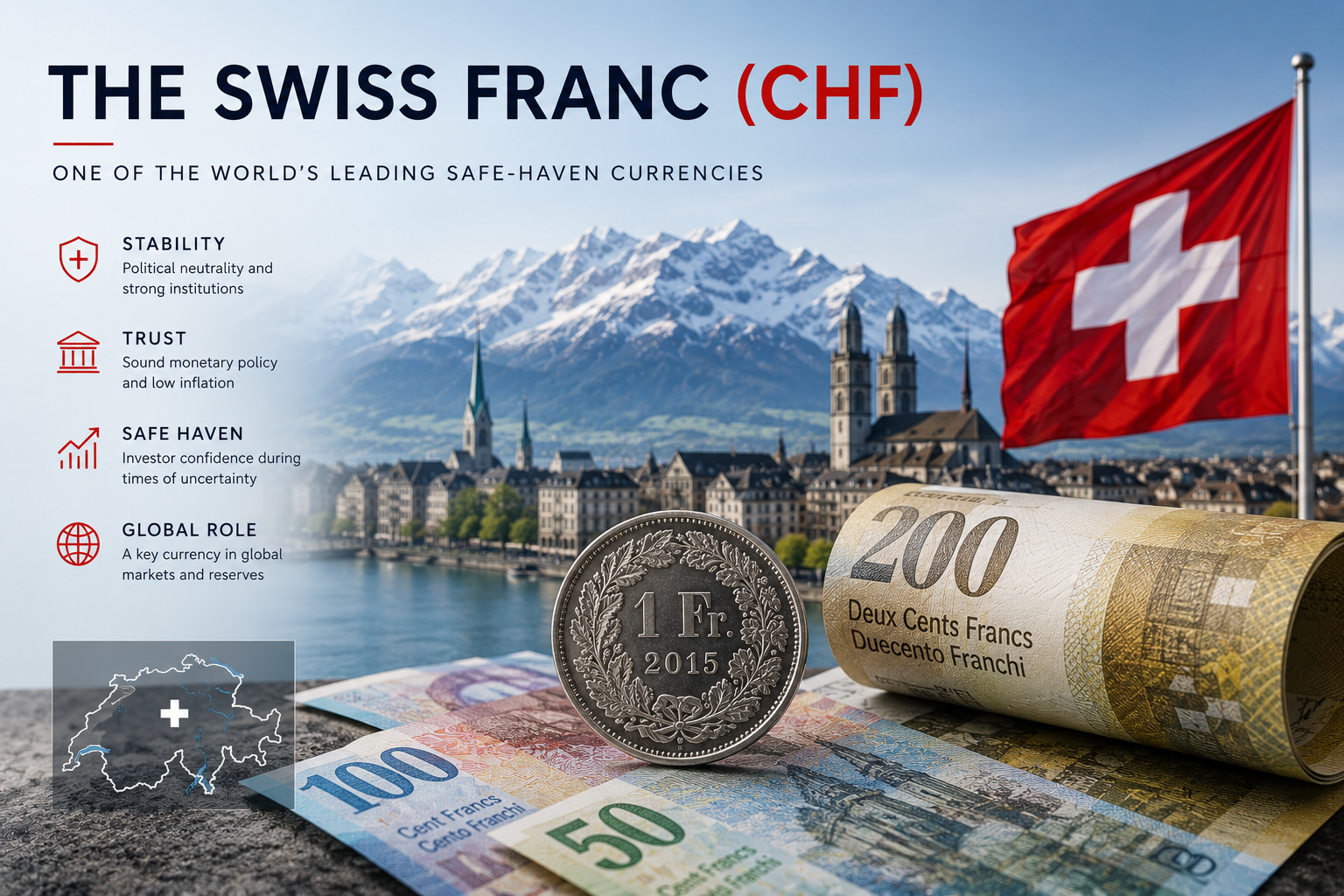
The Swiss Franc is widely regarded as one of the world’s leading safe-haven currencies. During periods of economic uncertainty, financial crises, or geopolitical tensions, investors often move capital into Swiss Franc-denominated assets due to Switzerland’s reputation for stability and sound economic management.
Today, the Swiss Franc is considered one of the strongest and most trusted currencies in the global financial system.
A History of Stability
The Swiss Franc was introduced in 1850 and has remained a symbol of monetary stability for more than a century.
Unlike many currencies that experienced periods of hyperinflation or major devaluations, the Swiss Franc has generally maintained its purchasing power over the long term.
This reputation has helped establish confidence among investors, businesses, and governments around the world.
Why Is the Swiss Franc Considered a Safe Haven?
Several factors contribute to the Swiss Franc’s status as a safe-haven currency:
Political Stability
Switzerland has a long tradition of political neutrality and stable governance.
Strong Institutions
The country’s legal system, property rights, and financial institutions are highly respected internationally.
Low Inflation
Switzerland has historically maintained relatively low inflation compared to many other countries.
Financial Strength
The Swiss banking sector and capital markets have helped reinforce confidence in the country’s currency.
The Role of the Swiss National Bank
The Swiss National Bank (SNB) is responsible for maintaining price stability and managing monetary policy.
Its primary objectives include:
Maintaining low inflation
Supporting economic stability
Managing currency market pressures
Preserving confidence in the Swiss Franc
Because the Swiss Franc is often in high demand during global crises, the SNB occasionally intervenes in currency markets to prevent excessive appreciation.
The Swiss Franc in Global Markets
The Swiss Franc is actively traded in international foreign exchange markets and is considered one of the world’s major reserve and investment currencies.
Investors frequently turn to the Swiss Franc during periods of:
Financial market volatility
Economic recessions
Banking crises
Geopolitical uncertainty
As a result, the currency often strengthens when global risk sentiment deteriorates.
Benefits and Challenges
The strength of the Swiss Franc provides several advantages:
High international confidence
Lower inflation pressures
Strong purchasing power
However, a strong currency can also create challenges:
Swiss exports become more expensive abroad
Tourism can become less competitive
Economic growth may face headwinds during periods of excessive currency strength
Balancing these factors remains an important task for Swiss policymakers.
Conclusion
The Swiss Franc is far more than Switzerland’s national currency. Its reputation for stability, safety, and reliability has made it one of the most respected currencies in the world. Supported by strong institutions, prudent monetary policy, and investor confidence, the Swiss Franc continues to play a unique role in the global financial system.
For many investors, the Swiss Franc represents one of the clearest examples of how trust and stability can become valuable financial assets in their own right.