
Bursa Malaysia
Understanding Malaysia’s National Stock Exchange and Its Role in Southeast Asian Capital Markets
Introduction
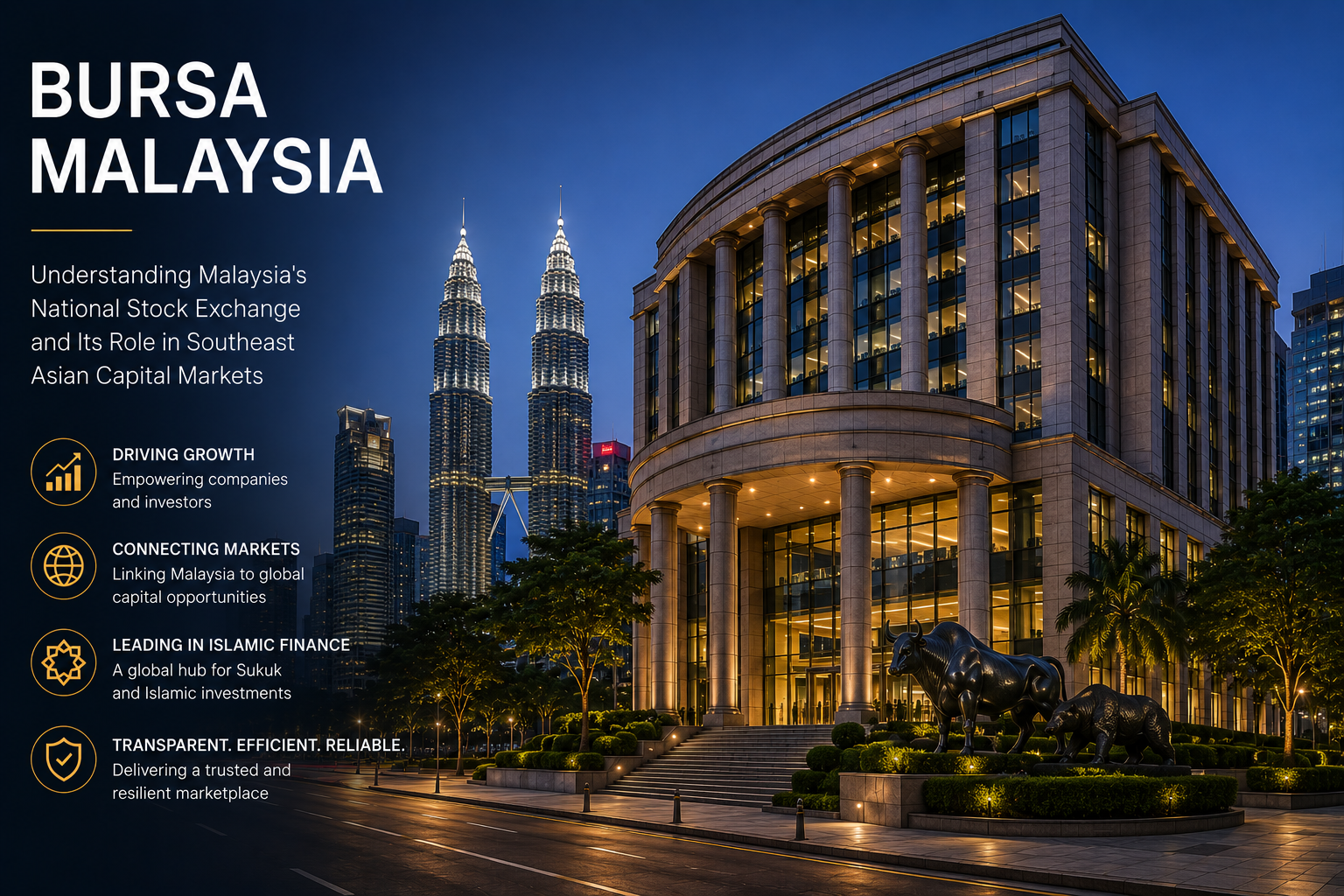
Bursa Malaysia is Malaysia’s national stock exchange and one of Southeast Asia’s leading financial marketplaces. Headquartered in Kuala Lumpur, the exchange provides a platform for trading equities, bonds, exchange-traded funds (ETFs), derivatives, real estate investment trusts (REITs), and Islamic financial products.
Serving as the backbone of Malaysia’s capital markets, Bursa Malaysia connects domestic companies with investors from around the world while supporting one of Asia’s most diversified economies.
The History of Bursa Malaysia
The origins of Bursa Malaysia date back to 1960, when the Malayan Stock Exchange was established to support the region’s growing economy. Following several structural changes and the separation of the Singapore and Kuala Lumpur exchanges, the Kuala Lumpur Stock Exchange (KLSE) became Malaysia’s primary securities market.
In 2004, the exchange was renamed Bursa Malaysia, reflecting its broader role as an integrated financial marketplace. Today, it operates one of Southeast Asia’s most developed exchange infrastructures.
How Bursa Malaysia Works
Bursa Malaysia operates a fully electronic marketplace where investors trade securities through licensed brokers.
Products traded on the exchange include:
Common Stocks
Government Bonds
Corporate Bonds
Exchange-Traded Funds (ETFs)
Real Estate Investment Trusts (REITs)
Islamic Securities (Sukuk)
Futures
Options
Its modern trading infrastructure provides efficient execution, transparent pricing, and reliable market access for both domestic and international investors.
Why Bursa Malaysia Matters
Bursa Malaysia plays a central role in Malaysia’s financial system by:
Helping companies raise capital.
Supporting economic growth.
Providing liquidity for investors.
Promoting transparent price discovery.
Attracting foreign investment.
Strengthening Malaysia’s position as a regional financial center.
The exchange is also recognized as one of the world’s leading marketplaces for Islamic finance, particularly in the issuance and trading of Sukuk.
Bursa Malaysia and Global Markets
Malaysia’s economy is closely connected to global trade, making Bursa Malaysia sensitive to international economic developments.
Key factors influencing the exchange include:
Commodity prices.
Global trade.
Foreign investment flows.
Regional economic growth.
Monetary policy.
Demand for technology and manufacturing exports.
As an important member of ASEAN, Malaysia benefits from increasing regional economic integration and cross-border investment.
Major Market Indices
Bursa Malaysia maintains several benchmark indices, including:
FTSE Bursa Malaysia KLCI
FTSE Bursa Malaysia Mid 70 Index
FTSE Bursa Malaysia Top 100 Index
FTSE Bursa Malaysia EMAS Index
FTSE Bursa Malaysia Small Cap Index
These indices provide investors with broad exposure to Malaysia’s equity market across different sectors and company sizes.
Key Facts
Founded: 1960 (origins)
Current Name: Bursa Malaysia (since 2004)
Headquarters: Kuala Lumpur, Malaysia
Market Type: Stock Exchange
Products: Stocks, Bonds, ETFs, Sukuk, REITs, Derivatives
Known For: Malaysia’s National Stock Exchange
Global Importance: One of Southeast Asia’s leading capital markets and a global leader in Islamic finance
Conclusion
Bursa Malaysia has developed into one of Southeast Asia’s most important financial marketplaces, providing companies with access to capital while offering investors exposure to Malaysia’s diversified economy. Its strong regulatory framework, modern trading infrastructure, and global leadership in Islamic finance make Bursa Malaysia an increasingly significant exchange within both the ASEAN region and the broader international financial system.