
New York Stock Exchange (NYSE)
How the New York Stock Exchange Shapes Global Capital Markets and Corporate Finance
Introduction
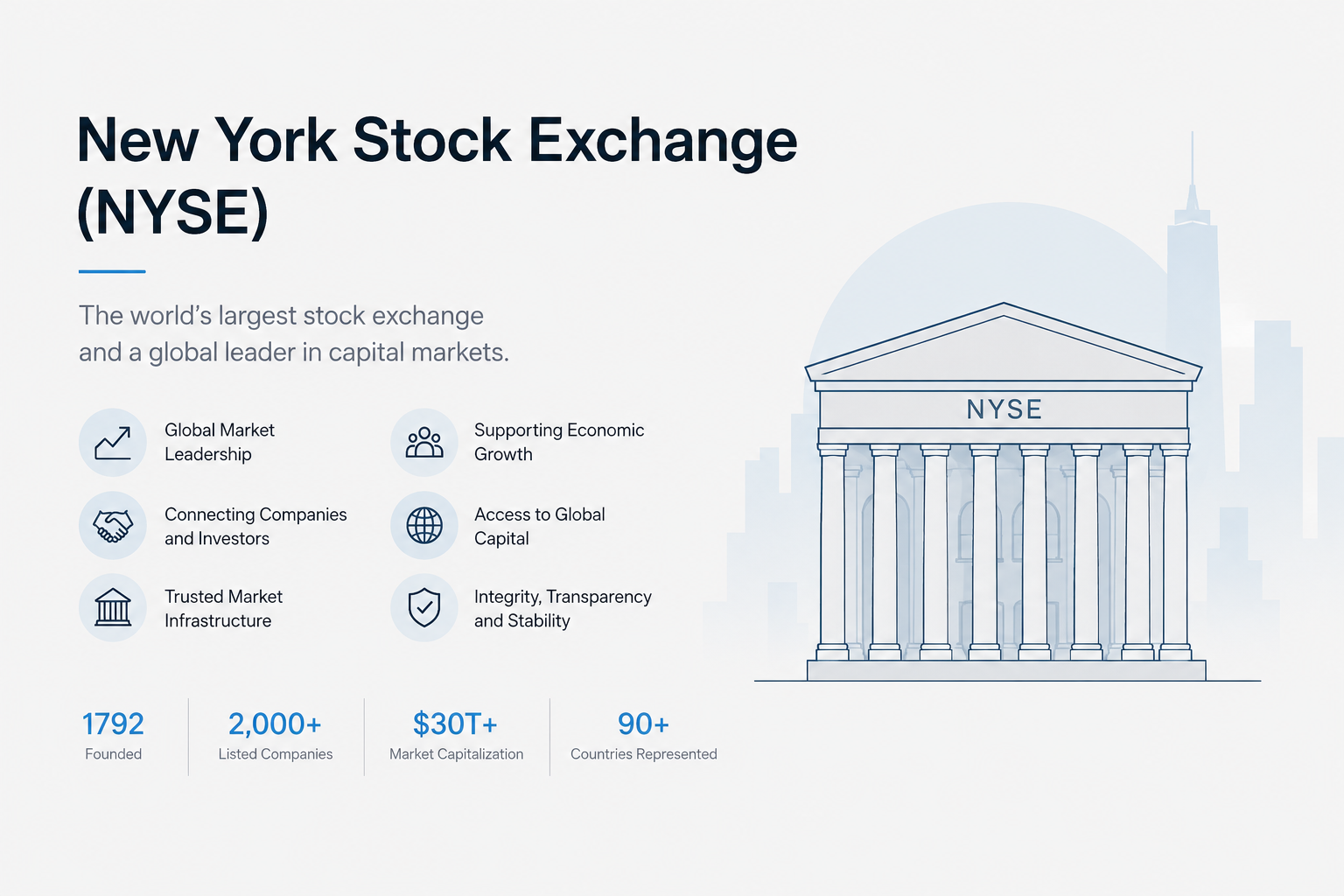
The New York Stock Exchange (NYSE) is the world’s largest stock exchange by market capitalization and one of the most influential financial institutions in history. Located on Wall Street in New York City, the NYSE serves as a global marketplace where investors, corporations, and institutions raise capital, trade securities, and allocate investment across virtually every sector of the economy.
As the home of many of the world’s largest publicly traded companies, the NYSE plays a central role in global finance and international capital markets.
The History of the NYSE
The origins of the New York Stock Exchange date back to 1792, when a group of stockbrokers signed the Buttonwood Agreement beneath a buttonwood tree on Wall Street. Over more than two centuries, the exchange has evolved into the world’s leading marketplace for publicly traded companies, supporting economic growth, innovation, and global investment.
Today, the NYSE remains one of the most recognized symbols of international finance.
Main Responsibilities
The NYSE is responsible for:
Facilitating stock trading.
Supporting capital raising through IPOs.
Providing market liquidity.
Ensuring transparent price discovery.
Maintaining orderly markets.
Supporting listed companies.
Connecting global investors with businesses.
These functions make the NYSE a cornerstone of modern financial markets.
Market Structure
The NYSE combines electronic trading with designated market makers (DMMs), creating a hybrid market structure designed to improve liquidity and maintain orderly trading during periods of market volatility.
The exchange lists thousands of companies from the United States and around the world.
The NYSE and Global Markets
The New York Stock Exchange influences global markets through:
Equity price discovery.
Corporate financing.
Initial Public Offerings (IPOs).
Institutional investment.
Global capital allocation.
Market confidence.
Movements on the NYSE often influence financial markets across Europe, Asia, and other regions.
Why the NYSE Matters
The NYSE affects:
Global equity markets.
Corporate fundraising.
Institutional investing.
Pension funds.
Exchange-traded funds (ETFs).
International capital flows.
Its scale and liquidity make it one of the most important financial marketplaces in the world.
Key Facts
Founded: 1792
Headquarters: New York City, United States
Market: Equities
Primary Function: Stock Exchange
Known For: IPOs, Blue-chip companies, Global capital markets
Global Importance: The world’s largest stock exchange by market capitalization
Conclusion
For more than two centuries, the New York Stock Exchange has stood at the center of global finance. By connecting investors with businesses, facilitating capital formation, and supporting transparent financial markets, the NYSE continues to influence investment, economic growth, and financial innovation worldwide. Understanding the NYSE is essential for anyone seeking to understand how modern capital markets operate and why they remain fundamental to the global economy.