
Bull Market vs Bear Market
Understanding the two primary market environments and how they influence investor behavior.
What Is a Bull Market?
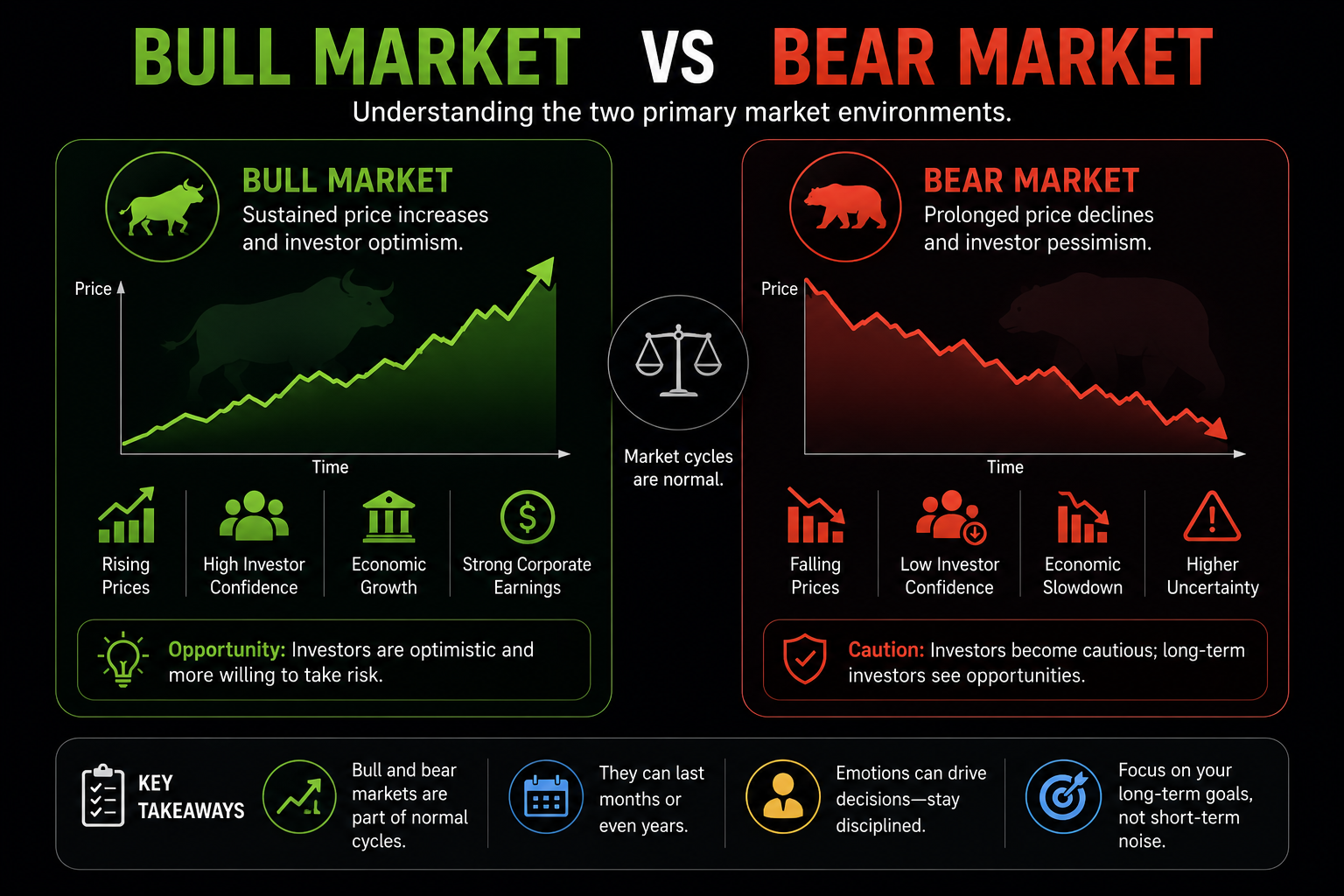
A bull market is a period during which financial markets experience sustained price increases over time.
Bull markets are often associated with:
Strong economic growth
Rising corporate earnings
High investor confidence
Increasing stock prices
Bull markets can last for months or even years.
What Is a Bear Market?
A bear market is a period of prolonged market decline, typically defined as a fall of 20% or more from recent highs.
Bear markets are often linked to:
Economic uncertainty
Lower investor confidence
Declining corporate profits
Increased market volatility
Although challenging, bear markets are a normal part of long-term investing.
Key Differences
Bull Market
Characteristics include:
Rising prices
Positive sentiment
Economic expansion
Strong investor confidence
Bear Market
Characteristics include:
Falling prices
Negative sentiment
Economic slowdown
Higher uncertainty
How Do Investors Respond?
During a Bull Market
Investors often become more optimistic and are more willing to take risk and strong market performance may encourage additional investment.
During a Bear Market
Investors often become more cautious and some reduce risk, while long-term investors may continue investing and view lower prices as opportunities.
Why Market Cycles Matter
Markets do not move in one direction forever and bull and bear markets are part of normal economic and financial cycles.
Understanding these cycles helps investors maintain realistic expectations and avoid emotional decision-making.
Common Misconceptions
A bear market does not necessarily mean a recession but likewise, a bull market does not guarantee that prices will continue rising indefinitely.
Markets naturally move through periods of expansion and contraction.
Key Takeaways
✓ Bull markets are characterized by rising prices and positive investor sentiment.
✓ Bear markets involve prolonged price declines and increased uncertainty.
✓ Both market environments are normal parts of investing.
✓ Long-term investors often prepare for both types of markets.
✓ Staying disciplined is often more important than attempting to predict market cycles.