
Deutsche Bank
How Deutsche Bank Became Germany’s Global Investment Banking Leader
Introduction
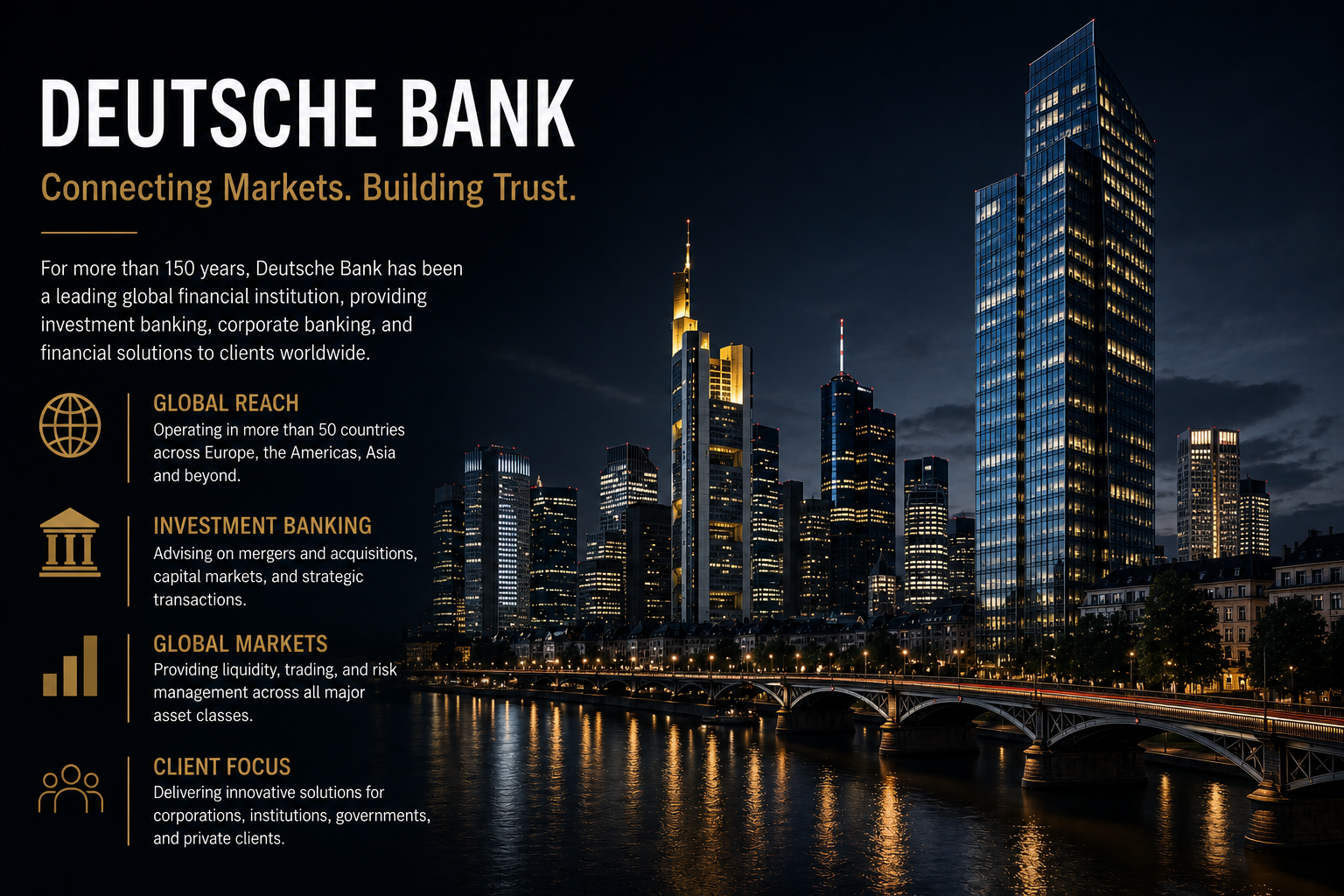
Deutsche Bank is Germany’s largest international banking institution and one of Europe’s most influential financial organizations. With operations spanning investment banking, corporate banking, asset management, and global capital markets, the bank serves corporations, governments, institutional investors, and private clients in more than 50 countries.
Over more than 150 years, Deutsche Bank has played an important role in financing international trade, supporting economic development, and connecting European capital markets with the global financial system.
The History of Deutsche Bank
Deutsche Bank was founded in 1870 in Berlin, Germany, with the objective of supporting Germany’s international trade and expanding its presence in global financial markets. Throughout the late nineteenth and twentieth centuries, the bank developed into one of Europe’s leading financial institutions. It expanded internationally through acquisitions, global investment banking activities, and the development of corporate and institutional banking services.
Today, Deutsche Bank operates as one of the world’s leading providers of corporate banking, investment banking, and financial market services.
Global Banking Services
Deutsche Bank provides a broad range of financial services across multiple business segments.
Its core activities include:
Corporate Banking
Investment Banking
Asset Management
Wealth Management
Global Markets
Transaction Banking
The bank works with multinational corporations, financial institutions, governments, and institutional investors across international markets.
Investment Banking and Capital Markets
Deutsche Bank has long been recognized as one of Europe’s leading investment banks.
Its investment banking services include:
Mergers and acquisitions (M&A)
Equity capital markets
Debt capital markets
Corporate financing
Risk management
Financial advisory
The bank supports companies and governments in raising capital while providing strategic advice on complex financial transactions.
Deutsche Bank and Global Bond Markets
Deutsche Bank is a significant participant in international fixed-income markets.
Its activities include:
Government bond trading
Sovereign debt markets
Corporate bond underwriting
Investment-grade credit
High-yield bonds
Structured finance
Interest rate products
Foreign exchange markets
The bank also acts as a market maker across numerous fixed-income products, contributing to liquidity and efficient price discovery within global bond markets.
Why Deutsche Bank Matters
As Germany’s largest global bank, Deutsche Bank serves as an important bridge between European and international capital markets. Its expertise in corporate finance, debt issuance, trading, and institutional banking makes it a key participant in the global financial system.
Its strong presence in fixed-income markets, cross-border financing, and international banking continues to support governments, corporations, and investors around the world.
Conclusion
Deutsche Bank has grown from a trade-focused institution into one of the world’s leading financial organizations. Through its expertise in corporate banking, investment banking, and global capital markets, the bank has become a key intermediary connecting businesses, governments, and investors across international markets.
With its strong position in European finance and continued involvement in global fixed-income and capital markets, Deutsche Bank is expected to remain an important institution supporting international trade, investment, and economic development for years to come.