
Citadel: How One Hedge Fund Became a Global Trading Powerhouse
Inside the Multi-Strategy Firm That Redefined Modern Market Making and Institutional Investing
Introduction
Few firms have reshaped modern financial markets as profoundly as Citadel. Founded in 1990 by Kenneth C. Griffin, the firm has grown into one of the world’s largest and most influential hedge fund managers, overseeing investments across equities, fixed income, commodities, credit, and quantitative strategies.
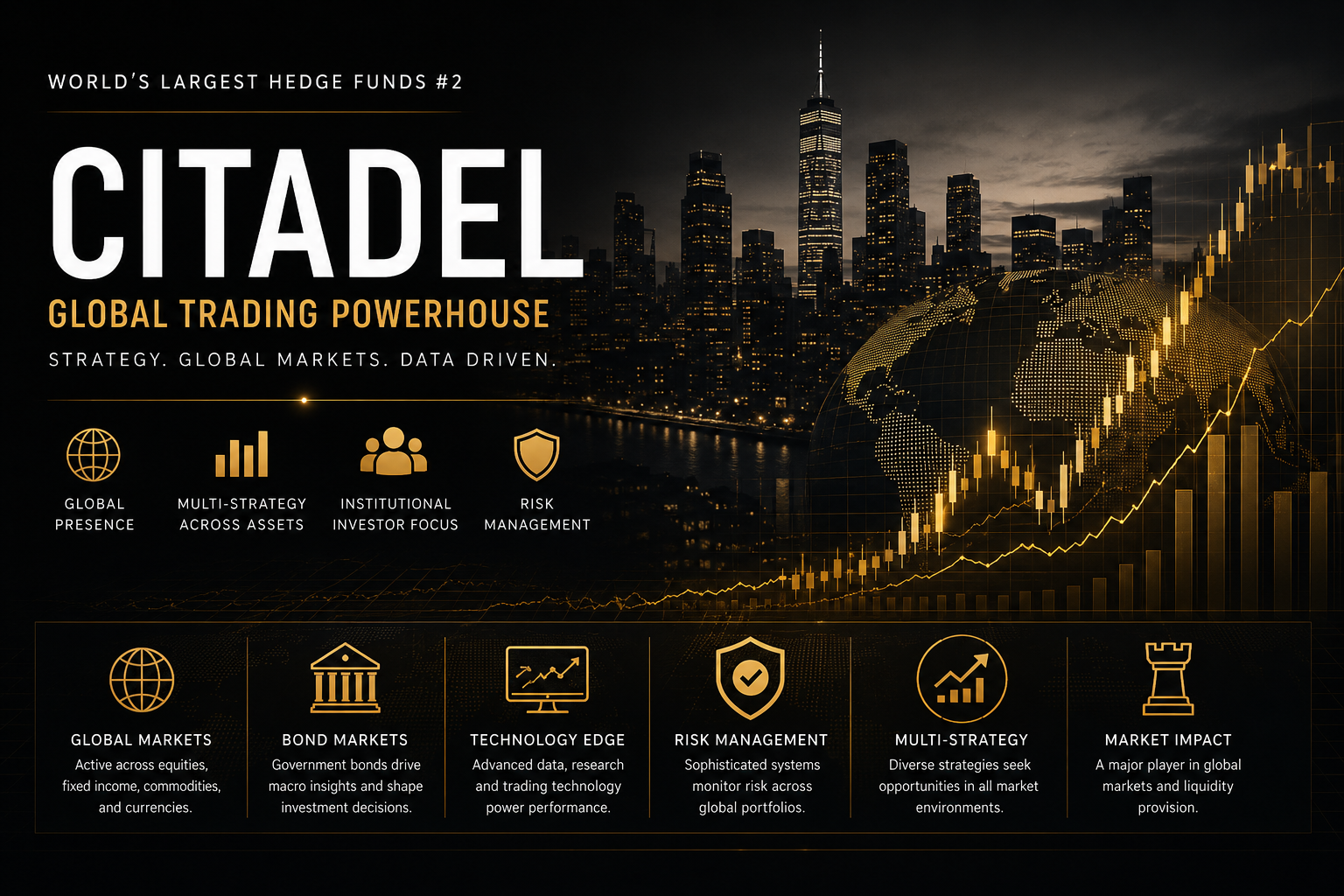
Unlike traditional investment firms that specialize in a single asset class, Citadel employs a multi-strategy approach. Teams of portfolio managers operate across different markets while sharing sophisticated technology, risk management systems, and market research.
Today, Citadel is widely regarded as one of the defining institutions of modern institutional investing.
The Rise of Citadel
Kenneth Griffin founded Citadel while still in his early twenties with the ambition of building a data-driven investment firm capable of performing across changing market environments. Rather than relying on a single investment philosophy, Citadel expanded into multiple independent strategies, allowing the firm to diversify both opportunities and risks.
Over the following decades, the company became one of the largest participants in global capital markets.
A Multi-Strategy Investment Model
Citadel’s investment platform spans several major asset classes.
Its portfolio managers actively invest in:
Global Equities
Government Bonds
Credit Markets
Commodities
Interest Rate Products
Foreign Exchange
Quantitative Strategies
This diversified structure allows the firm to allocate capital wherever it identifies attractive risk-adjusted opportunities.
Why Bond Markets Matter
Government bond markets play a central role within Citadel’s macro and fixed-income strategies and changes in Treasury yields, yield curves, inflation expectations, and central bank policy influence valuations across virtually every asset class.
Citadel continuously analyzes sovereign debt markets because government bonds affect equity valuations, corporate financing, currency movements, and global liquidity conditions.
For a multi-strategy hedge fund, understanding bond markets is essential rather than optional.
Technology as a Competitive Advantage
One of Citadel’s defining strengths is its investment in technology and the firm processes enormous quantities of market data in real time, combining quantitative research with advanced trading infrastructure and sophisticated risk analytics. Technology supports decision-making across multiple asset classes while helping portfolio managers respond rapidly to changing market conditions.
This emphasis on data has become a hallmark of modern hedge fund management.
Risk Management
Managing thousands of positions across global markets requires disciplined risk controls and citadel continuously monitors market exposure, liquidity, volatility, and portfolio correlations. Rather than evaluating individual trades in isolation, the firm focuses on understanding how risks interact across the entire portfolio.
This integrated approach has contributed to Citadel’s resilience during periods of elevated market volatility.
Citadel Securities
Although often associated with the hedge fund itself, Citadel Securities operates as a separate company and it is one of the world’s largest market makers, providing liquidity across equities, options, fixed income products, and other financial instruments. By facilitating millions of transactions each day, Citadel Securities has become an important component of modern financial market infrastructure.
The hedge fund and the market-making business are separate entities with distinct roles.
Influence on Global Markets
Citadel has become one of the most influential participants in global financial markets and its investment activity spans multiple continents, while its research, technology, and execution capabilities influence trading across equities, government bonds, derivatives, and foreign exchange markets.
The firm’s size and diversification make it an important participant during both stable and volatile market conditions.
What This Means for Bond Markets
For BondStats readers, Citadel demonstrates that government bond markets are not isolated from the rest of finance and movements in sovereign yields influence portfolio construction, derivative pricing, credit markets, currencies, and equity valuations. Large multi-strategy firms therefore devote substantial resources to monitoring interest rates, central bank decisions, and macroeconomic developments.
Bond markets often provide the foundation upon which broader investment strategies are built.
Conclusion
Citadel has become one of the defining hedge funds of the modern era by combining technology, diversified investment strategies, disciplined risk management, and deep macroeconomic analysis.
Its success illustrates how today’s largest institutional investors increasingly depend on understanding government bond markets alongside equities, currencies, commodities, and credit. In an interconnected financial system, sovereign yields remain among the most important signals guiding investment decisions across global markets.