
Can Governments Hide Debt?
How Off-Balance-Sheet Liabilities, State-Owned Companies and Guarantees Can Make Public Debt Look Smaller Than It Really Is
Introduction
Government debt is usually presented as a single number. Investors compare debt-to-GDP ratios, budget deficits and annual borrowing requirements, then rank countries according to how sustainable their finances appear. The problem is that the official debt figure does not always capture every obligation that may eventually fall back on the state.
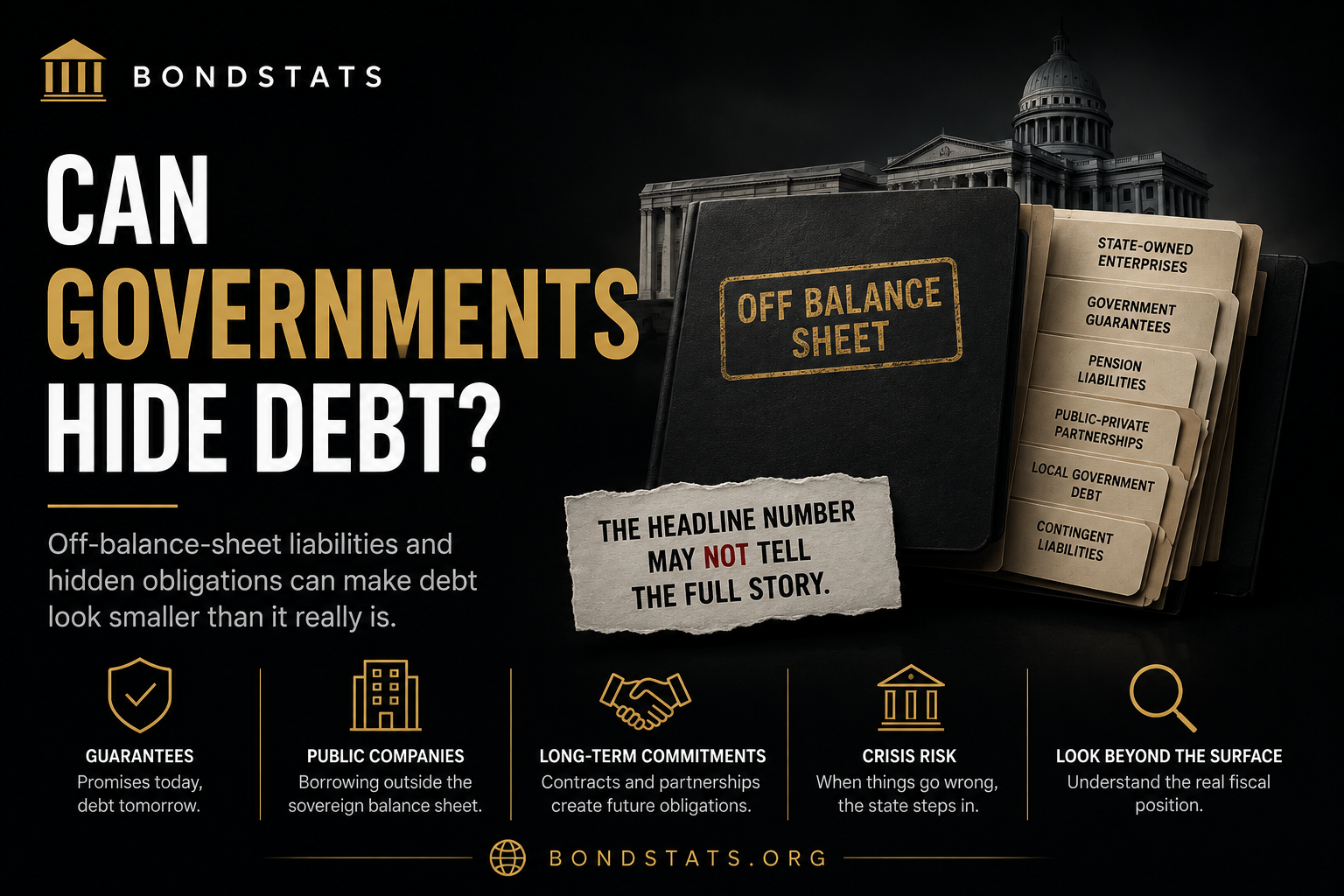
Governments can accumulate liabilities through public companies, guarantees, pension promises, public-private partnerships, regional authorities and special financing vehicles. Some of these obligations appear clearly in official statistics. Others sit outside the headline number until losses materialize or the government decides that an institution is too important to fail.
That creates an uncomfortable possibility: the debt investors can see may not be the only debt that matters.
What Counts as Government Debt?
There is no single universal debt measure used for every purpose. Gross central-government debt, general-government debt and broader public-sector liabilities can produce very different numbers for the same country. Central-government debt usually captures borrowing directly undertaken by the national government. General-government measures may also include regional authorities, municipalities and social-security institutions. Broader public-sector measures can extend further into state-owned enterprises and other public entities.
The distinction becomes important when obligations outside the central government are large. A country may appear to have a relatively moderate sovereign debt burden while public companies or local authorities have borrowed heavily elsewhere in the system.
If those entities remain financially independent, the distinction may be reasonable. If markets assume the national government will rescue them during a crisis, the economic separation becomes much less convincing.
THE HIDDEN-DEBT PROBLEM
A liability does not need to appear directly on the sovereign balance sheet to create future pressure.
Potential obligations can sit in:
State-owned enterprises
Local governments
Public pension systems
Government guarantees
Development banks
Development banks
They may remain invisible to the headline debt number until something goes wrong.
Government Guarantees Can Become Real Debt
Guarantees are one of the clearest examples and a government may guarantee loans made to companies, infrastructure projects or public institutions. As long as the borrower continues making payments, the guarantee creates no immediate cash expense for the state. Yet the risk has not disappeared. If the borrower fails, the government may suddenly inherit the obligation. What had previously been classified as a contingent liability becomes an actual fiscal cost.
This is why guarantees often expand during crises. Governments can support businesses or banks without immediately recording the full amount as direct spending, but the public balance sheet becomes exposed to future losses.
The true fiscal risk therefore depends not only on outstanding government bonds but also on promises the state has made elsewhere.
State-Owned Companies Blur the Boundary
State-owned enterprises create an even more difficult problem and a national railway, energy company, development bank or infrastructure group may borrow under its own name. Legally, that debt can be separate from sovereign borrowing. Investors may still assume that the government would intervene if the company faced default, particularly when the institution provides essential services or carries strategic importance.
That creates what markets often describe as an implicit guarantee and no formal promise may exist, but lenders price the debt as though public support is likely. If several large state-owned companies encounter difficulties simultaneously, those assumptions can suddenly become very expensive for the government.
Local Governments Can Accumulate Their Own Liabilities
Federal and decentralized countries introduce another layer but regional governments, provinces, municipalities and related financing entities may borrow independently. Depending on the accounting framework, some liabilities may not receive the same attention as national-government debt. During normal conditions this may matter little. A local government can service its obligations from local revenue.
A crisis changes the calculation and if defaults threaten banks, infrastructure or public services, the central government may come under political pressure to intervene. Debt that appeared local can effectively migrate upward onto the national balance sheet.
The headline sovereign number therefore sometimes underestimates how many layers of the public sector investors are ultimately exposed to.
Public-Private Partnerships Can Shift Costs Into the Future
Infrastructure projects create another opportunity for fiscal obligations to sit outside ordinary borrowing and instead of issuing government debt directly to build a road, hospital or railway, the state may enter a long-term contract with a private operator. The private entity finances construction, while the government promises future payments or guarantees minimum revenues. Such arrangements can be economically sensible and distribute project risks efficiently.
They can also make liabilities less obvious and a government that avoids issuing $10 billion of bonds today may instead commit itself to decades of contractual payments. The accounting treatment looks different, but taxpayers can still carry a long-term obligation.
For investors, the relevant question is therefore not merely whether an expense appears as debt today, but whether the government has created a binding future claim on public revenue.
Pension Promises Are an Even Larger Question
Public pension systems make the issue more complicated still and governments promise future benefits to workers and retirees, often stretching decades into the future. These promises are not normally treated in the same way as outstanding government bonds. Yet demographic changes can make them extremely expensive.
If the working-age population shrinks while the number of retirees increases, governments may need higher taxes, lower benefits, later retirement ages or greater transfers from the general budget.
Unlike conventional debt, pension liabilities do not have a simple maturity date visible on a bond certificate but their cost unfolds gradually. This is one reason conventional debt-to-GDP comparisons can miss long-term fiscal pressure.
Why Investors Care About Hidden Liabilities
Bond markets care about the state’s ultimate capacity to generate revenue and absorb losses and if official debt equals 60% of GDP but the government has guaranteed enormous public-company debts and faces a fragile banking system, investors may judge the fiscal position more cautiously than the headline number suggests. The opposite is also true. Not every contingent liability becomes government debt. Treating every possible obligation as certain would exaggerate risk.
Serious sovereign analysis therefore requires probabilities rather than simply adding every potential liability together. What matters is the combination of size, likelihood and political willingness to intervene.
Why This Matters for Sovereign Bond Investors
Debt-to-GDP remains useful, but it should rarely be viewed in isolation and investors analyzing government finances should also examine guarantees, public-sector companies, banking-system exposure, pension obligations and regional borrowing. Countries with similar reported debt levels can carry dramatically different hidden risks.
These liabilities are particularly important during periods of economic stress because several can crystallize simultaneously. Tax revenues fall just as government support for banks, companies and households becomes more expensive.
A fiscal position that appears comfortable during normal conditions may therefore deteriorate much faster than headline debt projections imply.
Conclusion
Governments cannot make economic obligations disappear simply by moving them outside the conventional sovereign debt figure. State-owned companies, guarantees, pension promises, regional borrowing and financial-sector rescues can all create liabilities that eventually reach the public balance sheet. Not every contingent liability becomes debt, and not every off-balance-sheet structure is designed to conceal risk. But investors who focus only on the official headline number can miss an important part of sovereign finance.
The most dangerous government debt is sometimes the debt that has not yet been called government debt.