
People’s Bank of China (PBoC)
How China’s Central Bank Shapes Monetary Policy, Bond Markets and the Global Financial System
Introduction
The People’s Bank of China (PBoC) is the central bank of the People’s Republic of China and one of the most influential monetary authorities in the global financial system. As the world’s second-largest economy and one of the largest government bond markets, China’s monetary decisions increasingly shape international capital flows, exchange rates, commodity prices, and fixed-income markets.
Unlike many Western central banks, the PBoC operates within China’s unique economic framework, working closely with the central government to support financial stability, economic growth, and long-term national development objectives.
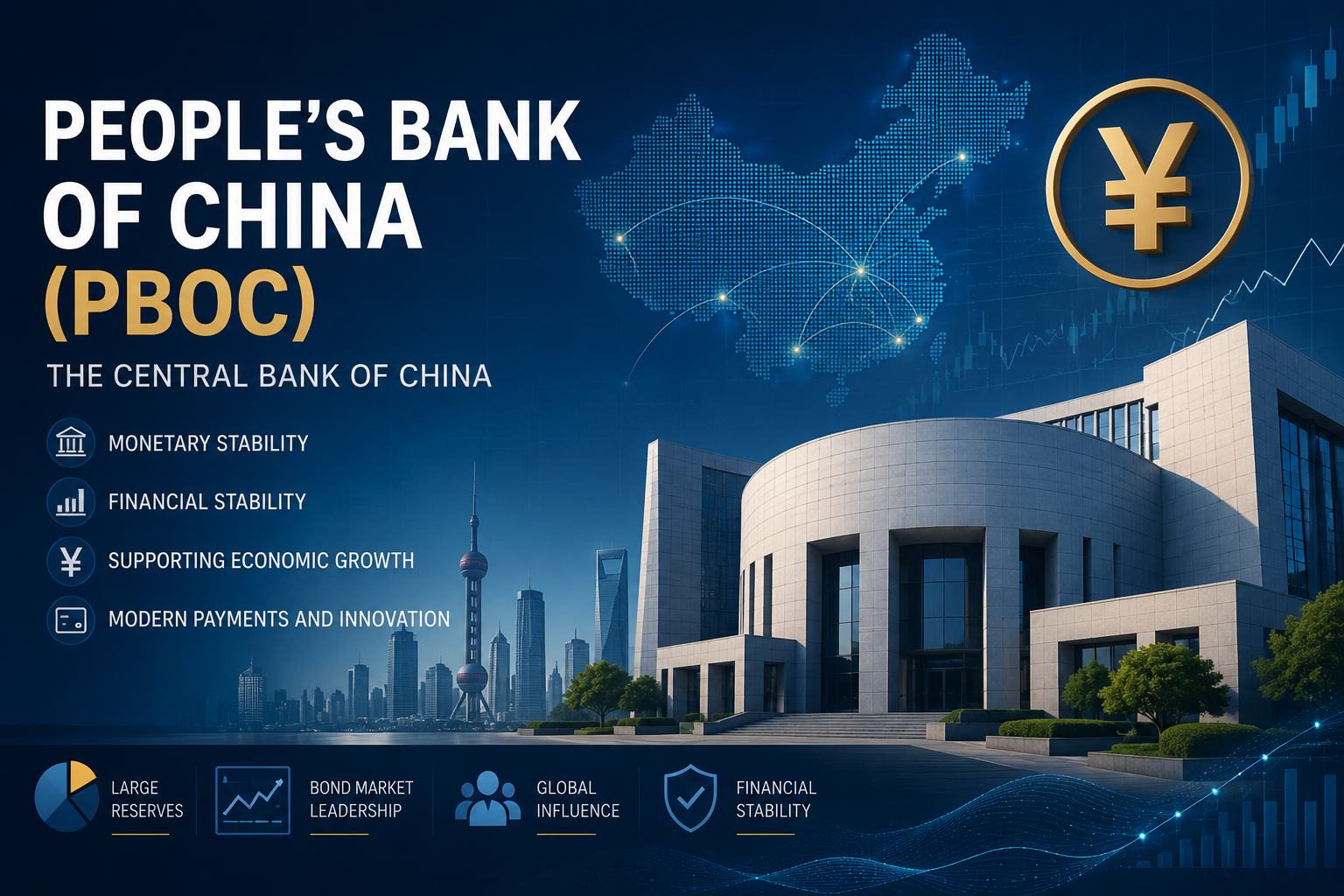
The History of the PBoC
The People’s Bank of China was established in 1948, shortly before the founding of the People’s Republic of China and for decades, the PBoC functioned as both the country’s central bank and commercial banking institution. During China’s economic reforms beginning in the late 1970s, commercial banking activities were gradually transferred to newly created state-owned banks, allowing the PBoC to focus on monetary policy and financial regulation.
Today, it has become one of the world’s largest and most influential central banks.
Main Responsibilities
The People’s Bank of China is responsible for:
Maintaining price stability.
Supporting sustainable economic growth.
Managing China’s monetary policy.
Supervising payment systems.
Managing foreign exchange reserves.
Maintaining financial stability.
Supporting the internationalization of the Chinese yuan (RMB).
The PBoC also plays an important role in supervising liquidity across China’s banking system and government bond market.
Monetary Policy
Unlike many Western central banks, the PBoC relies on a broader range of policy tools.
These include:
Policy interest rates
Reserve Requirement Ratio (RRR)
Medium-Term Lending Facility (MLF)
Open Market Operations (OMO)
Reverse repo operations
Targeted lending facilities
Rather than relying solely on benchmark interest rates, the PBoC frequently adjusts bank reserve requirements and liquidity conditions to influence lending and economic activity. This flexible approach allows policymakers to provide support to specific sectors while maintaining overall financial stability.
The PBoC and Bond Markets
China possesses one of the largest government bond markets in the world.
The People’s Bank of China influences bond markets through:
Liquidity injections
Reserve requirement adjustments
Interest rate policy
Open market operations
Exchange rate management
Banking system liquidity
Changes in PBoC policy can significantly affect Chinese government bond yields, corporate financing costs, and international investor sentiment. As foreign participation in China’s bond market continues to expand, PBoC decisions have become increasingly important for global fixed-income investors.
The Digital Yuan
The People’s Bank of China is a global leader in central bank digital currency (CBDC) development. Its Digital Yuan (e-CNY) project represents one of the world’s most advanced large-scale CBDC initiatives.
The digital yuan aims to:
Modernize payments
Improve financial efficiency
Enhance payment security
Support financial inclusion
Strengthen China’s digital financial infrastructure
Although still developing, the project has attracted significant international attention.
Why the PBoC Matters
China’s economic size means the People’s Bank of China now plays an increasingly important role in global finance.
Its policy decisions influence:
Global bond markets
Commodity demand
Emerging market capital flows
Currency markets
International trade
Investor risk sentiment
As China’s financial markets continue opening to international investors, the importance of the PBoC is expected to grow further.
Key Facts
Founded: 1948
Headquarters: Beijing, China
Currency: Chinese Yuan (Renminbi, RMB)
Primary Objective: Monetary and financial stability
Key Tools: Interest rates, Reserve Requirement Ratio (RRR), Open Market Operations, Medium-Term Lending Facility (MLF)
Global Importance: Central bank of the world’s second-largest economy
Conclusion
The People’s Bank of China has evolved into one of the most influential institutions in international finance. Its combination of conventional monetary policy, liquidity management, and structural policy tools reflects China’s distinctive economic model. As China’s bond market expands and the renminbi plays a larger role in global finance, understanding the PBoC has become increasingly important for anyone following sovereign debt, central banking, and fixed-income markets.