
Why Does Singapore Borrow Money If It Does Not Need to Finance Its Budget?
How Singapore Uses Government Debt Without Relying on It to Fund Everyday Spending
Introduction
Singapore creates an unusual puzzle for anyone approaching sovereign debt with the standard assumption that governments issue bonds because they have run out of tax revenue. The country has long maintained a reputation for fiscal discipline, substantial public assets and strong external finances, yet it also operates an active government securities market. At first glance, the two facts appear contradictory. Why would a financially strong state issue debt if it does not need traditional deficit financing?
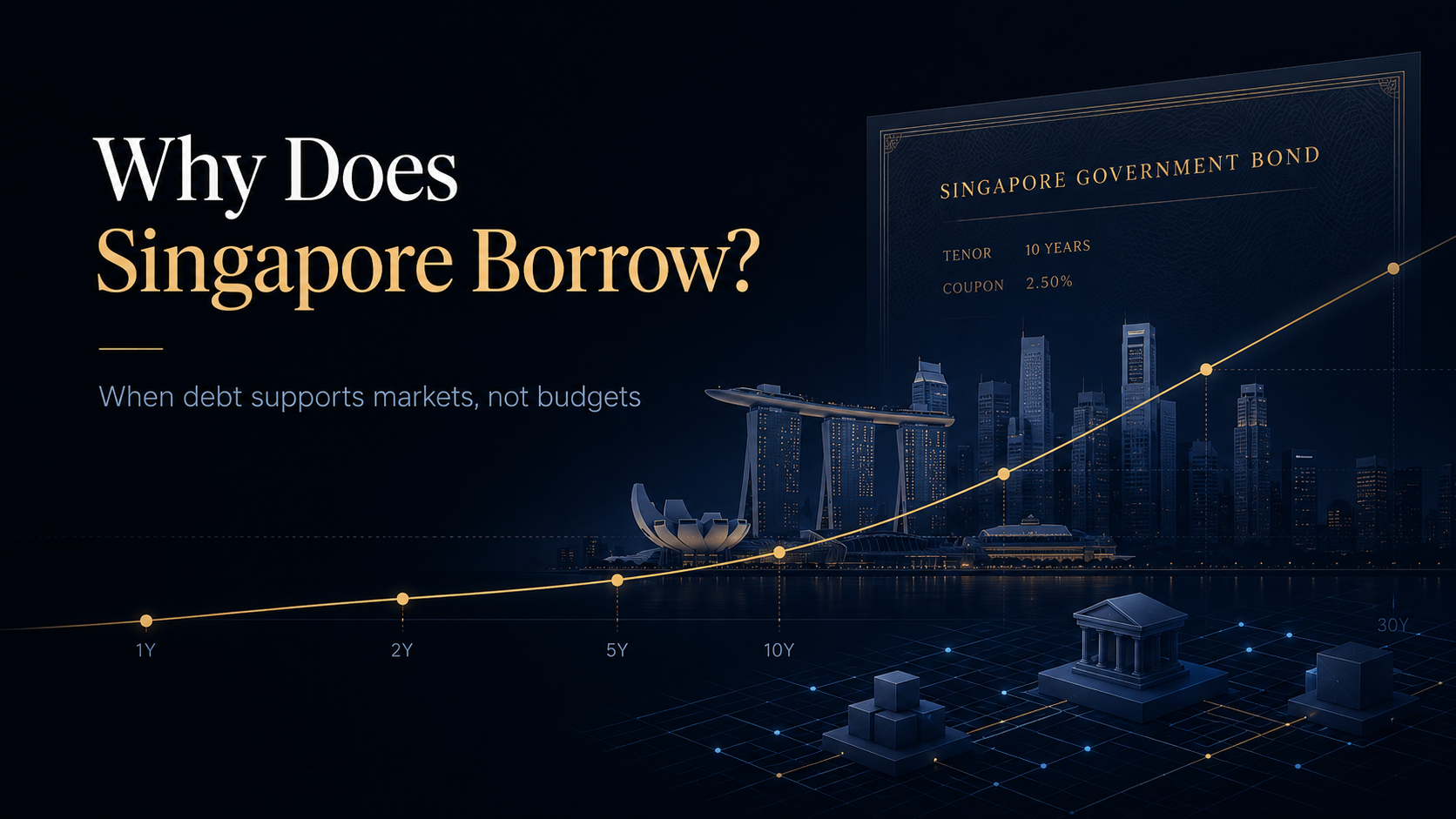
The answer reveals something important about modern bond markets: government debt can serve purposes far beyond funding government spending. In Singapore, sovereign securities help create a domestic yield curve, provide high-quality collateral, support financial-market development and give institutional investors a benchmark for pricing other assets.
Singapore therefore offers an unusually clear example of how government bonds can function as financial infrastructure rather than merely as evidence of fiscal weakness.
Government Debt Does Not Always Mean Fiscal Stress
In many countries, government borrowing is closely connected to budget deficits. Expenditure exceeds revenue, so the state issues bonds to finance the difference. Singapore complicates that model. Its fiscal framework places substantial restrictions on the use of borrowing for ordinary government expenditure, while accumulated reserves and investment income play an important role in the broader public-finance structure.
Sovereign debt issuance can consequently serve objectives that are separate from financing day-to-day spending and government can issue securities because markets need them. Banks require high-quality liquid assets. Institutional investors need benchmark securities. Dealers need collateral for secured funding transactions. Corporate issuers benefit from having a government yield curve against which their own borrowing costs can be priced.
Viewed this way, government bonds become part of the architecture of the financial system.
Borrowing Does Not Always Mean the Government Needs Cash
Government debt is normally interpreted as a sign that the state needs financing but singapore demonstrates another possibility. A financially strong government can issue bonds because those securities themselves are useful to the financial system.
Debt can be a fiscal liability and a market infrastructure asset at the same time.
Why Singapore Needs a Government Bond Market
A developed financial centre benefits from having a liquid sovereign yield curve extending across several maturities and here government securities provide a relatively standardized reference against which banks and investors can compare other instruments.
Now suppose a Singaporean corporation wants to issue a ten-year bond. Investors need some indication of the return available from a lower-risk Singapore-dollar asset over approximately the same period. Government securities provide that reference point, allowing the corporate bond to be priced as a spread over the sovereign benchmark. Without a functioning government bond market, pricing private debt becomes less transparent.
Singapore Government Securities also provide instruments that financial institutions can trade, hold for liquidity purposes and use as collateral. Their importance therefore extends into bank balance sheets, money markets and institutional portfolio management. For an international financial centre, such infrastructure can be economically useful even when the government itself does not urgently require the borrowed funds.
The Strange Relationship Between Debt and Assets
Headline government-debt statistics can create a misleading picture when examined without the other side of the public balance sheet. A country can report substantial gross public debt while simultaneously owning very large financial assets. The resulting economic position is fundamentally different from that of a state whose debt finances years of accumulated consumption and whose assets are comparatively small.
Singapore is particularly interesting because the government balance sheet cannot be understood by looking only at liabilities. Public reserves and investment assets form an important part of the wider system. This distinction between gross debt and net financial position is one of the reasons sovereign-debt comparisons can be deceptive.
Two countries can have similar debt ratios while facing completely different financial realities.
Why Singapore Does Not Simply Stop Issuing Bonds
If government securities disappeared, the consequences would extend beyond public finance but banks and investors would lose an important source of Singapore-dollar safe assets. The domestic benchmark yield curve would become less complete. Collateral markets would have fewer standardized sovereign securities available, while corporate and other issuers would lose an important pricing reference.
Reducing government debt might therefore improve a headline statistic while weakening useful parts of the financial-market infrastructure. That is a strange conclusion only if government debt is viewed exclusively as a fiscal burden.
Once sovereign bonds are understood as tradable financial instruments with monetary and market functions, continued issuance becomes much easier to understand.
Singapore Savings Bonds Add Another Dimension
Singapore’s debt market also includes securities designed specifically for individual investors. Singapore Savings Bonds provide households with access to government-backed savings instruments while allowing redemption with relatively high flexibility compared with conventional long-term bonds. They effectively connect ordinary savers with the sovereign securities system rather than restricting government debt entirely to banks and institutional investors.
That broadens the role of government securities beyond institutional market plumbing. Sovereign debt becomes part of household saving, capital-market development and domestic financial infrastructure simultaneously.
Singapore therefore illustrates how a state can deliberately use different types of government securities for different purposes without treating borrowing simply as a mechanism for covering a budget shortfall.
Gross Government Debt Can Tell the Wrong Story
A large gross debt number does not automatically imply that a government is financially weak.
To understand the true position, investors also need to consider:
government financial assets
currency denomination
maturity structure
interest costs
and why the debt was issued in the first place
Singapore is one of the clearest examples of why debt-to-GDP alone can be a poor measure of sovereign financial strength.
What Singapore Teaches About Sovereign Debt
Singapore challenges one of the most persistent assumptions in public finance: that government borrowing is inherently evidence of financial weakness. Government bonds can perform several functions simultaneously. They can create benchmark interest rates, provide collateral, support liquidity management and strengthen domestic capital markets. When the issuing government also possesses substantial financial assets, the meaning of the gross debt figure changes further.
None of this means government debt is irrelevant. Every liability still carries obligations, and the sustainability of sovereign finances always matters. Singapore’s case instead demonstrates that the purpose, ownership and balance-sheet context of debt are just as important as its headline size.
For investors comparing sovereign markets, that lesson is valuable. A debt ratio without understanding the structure behind it can produce exactly the wrong conclusion.
Conclusion
Singapore issues government debt even though sovereign borrowing does not play the same fiscal role that it does in many heavily indebted countries. Government securities help support the domestic financial system, provide benchmark yields, supply high-quality assets and deepen Singapore-dollar capital markets. The apparent contradiction disappears once government bonds are viewed as more than a way to finance deficits.
Sometimes a government issues debt because it needs money. Sometimes it issues debt because the financial system needs the bonds.