
What Is Liquidity?
Understanding how easily an asset can be bought or sold without significantly affecting its price.
What Is Liquidity?
Liquidity refers to how quickly and easily an asset can be converted into cash while maintaining its market value.
Highly liquid assets can be bought or sold quickly with little impact on price while less liquid assets may take longer to sell and often require accepting a lower price.
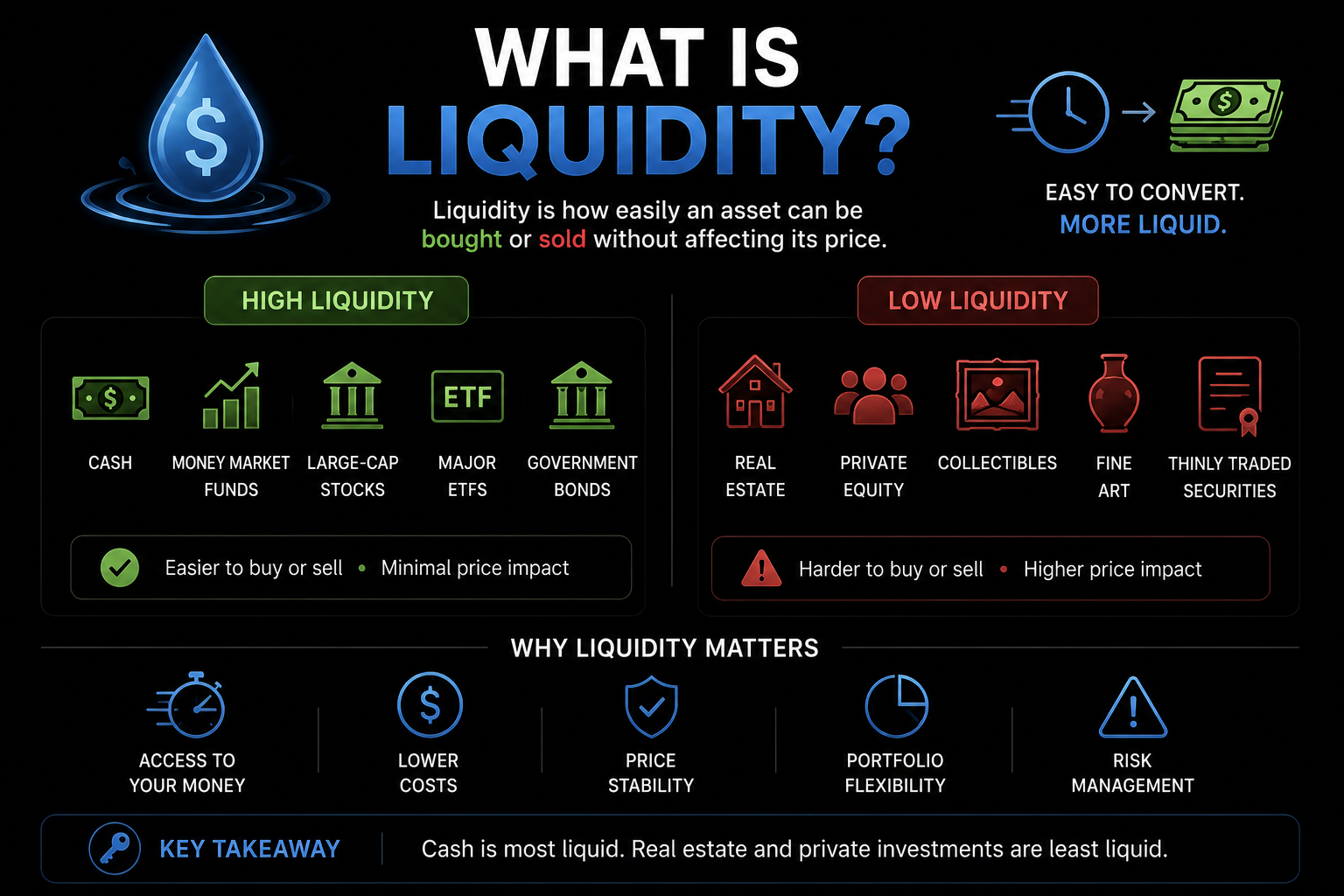
High Liquidity
Examples include:
Cash
Money market funds
Large-cap stocks
Major ETFs
Government bonds
These assets usually have many buyers and sellers, making transactions fast and efficient.
Low Liquidity
Examples include:
Real estate
Private equity
Collectibles
Fine art
Thinly traded securities
These assets often require more time to sell and may experience larger price changes.
Why Liquidity Matters
Liquidity plays an important role in investing because it affects:
How quickly you can access your money
Transaction costs
Price stability
Portfolio flexibility
Risk management
Higher liquidity generally means lower trading friction.
Liquidity Risk
Liquidity risk is the possibility that an asset cannot be sold quickly without accepting a significant price discount and this this risk often becomes more important during periods of market stress.
Common Misconceptions
A valuable asset is not always a liquid asset and an investment can have a high market value while still being difficult to sell quickly.
Key Takeaways
✓ Liquidity measures how easily an asset can be converted into cash.
✓ Cash is generally considered the most liquid asset.
✓ Stocks and ETFs are typically highly liquid.
✓ Real estate and private investments are generally less liquid.
✓ Liquidity is an important factor in portfolio construction and risk management.