
Portfolio Diversification Strategies.
Understand how diversified portfolios can balance risk and return
What Is Portfolio Diversification?
Portfolio diversification is the practice of spreading investments across different asset classes, sectors, regions and investment styles to reduce overall risk. Rather than relying on a single investment, diversification aims to create a more balanced portfolio that can better withstand changing market conditions.
While diversification cannot eliminate risk or guarantee profits, it may help reduce the impact of poor performance from any one investment.
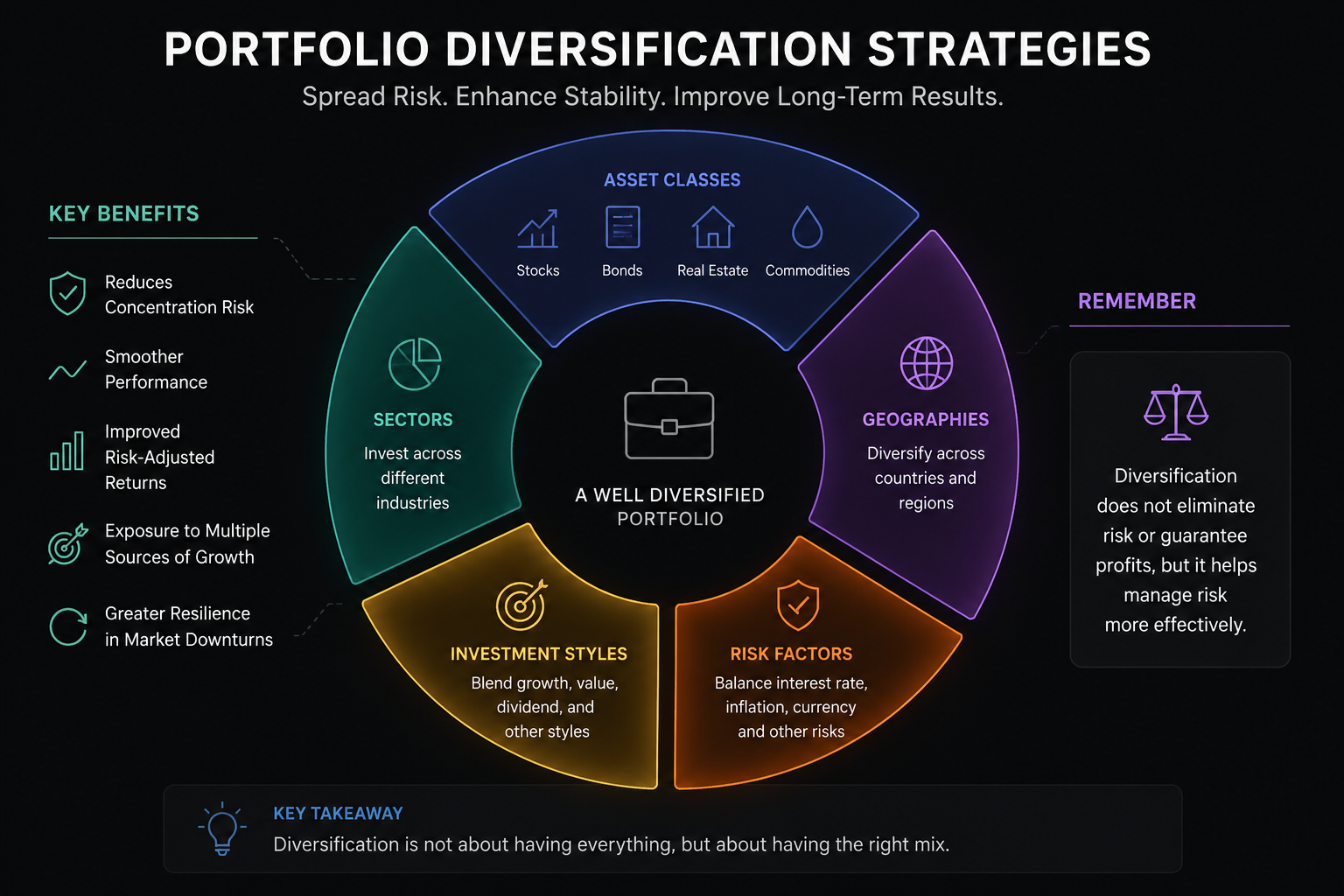
Why Diversification Matters
Diversification is a core principle of portfolio management because different investments often perform differently under various economic conditions.
Potential benefits include:
Reducing concentration risk
Smoothing portfolio volatility
Improving long-term risk-adjusted returns
Increasing exposure to different sources of growth
Better resilience during market downturns
Common Diversification Strategies
Asset Class Diversification
Invest across multiple asset classes such as:
Stocks
Bonds
Cash
Real Estate
Commodities
Sector Diversification
Avoid concentrating investments in a single industry.
Examples include:
Technology
Healthcare
Financials
Industrials
Consumer Goods
Energy
Geographic Diversification
Investing internationally can reduce dependence on a single country’s economy.
Examples:
North America
Europe
Asia-Pacific
Emerging Markets
Style Diversification
Combine different investment approaches.
Examples:
Growth
Value
Dividend
Small Cap
Large Cap
Potential Advantages
✅ Lower portfolio volatility
✅ Reduced concentration risk
✅ More consistent long-term performance
✅ Exposure to multiple economic trends
Potential Limitations
Diversification also has limitations.
Too much diversification may:
Reduce upside potential
Increase portfolio complexity
Make monitoring investments more difficult
In addition, diversification cannot fully protect investors during broad market declines when many asset classes fall simultaneously.
Key Takeaways
Portfolio diversification helps investors spread risk by investing across different assets, sectors and regions. Although it cannot eliminate losses, it remains one of the most widely used strategies for building resilient long-term investment portfolios.